DOACs in Renal Impairment: How to Adjust Dosing to Prevent Bleeding and Clots
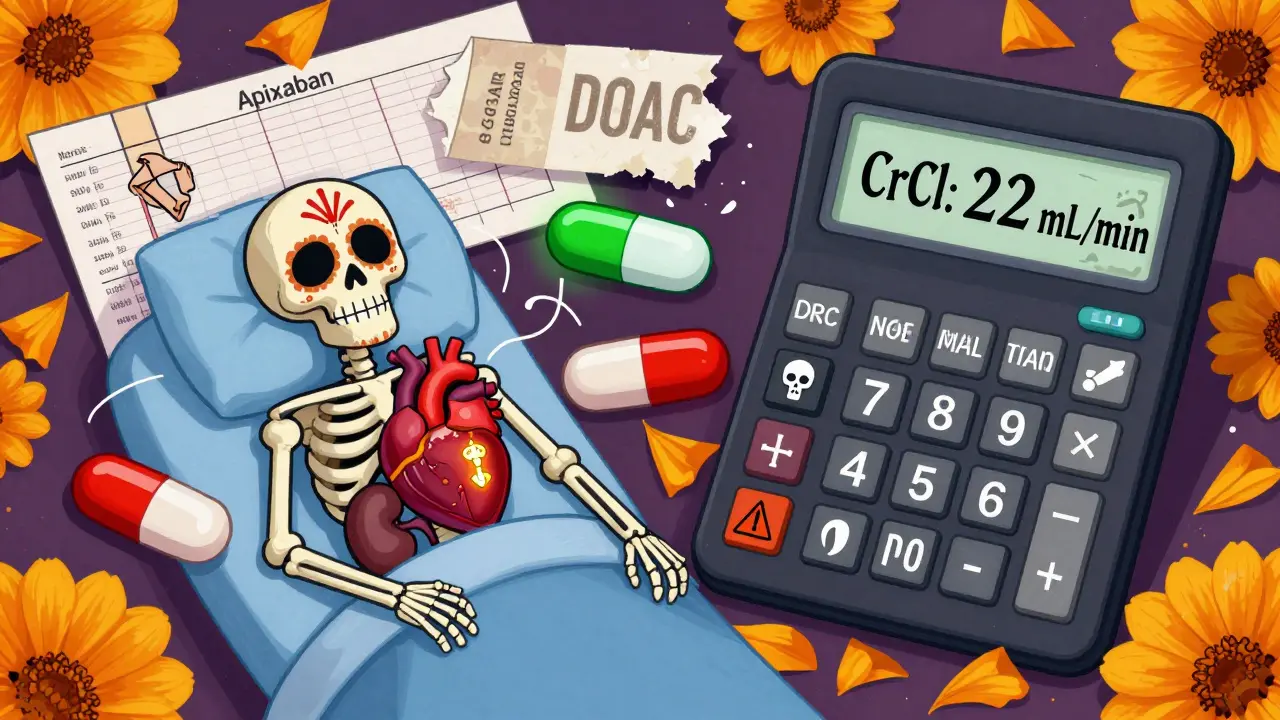 Feb, 8 2026
DOAC Dosing Calculator for Renal Impairment
Calculated CrCl
Recommended DOAC Dosing
Apixaban
Rivaroxaban
Dabigatran
Edoxaban
When you have atrial fibrillation and kidney problems, taking a blood thinner isn’t just about popping a pill-it’s about getting the dose just right. Too much and you risk bleeding. Too little and you could have a stroke. Direct Oral Anticoagulants (DOACs) like apixaban, rivaroxaban, dabigatran, and edoxaban are now the go-to choice for most people with AF, replacing warfarin in over 87% of cases. But here’s the catch: DOACs don’t work the same way if your kidneys are failing. And if you don’t adjust the dose, the consequences can be deadly.
Why Kidney Function Changes Everything
Most DOACs leave your body through your kidneys. That means if your kidneys aren’t filtering well, the drug builds up. A 2021 study found that between 11.5% and 44.6% of patients on DOACs for atrial fibrillation also have chronic kidney disease. That’s nearly half. And yet, many doctors still use eGFR to decide dosing-wrongly. The only accepted method is the Cockcroft-Gault formula, which calculates creatinine clearance (CrCl). It’s old, from 1976, but it’s still the gold standard. Why? Because the FDA and every major guideline since 1998 say so. eGFR? Don’t use it for DOACs. It’s not accurate enough for these drugs.How Each DOAC Needs to Be Adjusted
Not all DOACs are created equal when kidneys fail. Here’s what the data shows:- Apixaban: This one’s the safest in kidney disease. Standard dose is 5 mg twice daily. But if you’re over 80, weigh 60 kg or less, or have a creatinine level of 133 μmol/L or higher, drop to 2.5 mg twice daily. If your CrCl drops below 15 mL/min, don’t use it at all. Even in dialysis patients, apixaban is often used off-label because it’s the least likely to cause bleeding.
- Rivaroxaban: No dose adjustment below CrCl 30 mL/min. But if your CrCl falls below 15 mL/min? Don’t use it. Period. Major guidelines say it’s unsafe in end-stage kidney disease.
- Dabigatran: Use 150 mg twice daily if CrCl is above 30. If it’s between 15 and 30, cut it to 75 mg twice daily. Below 15? Avoid it. It’s mostly cleared by the kidneys, so it piles up fast.
- Edoxaban: Standard dose is 60 mg daily. If CrCl is between 15 and 50, reduce to 30 mg daily. Below 15? Don’t use it.
That’s why apixaban is becoming the default choice for patients with moderate to severe kidney disease. A 2020 study in the Journal of the American Heart Association found that in patients on dialysis, apixaban had lower bleeding rates than warfarin. Some nephrologists are now routinely prescribing it-even though it’s not officially approved for dialysis.
The Dangerous Gap Between Guidelines and Practice
Here’s the scary part: 37.2% of DOAC prescriptions in patients with kidney disease are dosed incorrectly, according to a 2022 JAMA Internal Medicine study. Why? Because doctors don’t calculate CrCl. They look at eGFR. Or they forget the criteria. Or they assume the patient is fine because they’re not on dialysis yet.One case from the American Society of Nephrology forum tells the story: a 78-year-old man on dialysis was given standard-dose apixaban (5 mg twice daily). He had a life-threatening GI bleed. He met two of the three criteria for dose reduction-age and weight-but no one checked creatinine. He was on the wrong dose because the system failed him.
Pharmacists are seeing this too. A 2022 study found that nearly 30% of CrCl calculations in patients over 80 were wrong. Why? Because the Cockcroft-Gault formula uses body weight and muscle mass. In elderly patients, muscle mass drops. Creatinine drops. But the formula doesn’t know that. So it underestimates kidney function. That means doctors might think a patient’s CrCl is 20 mL/min when it’s really 40. And they’ll underdose-putting the patient at risk for stroke.
What You Need to Do Right Now
If you or someone you care for is on a DOAC and has kidney disease, here’s your action list:- Get your CrCl calculated-not eGFR. Ask your doctor or pharmacist to use the Cockcroft-Gault formula. You’ll need your age, sex, weight in kg, and serum creatinine (from a recent blood test).
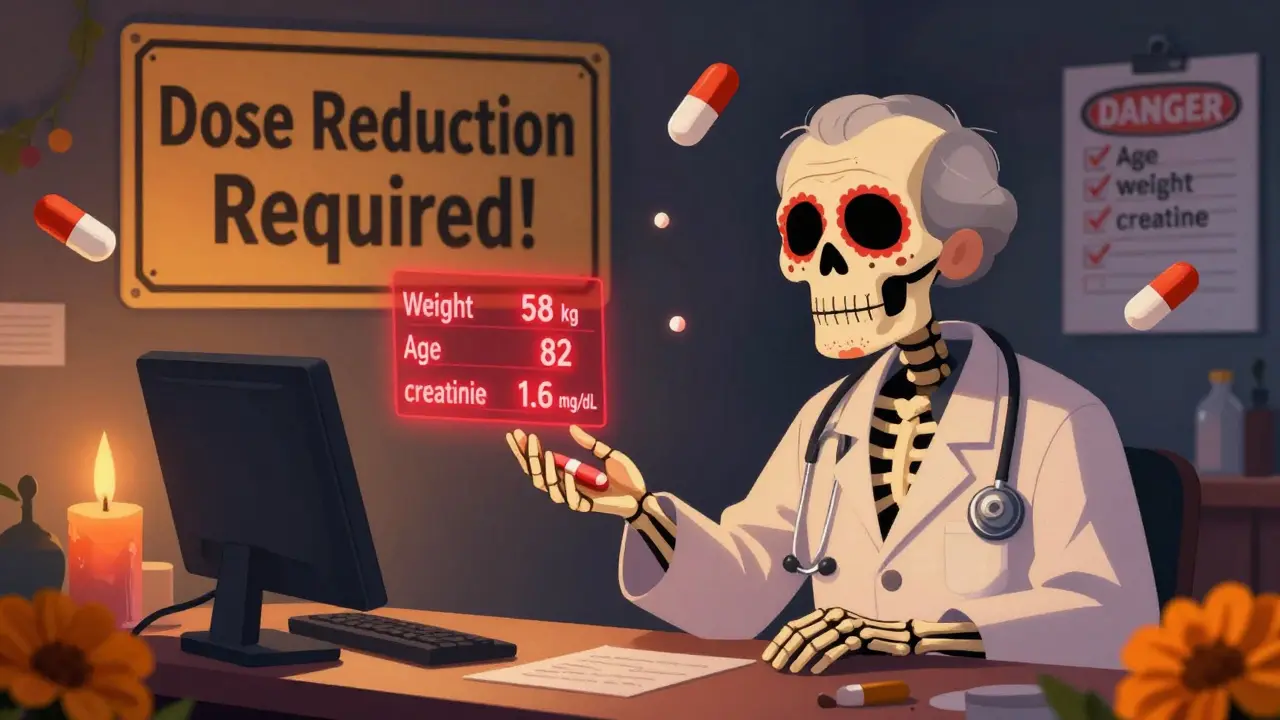
- Know the apixaban ABCs: Age ≥80? Weight ≤60 kg? Creatinine ≥1.5 mg/dL? If two of these are true, the dose drops to 2.5 mg twice daily. This is the most common mistake.
- Don’t assume dialysis = no DOAC. Apixaban is used safely in dialysis patients, even though it’s not FDA-approved for it. The evidence is strong enough that many experts now recommend it.
- Check every 3-6 months. Kidney function changes. A CrCl of 40 this year could be 25 next year. Recheck your labs regularly.
What’s Coming Next
The big trial everyone’s waiting for is RENAL-AF, which compares apixaban to adjusted warfarin in patients with severe kidney disease. Results are expected in 2025. Until then, we’re working with what we have. And what we have is clear: apixaban is the most reliable DOAC for kidney patients. Rivaroxaban and dabigatran? Avoid in advanced disease. Edoxaban? Use with caution.By 2026, we may have clearer guidelines for dialysis patients. But right now, the safest move is to use apixaban at the reduced dose-and to double-check your numbers.
Warfarin Still Has a Role
Some people think DOACs replaced warfarin completely. Not true. In patients with CrCl below 15 mL/min, warfarin is still an option. Studies show it’s risky-higher chance of bleeding, more calcification in blood vessels-but it’s predictable. You can monitor it with INR tests. If your kidney function is falling fast, and you’re not sure about DOAC dosing, warfarin might be the safer bet… for now.Can I take apixaban if I’m on dialysis?
Yes, apixaban is the only DOAC commonly used in patients on dialysis, even though it’s not officially approved for this use. Studies show it has lower bleeding risk than warfarin in this group. The standard dose is 2.5 mg twice daily, especially if you’re over 80, weigh less than 60 kg, or have high creatinine. Always confirm with your nephrologist.
Why is the Cockcroft-Gault formula used instead of eGFR?
Because DOACs are cleared by the kidneys, and the Cockcroft-Gault formula was validated specifically for dosing these drugs. eGFR is designed for general kidney health, not drug clearance. The FDA and all major guidelines require CrCl using Cockcroft-Gault for DOAC dosing. Using eGFR can lead to under- or overdosing.
What happens if I take the wrong dose of a DOAC?
If the dose is too high, you risk serious bleeding-brain, gut, or internal organs. If it’s too low, you’re not protected from clots, which can cause stroke or heart attack. A 2020 study found that inappropriate dosing was linked to a 3x higher risk of major bleeding and a 2x higher risk of stroke in kidney patients.
Is rivaroxaban safe for someone with stage 4 kidney disease?
No. Rivaroxaban is not recommended when CrCl is below 30 mL/min, and it’s contraindicated below 15 mL/min. Even in stage 4 CKD (CrCl 15-29), it’s considered high-risk. Apixaban is the preferred alternative in this group.
Should I stop my DOAC if my kidney function gets worse?
Don’t stop it without talking to your doctor. Instead, recalculate your CrCl and adjust the dose. For example, if you’re on apixaban 5 mg twice daily and your CrCl drops below 30, switch to 2.5 mg twice daily. Stopping anticoagulation without a replacement plan increases stroke risk more than the risk of bleeding.
Randy Harkins
February 8, 2026 AT 19:07Just wanted to say this post saved my dad’s life. He’s 82, weighs 58 kg, and was on standard-dose apixaban until his pharmacist caught it. We switched to 2.5 mg BID and he’s been fine for 14 months now. 🙌
Doctors really need to stop relying on eGFR. It’s like using a slide rule to navigate a rocket ship. Cockcroft-Gault isn’t perfect, but it’s the only tool we’ve got that actually works for DOACs. Thanks for laying this out so clearly.
Tori Thenazi
February 8, 2026 AT 22:34Wait… so you’re telling me the FDA, the AMA, and every hospital in America are all just… wrong? 😳
Let me guess-this is all a Big Pharma ploy to sell more apixaban, right? I mean, why else would they push a drug that’s NOT EVEN APPROVED for dialysis? I’ve seen the videos. The kidneys are just… *filters*… right? So why can’t we just dialyze the drug out? 😐
Also, I read somewhere that creatinine is made from steak. So if you eat less meat, your numbers go up? That’s why my cousin’s CrCl jumped from 18 to 42 after going vegan. Coincidence? I think NOT.
Ashlyn Ellison
February 9, 2026 AT 21:36Apixaban at 2.5 mg twice daily for elderly kidney patients is basically the new default. I’ve seen it in three different clinics now. It’s not perfect, but it’s the least bad option.
Also, warfarin is still hanging on in the shadows like a grumpy old uncle at Thanksgiving. Some people just… can’t let go. But honestly? If your CrCl is under 30 and you’re not on apixaban, you’re gambling. And I’m not talking about poker. I’m talking about your brain.
THANGAVEL PARASAKTHI
February 11, 2026 AT 18:55Really useful post. I work in a hospital in India and we face this daily. Many patients don’t even know what CrCl is. We use Cockcroft-Gault manually because our EHR doesn’t auto-calculate it. 😅
One thing I add: always check for muscle mass. Elderly patients with low BMI? Their creatinine might be low not because kidneys are good-but because they’re wasting. So even if CrCl says 25, they might need dose reduction anyway. Just a heads-up from the field.
Chelsea Deflyss
February 12, 2026 AT 05:57Okay but like… who even uses the Cockcroft-Gault formula anymore? I mean, it’s 2025. Why are we still doing math by hand? I got my eGFR from my Apple Watch. It says I’m fine. So why is everyone mad? 😑
Also, I think apixaban is overhyped. My aunt took it and got a nosebleed. So maybe it’s not safer. Maybe we just need to stop giving blood thinners to old people. End of story.
Tricia O'Sullivan
February 12, 2026 AT 14:10This is an exceptionally well-structured and evidence-based overview. I appreciate the emphasis on the Cockcroft-Gault formula’s continued relevance, despite its age. The distinction between renal clearance mechanisms and eGFR’s predictive utility for morbidity-rather than pharmacokinetics-is clinically indispensable.
Furthermore, the documented discrepancy between guideline adherence and real-world prescribing practices is alarming, and underscores the necessity for mandatory pharmacist-led medication reconciliation in geriatric and nephrology clinics. Thank you for this vital contribution.
Scott Conner
February 12, 2026 AT 17:52Wait so if my CrCl is 22 and I’m 75, 55kg, creatinine 1.6… I’m on apixaban 2.5mg BID right? But what if I’m on dialysis 3x/week? Do I take it before or after? I’ve heard conflicting things. Also, does dialysis remove apixaban at all? Or is it just sitting there in my blood like a chill ghost?
Also-why is no one talking about the fact that some labs use different creatinine assays? My hospital uses Jaffe, but my nephew’s lab uses enzymatic. That changes the number by like 0.3. Is that a big deal? 😅
Susan Kwan
February 13, 2026 AT 16:45Oh wow. So the system failed him. 😏
Yeah, because doctors are just… lazy. And pharmacists? They’re overworked and underpaid. And patients? They don’t know their own lab numbers. We’re not just dealing with medical ignorance here-we’re dealing with a broken system that treats kidneys like an afterthought.
Apixaban isn’t magic. It’s just the least terrible option in a sea of bad choices. But yeah-this post is right. If you’re not checking CrCl manually, you’re not doing your job. And if your EHR auto-calculates eGFR as the default? Someone needs to get fired.