How to Use Behavioral Tricks to Build a Medication Habit
 Feb, 7 2026
Taking medication daily isn’t just about following a doctor’s order-it’s about turning a chore into a habit. If you’ve ever forgotten your pills, skipped a dose because it felt like too much effort, or just lost track amid a busy day, you’re not alone. About half of people with long-term health conditions don’t take their meds as prescribed. That’s not laziness. It’s human. But there’s a better way than relying on willpower. The science of behavior shows us how to make medication-taking automatic, effortless, and even invisible in your daily life.
Start with the simplest change: Take it at the same time every day
Your brain loves routine. When something happens at the same time every day, your mind starts to expect it. That’s why brushing your teeth in the morning feels natural-you don’t have to think about it anymore. The same principle works for medication.A 2020 study in Patient Preference and Adherence found that people who took their meds at the exact same time each day improved adherence by 15.8%. That’s not a small boost. It’s the difference between missing a dose once a week and rarely missing one at all.
Don’t pick a time that’s convenient. Pick a time that’s unavoidable. If you wake up at 7 a.m. every day, take your pill right after you get out of bed. If you eat dinner at 6 p.m., take it with your meal. Link it to something your body already does without thinking. No alarms needed. Just repetition.
Stack it with an existing habit (habit stacking)
This is one of the most powerful tricks. Habit stacking means attaching a new behavior to an old one. You don’t need to create a whole new routine-you just glue your pill to something you already do.Here’s how it works: After you brush your teeth, you take your pill. After you pour your morning coffee, you take your meds. After you lock your front door, you check your pillbox.
Why does this work? Because your brain already has strong neural pathways for brushing your teeth or making coffee. When you pair your pill with one of those actions, you borrow that automaticity. A 2021 study in the Journal of the American Geriatrics Society showed that elderly patients who used habit stacking reduced missed doses by 27%. That’s because they weren’t trying to remember a new task-they were just continuing what they already did.
Try this: Write down your top three daily routines. Pick one. Attach your medication to it. Do it for 21 days. That’s all it takes to rewire your brain.
Use a pill organizer-not just for storage, but for feedback
Pill organizers aren’t just containers. They’re visual feedback tools. Seeing an empty compartment tells you: “You didn’t take it.” Seeing a full one tells you: “You did.”Don’t just buy a generic plastic box. Get one with labeled compartments for morning, afternoon, evening, and night. Fill it once a week. Make it part of your Sunday ritual. If you forget to take your pill, you’ll know immediately because the compartment is still full. No guesswork. No guilt.
That simple visual cue cuts missed doses by nearly a third in older adults. It’s not magic. It’s design. Your eyes are wired to notice empty spaces. Use that.

Let your phone remind you-but make it personal
Smartphone reminders work. A 2021 meta-analysis in JMIR mHealth and uHealth found they boosted adherence by 28.7%. But generic alarms? They’re useless after a few weeks. Your brain tunes them out.Here’s how to make them stick: Use a medication app that lets you customize the message. Instead of “Take your pill,” try “Your blood pressure is thanking you right now.” Or “You’re one step closer to hiking again.”
Apps with progress tracking-like a calendar that fills in as you take your meds-add another layer. Seeing a streak of 10 days in a row? That feels good. It triggers your brain’s reward system. That’s why apps with visual progress bars improve adherence by 23.7%.
And if your pharmacy offers auto-refill? Sign up. A 2022 study in Medical Care found auto-refill programs improved medication continuity by 33.4%. No more running out. No more last-minute pharmacy runs. Just a delivery at your door.
Make it easier: Ask for a simpler regimen
If you’re taking five different pills at three different times a day, it’s no wonder you forget. Complexity kills adherence.Ask your doctor: “Can I combine any of these?” Many medications now come in single-pill combinations. A 2011 meta-analysis of over 21,000 patients showed that switching from multiple pills to one daily pill increased adherence by 26%.
Even reducing dosing frequency helps. Taking a pill once a day instead of twice? That cuts missed doses by up to 40%, according to clinical data from Dr. Jonathan Keigher’s team. Your doctor might not bring this up. So ask.
For some conditions, long-acting injectables (LAIs) are an option. These shots last weeks or months. A 2022 study in Schizophrenia Bulletin found LAIs reduced non-adherence by 57% compared to daily pills. It’s not for everyone-but if you’re struggling, it’s worth discussing.
Pair it with purpose: Why does this matter to YOU?
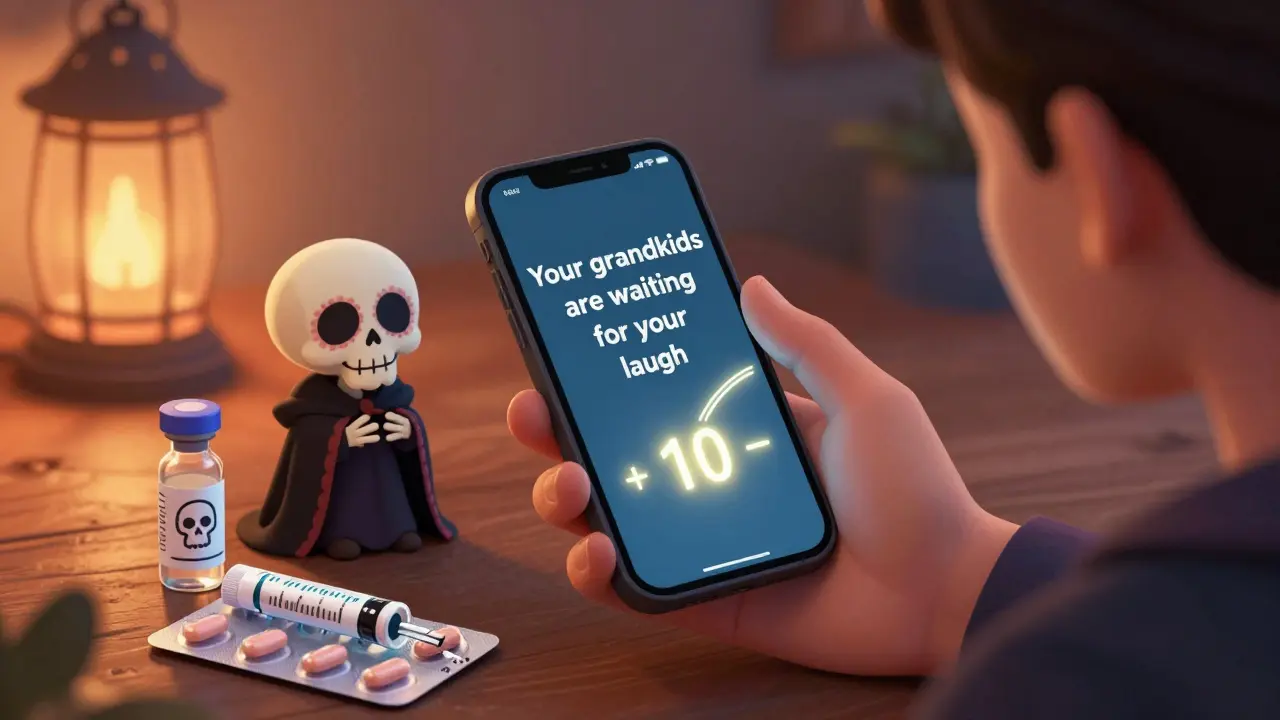
Motivation isn’t about being told what to do. It’s about connecting the action to something you care about.Ask yourself: “What happens if I skip this pill?” The answer isn’t “I’ll get sicker.” That’s too abstract. Instead, ask: “What will I miss out on if I don’t take this?”
Maybe it’s playing with your grandkids without getting winded. Maybe it’s keeping your job. Maybe it’s being able to walk your dog without pain.
Write that down. Keep it on your phone. Say it out loud every time you take your pill. A 2020 review in Patient Education and Counseling found that motivational interviewing-where patients articulate their own reasons for taking meds-improved adherence by 22.1%.
You’re not following a rule. You’re choosing a life.
Track it, but don’t overthink it
Self-monitoring works. A 2005 study by Cochran found that people who kept a daily medication chart improved adherence by 19.3%. But you don’t need a spreadsheet.Use a simple calendar. Mark an X each day you take your meds. No fancy app. Just pen and paper. The act of marking it-physically-creates a small sense of accomplishment. It’s not about perfection. It’s about seeing the pattern.
And if you miss a day? Don’t panic. Don’t guilt-trip yourself. Just reset. One slip doesn’t break the habit. Stopping does.
Get support: You don’t have to do this alone
The most effective adherence programs aren’t solo missions. They’re team efforts. When doctors, pharmacists, and nurses all give you the same message, adherence jumps to 68%.Ask your pharmacist: “Can we set up a weekly check-in?” Many pharmacies now offer free adherence counseling. Ask your doctor if they use a program like ADAPT (Adherence through Dynamic Assessment, Planning, and Teaching). It combines personalized coaching with behavioral tools-and in trials, it raised adherence from 52% to 78%.
Bring a family member to your next appointment. Let them help you set up your pillbox. Ask them to remind you-gently. You’re not failing. You’re human. And humans do better when they’re supported.
What if nothing seems to work?
Sometimes, the barrier isn’t forgetfulness. It’s fear. Cost. Side effects. Distrust.If you’re skipping pills because they make you feel weird, talk to your doctor. There might be alternatives. If you can’t afford them, ask about patient assistance programs. Many drugmakers offer free or low-cost meds to those who qualify.
And if you’re overwhelmed by the idea of “building a habit”? Start with one pill. One day. One time. That’s enough. Progress isn’t about doing everything right. It’s about doing something, consistently.
Medication isn’t a chore. It’s a tool. And like any tool, it only works when you use it. Behavioral tricks don’t ask you to be perfect. They just ask you to be consistent. One day at a time.
Chima Ifeanyi
February 8, 2026 AT 03:56Elan Ricarte
February 9, 2026 AT 22:48glenn mendoza
February 10, 2026 AT 17:24Angie Datuin
February 11, 2026 AT 01:42Camille Hall
February 11, 2026 AT 03:17Ritteka Goyal
February 11, 2026 AT 19:41Monica Warnick
February 13, 2026 AT 03:23Ashlyn Ellison
February 13, 2026 AT 04:04Jonah Mann
February 14, 2026 AT 10:42