Tramadol Seizure Risk: Key Vulnerable Groups Explained
 Feb, 4 2026
Tramadol Seizure Risk Calculator
Assess Your Risk
Enter your profile to see your personalized seizure risk level based on clinical research.
Your Seizure Risk Assessment
Important: This tool provides educational information only. Consult your doctor before making any medication changes.
Understanding Tramadol seizure risk is critical for safe pain management. Tramadol is a centrally acting synthetic opioid analgesic used for moderate to moderately severe pain. Unlike other opioids, it has a dual mechanism of action: it binds to opioid receptors and also blocks serotonin and norepinephrine reuptake. This makes it effective for pain but also increases the risk of seizures.
The seizure risk facts
According to a 2019 study published in the PMC, 58% of tramadol-intoxicated patients in emergency departments experienced seizures. That's almost six out of ten. Most were young men with a median age of 23, but older adults and people with certain health conditions are also at high risk. The study found that seizure occurrence correlates more with the dose taken than blood levels, meaning even "normal" doses can be dangerous for vulnerable individuals.
Key vulnerable populations
Patients with a history of seizures face a 3.7 times higher risk. Babahajian's research showed that those with prior seizure disorders had an odds ratio of 3.71 (95% CI: 1.17-11.76). This means if you've had seizures before, tramadol could be dangerous.
Taking certain antidepressants like fluoxetine (Prozac) or amitriptyline (Elavil) can block the CYP2D6 enzyme. The Wei et al. 2023 study found that combining tramadol with these drugs increased seizure risk by 9% in older adults. This isn't just a small risk - it translates to thousands of preventable seizures each year.
Older adults are especially vulnerable. The FDA updated tramadol's label in January 2022 to lower the maximum daily dose for older patients. If your kidneys aren't working well (creatinine clearance below 60 mL/min), the max dose is 300mg. Below 30, it's not recommended. This is because kidney problems slow down tramadol clearance, leading to higher blood levels.
High doses significantly raise seizure risk. Babahajian's study showed that patients with multiple seizures had median doses of 2800mg, while single-seizure cases had 850mg. The FDA's max dose is 400mg daily. Taking more than this significantly raises seizure risk.
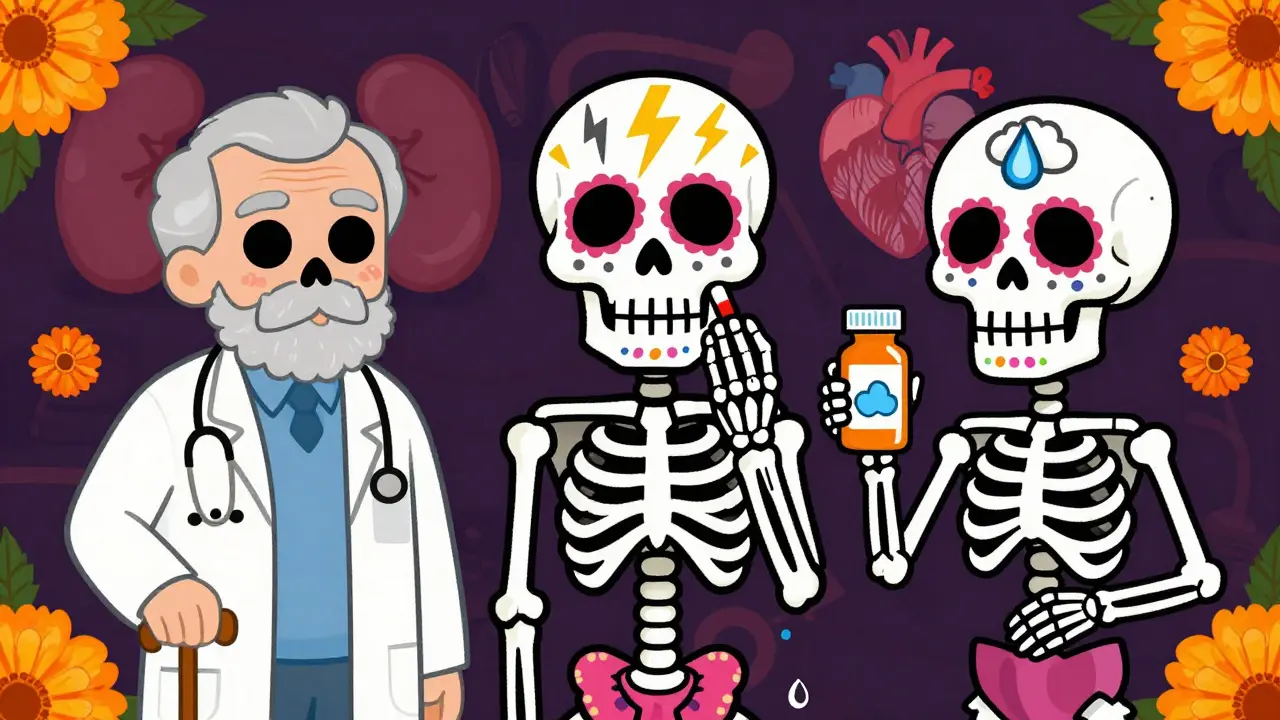
How tramadol causes seizures
Tramadol needs the CYP2D6 enzyme to convert into its active form. When you take medications that block CYP2D6 - like some antidepressants - tramadol builds up. This excess tramadol lowers your seizure threshold. Plus, the serotonin effects from tramadol can trigger seizures on their own. It's a dangerous combo.
Real-world cases
New Zealand's CARM database recorded ten tramadol-related seizures by 2006. Three cases involved tricyclic antidepressants (TCAs), including one where a patient with epilepsy had more seizures after starting tramadol. A Reddit user named PainPatient87 shared their experience: "My neurologist didn't mention the seizure risk when adding tramadol to my sertraline... I had my first seizure at 32 years old and now I'm on lifelong anti-epileptics." This shows how critical it is to discuss medication interactions with your doctor.
What to do
If you're at risk, talk to your doctor. For chronic pain, alternatives like acetaminophen or NSAIDs (if appropriate) are safer. If you must take tramadol, avoid CYP2D6-inhibiting antidepressants. Citalopram or escitalopram are safer SSRI options. Always check your kidney function before starting tramadol. And never exceed your prescribed dose.
Can tramadol cause seizures at normal doses?
Yes. Even at therapeutic doses, tramadol can trigger seizures. Research shows that 58% of tramadol-intoxicated patients in emergency departments experienced seizures. The risk is higher in vulnerable populations like those with seizure history or on certain antidepressants.
What antidepressants increase tramadol seizure risk?
Antidepressants that block the CYP2D6 enzyme, such as fluoxetine (Prozac), paroxetine (Paxil), and tricyclic antidepressants like amitriptyline (Elavil), significantly increase seizure risk. The Wei et al. 2023 study found a 9% higher seizure rate when these were combined with tramadol in older adults.
How does kidney function affect tramadol risk?
Kidneys clear tramadol from your body. If your creatinine clearance is below 60 mL/min (indicating kidney impairment), the maximum daily dose drops to 300mg. Below 30 mL/min, tramadol is contraindicated. This is because impaired kidneys cause tramadol to build up, increasing seizure risk.
What are safer alternatives to tramadol?
For chronic pain, acetaminophen (Tylenol) or NSAIDs like ibuprofen (if appropriate) are safer options. The American Geriatrics Society's 2023 Beers Criteria lists tramadol as potentially inappropriate for older adults due to seizure risk, recommending these alternatives first.
Should I get tested for CYP2D6 status before taking tramadol?
Research from the University of Toronto in July 2023 suggests that poor CYP2D6 metabolizers have 3.2 times higher tramadol plasma concentrations. While not yet standard practice, discussing genetic testing with your doctor may help assess individual risk, especially if you have a history of seizures or are taking other medications.
Rene Krikhaar
February 5, 2026 AT 05:31Hey everyone just wanted to share that while tramadol is useful for pain its crucial to know the risks I've seen patients with seizure history struggle after taking it always talk to your doctor before starting especially if you're on antidepressants kidney function matters too low clearance means higher risk don't ignore those warning signs its better to be safe than sorry trust me I've been in the medical field for years and this is something I always emphasize the stats are scary 58 of ER cases with tramadol had seizures but with proper checks it can be managed just don't take more than prescribed your health is worth it Also the FDA updated the label for older adults so make sure your doctor knows your kidney function And if you're on SSRIs like Prozac thats a red flag I've had patients who didnt know about the interaction and it was a disaster So please get checked Its not worth the risk
Dr. Sara Harowitz
February 6, 2026 AT 23:20Tramadol is a disaster waiting to happen!! The government should ban this immediately!!! People are dying because of careless prescribing!! We need stricter controls!!! Every single case of seizure is preventable!!! Why aren't they doing more??? This is why America needs to take back control of its healthcare!!! It's a national emergency!!! The FDA is failing us all!! They're too cozy with Big Pharma!!!
Georgeana Chantie
February 8, 2026 AT 05:08I've taken tramadol for years with no issues, so clearly the stats are wrong 😂
Carol Woulfe
February 9, 2026 AT 18:45Clearly, the FDA's regulatory framework is compromised by pharmaceutical lobbying. The data on tramadol-induced seizures is being suppressed to maintain profit margins. It's a classic case of corporate influence on public health policy. The truth is buried under layers of bureaucratic obfuscation. This is why we need independent oversight!
Kieran Griffiths
February 10, 2026 AT 12:47Hey, it's important to stay informed but don't panic. Talk to your doctor and they can help you find the right treatment. There are safer alternatives for chronic pain.
Brendan Ferguson
February 11, 2026 AT 13:03I agree with Kieran. It's all about personalized medicine. What works for one person might not work for another. Always consult a professional. There's no one-size-fits-all solution here.
Nancy Maneely
February 12, 2026 AT 13:30Tramadol is a ticking time bomb for your brain.
Phoebe Norman
February 13, 2026 AT 03:33The pathophysiology of tramadol-induced seizures involves GABAergic modulation and serotonin syndrome, which is why the mechanism is so complex.
Katharine Meiler
February 13, 2026 AT 12:15From a pharmacokinetic perspective, the CYP2D6 polymorphism plays a critical role in metabolizing tramadol, leading to variable plasma concentrations. Thus, genetic testing could mitigate risks.