The Science of Medication Safety: Risk, Benefit, and Evidence
 Feb, 3 2026
Every time someone takes a pill, there’s a hidden calculation happening: benefit versus risk. It’s not just about whether the drug works-it’s about whether it’s safe for you, in your body, under your conditions. This isn’t guesswork. It’s science. And that science is built on decades of research, data, and hard lessons learned from tragedies like thalidomide, where thousands of babies were born with severe limb defects because a drug thought to be safe for morning sickness turned out to be devastatingly harmful. Today, medication safety is a full-blown field-pharmacoepidemiology-that tracks how drugs behave in real life, not just in labs or controlled trials.
Why Clinical Trials Aren’t Enough
Clinical trials are the gold standard for getting a drug approved. But they’re limited. The average Phase III trial includes only 707 people, and lasts about a year. That’s fine for spotting common side effects-like nausea or dizziness-but it misses the rare ones. Things that happen in 1 out of 10,000 patients? Those don’t show up. And what about people over 70? Those with kidney disease? Those taking five other medications? Most trial participants are healthy, young, and free of other conditions. Real patients? They’re messy. That’s where real-world evidence comes in.After a drug hits the market, millions of people start using it. That’s when the real data starts pouring in. The FDA’s Sentinel Initiative now monitors over 190 million patients across U.S. health systems. Medicare claims data tracks 57 million seniors. Kaiser Permanente’s records cover 12.5 million members. These aren’t just numbers-they’re stories. A 72-year-old woman on blood thinners who ends up in the ER after starting a new antibiotic. A teenager who develops a rare skin reaction after taking a common acne drug. These events wouldn’t have been caught in a trial. But now, they’re part of the evidence.
How Scientists Track Drug Risks in the Real World
Researchers don’t just guess. They use smart, proven methods to find patterns in chaos. One common approach is the cohort study: follow a group of people who took a drug and compare them to a group who didn’t. Did more people in the drug group have a stroke? That’s a red flag. Another method is the case-control study: look at people who had a bad reaction and see what drugs they were on, then compare them to people who didn’t have the reaction. It’s like solving a puzzle backwards.Then there are the smarter designs. The self-controlled case series (SCCS) looks at one person over time. Did they have a hospital visit right after starting the drug? Then not again? That pattern-when the event only happens after exposure-suggests a link. This method cuts out confounding factors like age or diet because it uses the same person as their own control. It’s especially powerful for vaccines and short-term reactions.
These methods aren’t perfect. Observational studies can’t prove cause like a randomized trial can. A 2021 review found that 22% of associations found in observational studies were later disproven by RCTs. But they’re not meant to replace trials-they’re meant to complement them. Think of it like this: trials tell you what could happen. Real-world data tells you what does happen.
The Cost of Getting It Wrong
The stakes are high. In 2022, over 80,000 deaths in the U.S. were linked to opioid misuse. That’s not just addiction-it’s a medication safety failure. Older adults are another big concern. Fifteen percent of Medicare beneficiaries suffer an adverse drug event every year. Many of these are preventable. A nurse gives the wrong dose. A pharmacist misses a dangerous interaction. A doctor prescribes a drug that clashes with another, and no one catches it.One study found that 38% of preventable medication errors happen during nursing administration. Another showed that 89% of drug interaction alerts in emergency rooms get ignored-because doctors are flooded with them. Alert fatigue is real. When every third alert is a false alarm, people stop paying attention. That’s why some health systems are now using medication decision intelligence (MDI)-AI tools that don’t just flag interactions but rank them by severity and relevance. One trial at Kaiser Permanente cut severe alcohol withdrawal events by 42% by using a standardized protocol instead of guessing doses. That’s the power of evidence-based practice.
What’s Working: Real Examples
It’s not all problems. There are wins. In 2025, Kaiser Permanente implemented a phenobarbital protocol for alcohol withdrawal across 12 hospitals. Before, about 15% of patients had seizures or delirium. After? It dropped to 8.9%. That’s not luck. That’s using data to build a better system.Another success story? Nurses in Iran. A 2023 survey found that medication safety competence explained 61% of safe care practices. When nurses were trained to recognize risks, document clearly, and communicate with pharmacists, errors dropped. No fancy tech. Just better training and clearer processes.
Meanwhile, the FDA now requires post-market safety studies for 37% of new drugs. That’s a huge shift. Ten years ago, a drug could be approved with minimal long-term data. Now, companies must continue monitoring. And the data is public. You can look up how many people reported liver injury after taking a new diabetes drug. That transparency didn’t exist before.
The Tools Behind the Science
This field runs on data-and a lot of it. Researchers use software like SAS, R, and Stata to analyze millions of records. They build algorithms to find hidden signals. A common challenge? Missing data. Over-the-counter drugs aren’t always tracked. People forget to mention supplements. Some pharmacies don’t report to central databases. That leaves gaps. Studies estimate 15-25% of medication records in administrative systems are incomplete.That’s why validation matters. The best studies cross-check claims data with medical charts. If a database says someone took a drug, but the chart says they didn’t? That’s a false positive. It takes time. It takes money. Up to 40% of a study’s budget goes to manual chart review. But it’s worth it. Without it, false signals lead to wrong warnings-and that’s dangerous.
What’s Next: AI, Wearables, and Standardization
The future is here. In 2023, the FDA launched Sentinel System 3.0, which can now detect safety signals in near real-time. By 2025, they plan to include data from smartwatches-heart rate spikes, sleep changes, activity drops-that might hint at a bad reaction before someone even goes to the hospital.AI is being used to predict who’s at risk. One early system at KPWHRI reduced high-alert medication errors by 22-35% by flagging patients who had similar patterns to past adverse events. It’s not perfect, but it’s a start.
But there’s a problem: inconsistency. Different research groups use different methods. One study might define an “adverse event” as any hospital visit within 30 days. Another might only count serious outcomes like death or ICU admission. That makes it hard to compare results. The International Society of Pharmacoepidemiology is pushing for standardized protocols by 2026. If they succeed, regulators will have clearer, more reliable data to make decisions.
Why This Matters to You
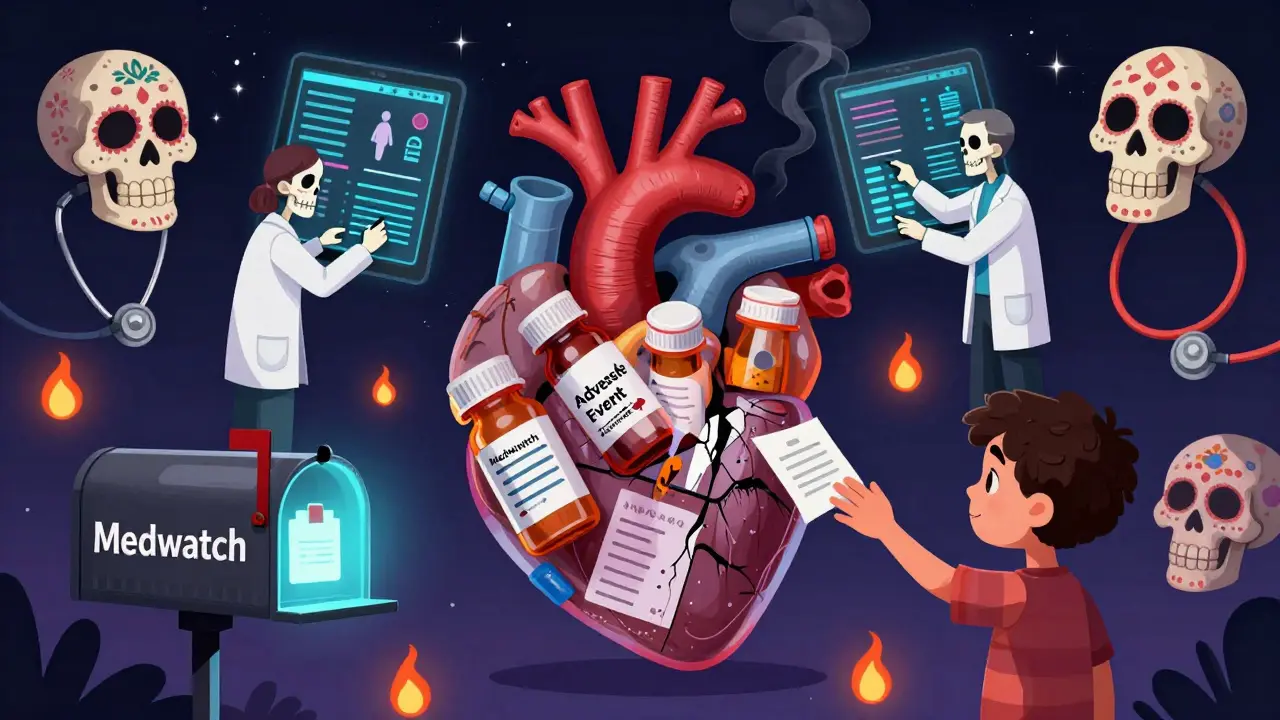
You might think this is all about regulators and scientists. But it’s not. It’s about you. If you’re on five medications, you’re at higher risk. If you’re over 65, you’re in the group most likely to have a dangerous interaction. If you’ve ever been told, “This drug is safe,” but you felt weird after taking it-you’re part of the data. Your experience matters. Your report to a pharmacist, your note to your doctor, your hesitation to take a pill… those are the building blocks of better safety.And you don’t have to wait for a study to change things. Ask your doctor: “Has this drug been tested in people my age?” Ask your pharmacist: “Could this interact with my other meds or supplements?” If you notice something unusual-dizziness, rash, fatigue-don’t ignore it. Report it. The FDA’s MedWatch system lets patients report adverse events directly. That’s real-world evidence in action.
How do scientists know if a drug is truly causing harm?
They use multiple methods to rule out coincidence. For example, if a drug is linked to a rare liver injury, researchers check whether the injury happened more often after the drug started, whether it went away when the drug was stopped, and whether other factors (like alcohol use or another medication) could explain it. They compare users to non-users, look at patterns over time, and sometimes use self-controlled designs where the patient acts as their own control. No single method is perfect, but together, they build a strong case.
Can I trust drug safety information from the FDA?
Yes-but with context. The FDA doesn’t just rely on clinical trials. They use real-world data from millions of patients through systems like Sentinel and the Adverse Event Reporting System. They update warnings when new evidence emerges. But they also rely on manufacturers to report safety data. That’s why it’s important to report your own experiences. The more data they have, the more accurate their warnings become.
Why do drug interaction alerts keep going off if they’re not always important?
Because the systems are built to err on the side of caution. A warning might say “avoid this combination” even if the risk is low for most people. But in some patients-like those with kidney disease or over 70-the risk is real. The problem is alert fatigue: too many warnings make doctors ignore them all. Newer systems use AI to prioritize alerts based on patient history, severity, and likelihood of harm, cutting down noise while keeping critical warnings visible.
Are natural supplements safer than prescription drugs?
Not necessarily. Many people assume “natural” means “safe,” but that’s not true. Supplements aren’t tested the same way as prescription drugs. A 2023 study found that 1 in 4 herbal products contained hidden prescription drugs, like statins or blood pressure meds. Others interact dangerously with common medications. St. John’s Wort, for example, can make birth control, antidepressants, and blood thinners ineffective. Always tell your doctor what supplements you take.
What can I do to protect myself from medication errors?
Keep a written list of all your medications-including doses and why you take them. Bring it to every appointment. Ask your pharmacist to review it at least once a year. Don’t assume a new drug is safe just because it’s prescribed. Ask: “What are the most common side effects?” and “Could this interact with my other meds?” If you feel something unusual, write it down and report it. Your input helps improve safety for everyone.
pradnya paramita
February 3, 2026 AT 19:51Pharmacoepidemiology is fundamentally about signal detection in noisy, high-dimensional datasets. The cohort and case-control designs are foundational, but the self-controlled case series (SCCS) is particularly elegant for transient exposures-by using within-individual comparisons, it effectively controls for time-invariant confounders like genetic predisposition or chronic comorbidities. The challenge lies in temporal alignment: defining the risk window post-exposure requires careful calibration, often using kernel density estimation to model hazard functions non-parametrically. Validation against gold-standard clinical chart reviews remains non-negotiable, especially given the 15–25% data incompleteness in administrative claims. Without this, false positives cascade into unnecessary black-box warnings that erode clinical trust.
Jesse Naidoo
February 4, 2026 AT 00:09So let me get this straight-you’re telling me the FDA just sits around waiting for people to die before they realize a drug is dangerous? And you call this science? I’ve seen my cousin go into a coma because of a ‘safe’ prescription, and now you wanna tell me it’s just ‘real-world evidence’? This system is broken. They’re not protecting us-they’re protecting profits. Wake up.
Zachary French
February 5, 2026 AT 00:53Okay, buckle up, buttercup-this is gonna be a wild ride. So we got this whole ‘science’ thing going on, right? Clinical trials? Pfft. 707 people? That’s less than my high school senior class! Meanwhile, real people? They’re on 7 meds, 3 supplements, 2 energy drinks, and a bag of gummy bears they swear ‘help with anxiety.’ And you wanna tell me a 12-month trial with 25-year-old jocks is gonna catch what happens to a 78-year-old grandma on warfarin who just started turmeric? Nah. Nahhh. We need AI that reads tea leaves AND EHRs. And if the FDA’s still using spreadsheets in 2025, I’m moving to Mars. #DrugSafetyIsAScandal
Daz Leonheart
February 6, 2026 AT 22:13This is actually really encouraging to see. The fact that systems like Kaiser’s phenobarbital protocol reduced seizures by almost half? That’s proof that structure and standardization save lives. It’s not about fancy tech-it’s about consistency. Nurses aren’t guessing. Doctors aren’t overwhelmed. Patients aren’t left to suffer because someone missed a detail. Small, smart changes add up. Keep pushing for protocols like this. It’s working.
Samuel Bradway
February 7, 2026 AT 23:56I’ve been on 5 meds for years and never knew half of this. I thought if a doctor prescribed it, it was fine. But now I’m gonna start asking: ‘Is this tested on people like me?’ And I’m writing down every weird symptom-even if it seems small. Thanks for the clarity.
Caleb Sutton
February 9, 2026 AT 10:27They’re lying. The FDA is owned by Big Pharma. Every ‘safety study’ is paid for by the drug company. The ‘real-world data’? Fabricated. The AI? Trained to ignore red flags. They want you dependent. They want you scared of natural remedies so you keep buying pills. Wake up. The system is a scam.
Jamillah Rodriguez
February 9, 2026 AT 20:58Ugh. Another ‘science’ post. Can we just admit that most drugs are just glorified placebos with side effects no one talks about? I took that ‘safe’ antidepressant and felt like my brain was being scraped with a cheese grater. Nobody warned me. Just ‘it’s normal.’ Yeah, normal for a lab rat.
Susheel Sharma
February 10, 2026 AT 04:46The entire pharmacovigilance framework is structurally compromised by data fragmentation and inconsistent operational definitions. The absence of standardized adverse event ontologies across jurisdictions renders cross-population meta-analyses statistically untenable. Moreover, the reliance on passive reporting systems-such as MedWatch-introduces severe selection bias, as only the most severe or ideologically motivated cases are documented. Without mandatory digital integration of EHRs and pharmacogenomic data, this remains a probabilistic guessing game dressed in peer-reviewed clothing.
Roshan Gudhe
February 10, 2026 AT 14:58It’s fascinating how we treat medicine like a machine-input drug, output outcome. But the human body isn’t a machine. It’s a living, breathing, emotional, chaotic system. We measure risk in percentages, but real people feel it in fear, in sleepless nights, in the silence after a doctor says, ‘We didn’t see this coming.’ Maybe the real science isn’t just in the data-but in listening to the stories behind the numbers.
Rachel Kipps
February 11, 2026 AT 05:40I’ve been a nurse for 18 years. I’ve seen alert fatigue firsthand. We get 200 alerts a shift. 190 are useless. One is life-threatening. We stop looking. That’s not a tech problem-it’s a design failure. We need smarter systems that learn from our actions, not just bomb us with noise. And yes, chart reviews are slow. But they’re the only thing keeping people alive.
Katherine Urbahn
February 13, 2026 AT 00:01It is imperative to underscore, with unequivocal clarity, that the current paradigm of pharmacovigilance is fundamentally inadequate-particularly when considering the proliferation of unregulated supplements, which are not subject to pre-market safety evaluations under the Dietary Supplement Health and Education Act of 1994. The fact that 25% of herbal products contain undisclosed pharmaceutical agents is not merely a regulatory oversight-it is a public health emergency. Patients must be held accountable for disclosing ALL substances consumed; failure to do so is not ignorance-it is negligence.
Alex LaVey
February 13, 2026 AT 03:29I’ve seen this work in rural clinics in India. No fancy AI. No big data. Just a nurse who takes the time to sit down, ask the patient what they’re taking, and write it all down. Then they call the pharmacist together. Simple. Human. Effective. We don’t need more tech-we need more presence. More care. More listening.
caroline hernandez
February 13, 2026 AT 06:22Real-world evidence isn’t just about volume-it’s about granularity. The SCCS method, for instance, leverages within-subject temporal dynamics to isolate drug effects with remarkable precision, especially for acute, transient outcomes like arrhythmias or anaphylaxis. But the real bottleneck? Data interoperability. EHRs still speak different languages. Claims data lacks phenotypic detail. We need FHIR-based, structured, longitudinal datasets with embedded clinical narratives-not just ICD codes. Until then, we’re optimizing the wrong variables.
Jhoantan Moreira
February 14, 2026 AT 11:24It’s easy to feel overwhelmed by all this. But small actions matter. Writing down your meds. Asking one question. Reporting that weird rash. You’re not just helping yourself-you’re helping someone else five years from now who might be prescribed the same thing. This isn’t just science. It’s community.