Bioequivalence Testing for Generic Drugs: What It Proves
 Mar, 3 2026
When you pick up a prescription and see a generic version on the shelf, you might wonder: does it really work the same? After all, it looks different, costs less, and doesn’t have the same brand name. But here’s the truth: if it’s approved by the FDA, it’s not a cheaper copy-it’s a scientifically proven twin.
What Bioequivalence Testing Actually Measures
Bioequivalence testing isn’t about guessing or assumptions. It’s a precise, data-driven process that answers one question: Does the generic drug enter your bloodstream at the same rate and amount as the brand-name version?
The FDA defines bioequivalence as the absence of a significant difference in how quickly and how much of the active drug reaches your system. That’s it. No need to repeat full clinical trials. No need to re-prove safety. The brand-name drug already did that. The generic just has to show it behaves the same way inside your body.
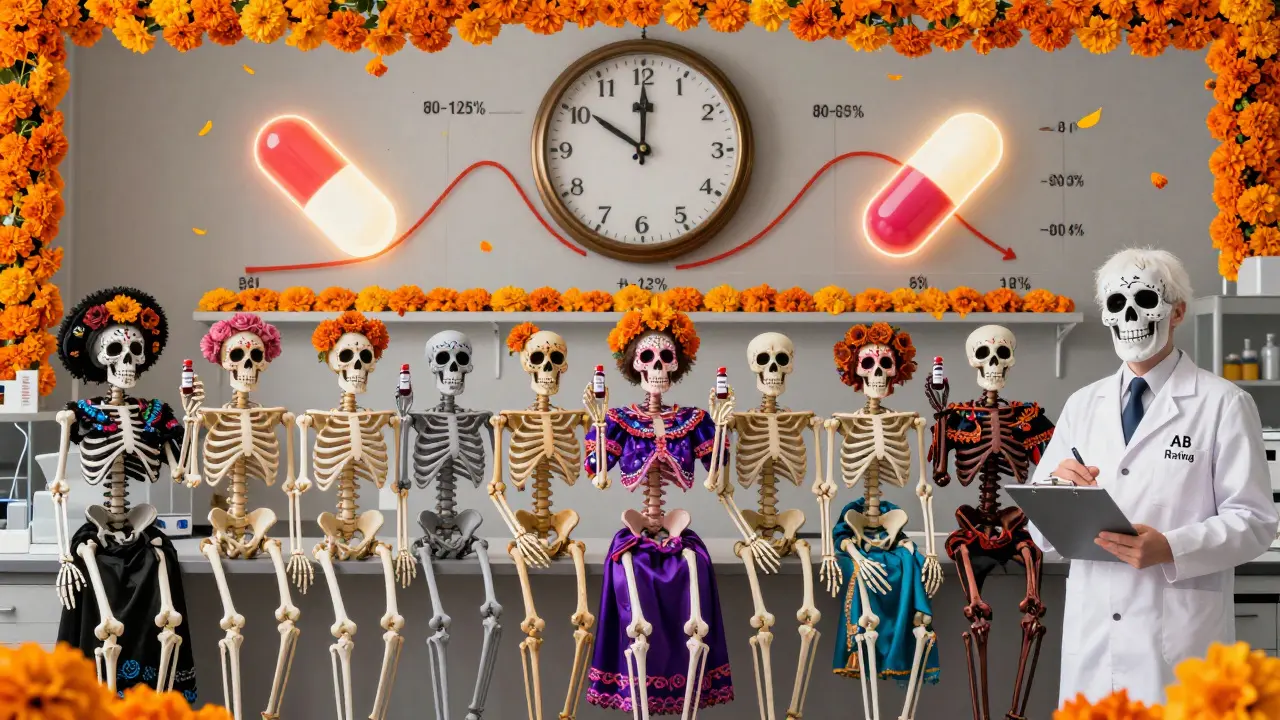
Here’s how it works: in a typical study, 24 to 36 healthy volunteers take both the generic and the brand-name drug-sometimes one first, sometimes the other-under controlled conditions, usually on an empty stomach. Blood samples are drawn over several hours to track how the drug’s concentration changes. Two key numbers are measured:
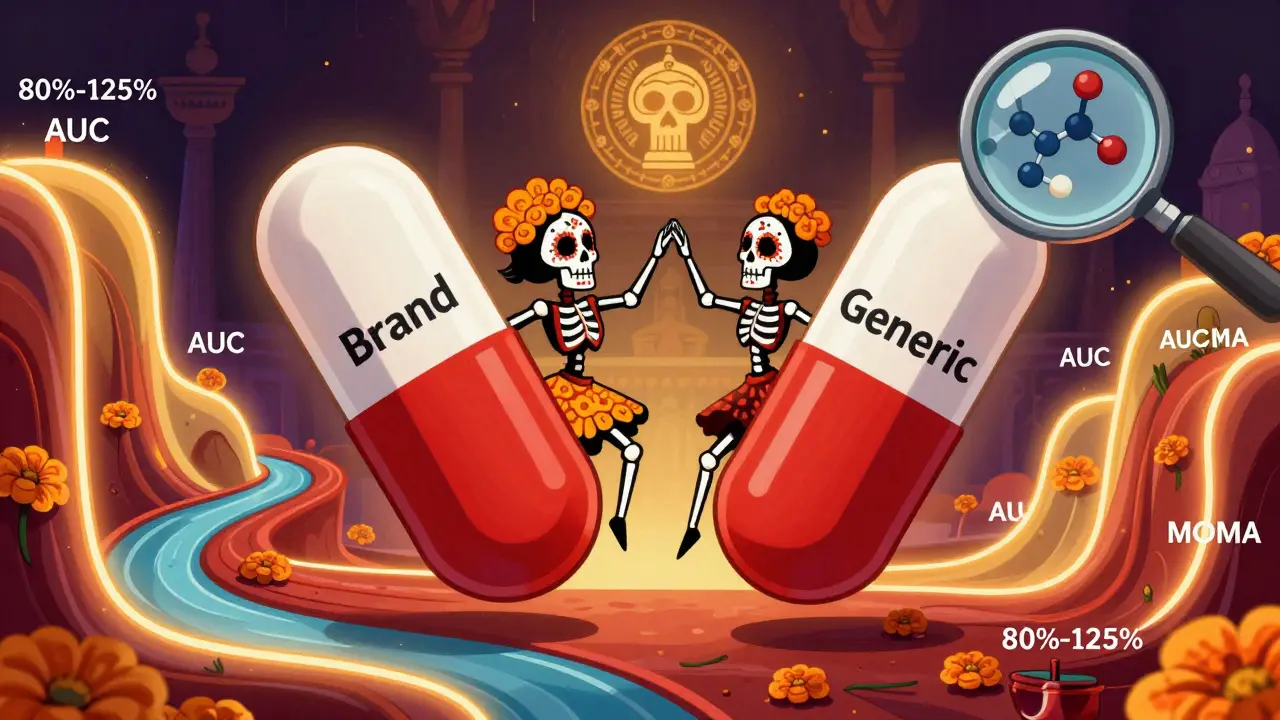
- AUC (Area Under the Curve): This tells you the total amount of drug absorbed over time. Think of it as the total dose your body gets.
- Cmax (Maximum Concentration): This shows how fast the drug gets into your blood. It’s about how quickly you feel the effect.
For the generic to pass, both numbers must fall within 80% to 125% of the brand-name drug’s values. That’s not a wide range-it’s tight. It means if the brand delivers 100 units of drug into your blood, the generic must deliver between 80 and 125 units. That’s the standard for nearly all oral medications.
Why This Matters More Than You Think
Most people assume that if two pills have the same active ingredient, they’re the same. But that’s not enough. A pill with the same chemical name can still behave differently if the inactive ingredients change how it breaks down in your stomach, or if the coating affects how fast it dissolves.
Bioequivalence testing catches those differences. For example, if a generic dissolves too slowly, you might not get enough drug into your system. If it dissolves too fast, you could get a spike that causes side effects. Both scenarios can mean the drug doesn’t work as intended.
That’s why the FDA doesn’t just approve generics based on a label check. They require dissolution testing-where the pill is tested in lab conditions that mimic your stomach-to make sure it breaks down the same way. Then they follow up with real human studies to confirm it works the same inside your body.
What Bioequivalence Doesn’t Prove
It’s important to know what bioequivalence testing does not cover. It doesn’t prove the generic works better for certain populations, like elderly patients or people with kidney disease. Those studies are done for brand-name drugs during development. Generics rely on that data.
It also doesn’t prove identical effects for drugs that act locally-like inhalers, eye drops, or skin creams. For those, measuring blood levels doesn’t tell you much. A steroid cream might absorb differently through skin, or an inhaler might deposit differently in the lungs. For these, the FDA requires different kinds of testing: clinical endpoint studies or pharmacodynamic tests that measure actual effects, not just blood levels.
That’s why some complex generics-like certain asthma inhalers or topical treatments-take longer to approve. The science is harder. The FDA has special guidance for these, and manufacturers must prove equivalence through more than just blood tests.
Real-World Proof: What Patients Experience
Despite myths, most people don’t notice a difference. A 2022 Consumer Reports survey of 1,200 prescription users found that 87% saw no change in effectiveness when switching from brand to generic. Nine percent even said the generic worked better. Only 4% felt it was less effective.
Reddit’s r/pharmacy community had a similar story. In a 2023 thread with over 1,400 comments, 78% of users who shared experiences reported no difference. The few who did notice changes mostly pointed to side effects from inactive ingredients-like a different dye or filler-rather than the drug not working.
Still, 32% of patients in a 2021 study believed generics were weaker. That’s a perception problem, not a science problem. The truth? The FDA approves over 20,000 generic products each year. Nearly 90% of all prescriptions filled in the U.S. are generics. If they didn’t work, the system would collapse.
The Cost and Impact
Bioequivalence testing is the reason generic drugs save the U.S. healthcare system $313 billion a year. Without it, every new generic would need a full clinical trial-costing hundreds of millions and taking years. That’s not feasible. But with bioequivalence, a generic can be approved in about 10 months instead of 10 years.
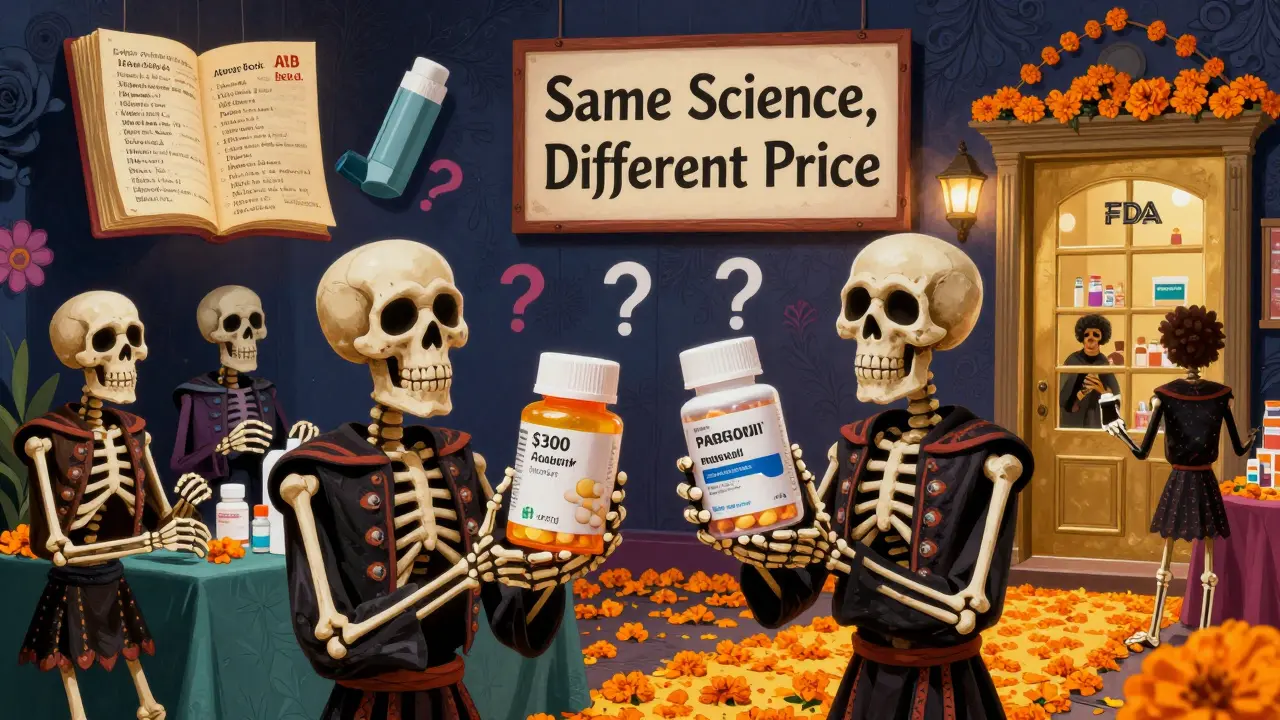
It’s not just about money. It’s about access. When a brand-name drug’s patent expires, multiple companies can make the generic. Competition drives prices down. A drug that costs $300 a month as a brand might drop to $10 as a generic. For chronic conditions like high blood pressure or diabetes, that makes all the difference.
Regulatory Trust and Oversight
The FDA doesn’t just approve generics and walk away. They inspect over 1,200 manufacturing facilities every year-both in the U.S. and overseas. They check that every batch meets strict standards for purity, strength, and stability. If a facility fails, the FDA can block approval or pull existing products.
Their Orange Book lists every approved generic and its therapeutic equivalence rating. If a generic is rated “AB,” it means the FDA has confirmed it’s bioequivalent and interchangeable. You can trust that rating.
Even experts who are cautious about certain drugs-like Dr. Jerry Avorn from Harvard-agree that bioequivalence standards are solid for most medications. The issue isn’t the method. It’s the complexity of some products. And the FDA is adapting. They’re using computer modeling and simulation to predict how drugs behave, especially for inhalers and topical products. This isn’t cutting corners-it’s getting smarter.
What You Can Do
If you’re switching to a generic and feel something’s off-like new side effects or reduced effectiveness-talk to your pharmacist. Sometimes, it’s not the drug. It’s the filler. A different dye or binding agent can cause minor reactions. Your pharmacist can check if the generic has changed manufacturers or if there’s a different version available.
Don’t assume generics are inferior. They’re not. They’re held to the same standards. The only difference is price. And that’s not because they’re weaker. It’s because they don’t need to spend millions on advertising or repeat clinical trials.
When you choose a generic, you’re not taking a risk. You’re using a scientifically validated alternative that’s been tested, inspected, and proven to work just like the brand.
Is bioequivalence testing the same worldwide?
Yes, the core standards are aligned across major regions like the U.S., EU, and Japan through the International Council for Harmonisation (ICH). Most countries require the 80%-125% range for AUC and Cmax. Some, like the EMA, add extra requirements for complex products like extended-release tablets or inhalers, but the foundation is the same.
Can a generic drug be approved without bioequivalence testing?
No. For nearly all oral drugs, bioequivalence testing is mandatory. The only exceptions are for certain complex products-like some inhalers or topical creams-where alternative testing methods are used. But even then, there’s still a requirement to prove equivalence, just not through blood tests.
Why do generics look different than brand-name drugs?
By law, generics can’t look exactly like the brand-name drug. They must differ in color, shape, or markings to avoid trademark infringement. But the active ingredient, strength, and dosage form must be identical. The differences are only cosmetic-nothing about how the drug works.
Are all generics the same as each other?
Each generic must meet the same bioequivalence standard as the brand, but different manufacturers may produce slightly different versions. That’s why you might notice a change if you switch from one generic to another. It’s rare, but if you feel a difference, ask your pharmacist to stick with the same manufacturer.
Do bioequivalence studies include people with the condition the drug treats?
No. Most bioequivalence studies use healthy volunteers because they provide cleaner, more consistent data. The safety and effectiveness of the drug for the actual condition were already proven in the original brand-name trials. The generic just needs to show it behaves the same way in the body.
Diane Croft
March 4, 2026 AT 01:25Generic drugs are one of the few things in healthcare that actually deliver on their promise. No fluff, no marketing hype-just science that saves lives and money.
Donna Zurick
March 5, 2026 AT 08:43I’ve been on generics for a decade. Never had an issue. The panic some people feel is pure psychology, not pharmacology.
Tobias Mösl
March 5, 2026 AT 21:17Let’s be real-the FDA is pressured by Big Pharma to approve generics too fast. I’ve seen batches that dissolved unevenly. The system is rigged. You think they test every batch? Ha. They sample. One out of every 500. That’s not oversight-that’s negligence.
tatiana verdesoto
March 7, 2026 AT 05:56My aunt switched from brand-name Lipitor to generic and said she felt better. No side effects. Her cholesterol dropped further. Sometimes the placebo effect goes both ways.
Ethan Zeeb
March 9, 2026 AT 02:36It’s not about whether generics work. It’s about who benefits. Corporations profit. Patients save. But the real win? The system that lets this happen without collapsing. That’s the miracle.
Darren Torpey
March 9, 2026 AT 08:29Generics are the unsung heroes of modern medicine. They’re the quiet warriors in white pills, doing the heavy lifting so millions can afford to live. No parades, no headlines-just results.
Deborah Dennis
March 10, 2026 AT 09:07Wait. So you’re telling me, after all these years, I didn’t need to pay $200 for my blood pressure med? That’s insane. And the fact that I didn’t notice a difference? That’s the whole point. I feel tricked. In a good way. But still. Trickery.
Mariah Carle
March 11, 2026 AT 02:28It’s funny how we trust a pill more when it costs less. The universe doesn’t work that way. Or does it? Maybe value is an illusion. Maybe the placebo is the only real thing. And if the placebo works… is it still a placebo?
Megan Nayak
March 11, 2026 AT 19:4980%-125%? That’s not tight. That’s a loophole. What if your body absorbs 81%? What if the brand is 124%? That’s a 43% swing in real-world effect. They call that science? I call it gambling with your health.
Pankaj Gupta
March 13, 2026 AT 07:58As someone from India, where generics are the backbone of healthcare, I can say this: the system works. Millions rely on it daily. The standards are not perfect, but they are rigorous. And yes, the ICH alignment is real.
Renee Jackson
March 13, 2026 AT 15:08It is imperative to recognize that the bioequivalence framework is not merely a regulatory mechanism-it is a foundational pillar of equitable pharmaceutical access. The data supporting this model is robust, peer-reviewed, and internationally validated.
Jane Ryan Ryder
March 13, 2026 AT 20:26So you’re telling me the same drug that costs $300 is now $10? Yeah right. Someone’s getting rich off this. Probably the same people who made the brand. Generics are just a shell game with more labels.
Callum Duffy
March 15, 2026 AT 14:27The regulatory rigor applied to generics is often underestimated. The requirement for dissolution profiling, bioavailability testing, and facility inspections is far more comprehensive than many assume. This is not a backdoor approval.
Levi Viloria
March 16, 2026 AT 19:38My pharmacist switched me to a different generic last month. I felt weird for a few days. Turns out, the filler was different. Didn’t affect the drug-just gave me a rash. Talked to my doc. Switched back. Point is: it’s not the drug. It’s the extras. Always ask your pharmacist.
Tobias Mösl
March 16, 2026 AT 22:22You think the FDA inspects every batch? They inspect the paperwork. The factory in China? They get a 2-hour visit every 3 years. I’ve seen the reports. They’re jokes. If you want real safety, stick with brand. Pay the extra. You’re not being paranoid-you’re being smart.