When to Avoid a Medication Family After a Severe Drug Reaction
 Feb, 25 2026
When you’ve had a severe drug reaction, your body isn’t just saying "no" to one pill-it might be warning you to stay away from an entire family of medications. But not every bad reaction means you need to avoid everything in that class. The difference between a harmless rash and a life-threatening response can mean the difference between safe treatment and unnecessary risk. Knowing when to avoid a whole medication family-and when you might still be able to use a similar drug-isn’t just medical advice. It’s about protecting your health without cutting off options you might still safely use.
What Counts as a Severe Drug Reaction?
Not every side effect is a reason to avoid an entire drug family. A severe reaction is one that threatens your life, sends you to the hospital, or leaves you with lasting damage. The FDA defines it as any reaction that causes: life-threatening symptoms, hospitalization, permanent disability, or birth defects. Common examples include anaphylaxis (a sudden drop in blood pressure, swelling, trouble breathing), Stevens-Johnson syndrome (SJS), toxic epidermal necrolysis (TEN), and DRESS (drug reaction with eosinophilia and systemic symptoms). These aren’t just rashes or stomach upset. They’re immune system overreactions that can destroy skin, organs, or even stop your heart.For example, TEN has a 30-50% death rate. If you’ve had it after taking a drug like sulfamethoxazole (Bactrim) or carbamazepine (Tegretol), you’ll likely need to avoid the entire class forever. But if you got a mild, itchy rash after amoxicillin and didn’t need hospital care? That’s not the same. Most rashes aren’t allergic-they’re just side effects.
True Allergy vs. Side Effect: The Key Difference
Many people think they’re allergic to penicillin because they got a rash as a kid. But research shows 95% of those labeled "penicillin allergic" aren’t truly allergic at all. True allergies involve the immune system releasing IgE antibodies, causing symptoms within minutes to hours: hives, swelling of the throat, wheezing, or a sudden drop in blood pressure. These reactions can be deadly. That’s why doctors recommend epinephrine auto-injectors and medical alert bracelets for true anaphylaxis.On the other hand, 80-90% of reported drug reactions are non-allergic. These are predictable side effects based on how the drug works in your body. For example, NSAIDs like ibuprofen can cause stomach bleeding because they block protective enzymes. That’s not an allergy-it’s a pharmacological effect. Switching from ibuprofen to naproxen might still cause bleeding. But switching to a COX-2 inhibitor like celecoxib might not.
Here’s the catch: if your reaction was immune-based, you need to avoid the whole family. If it was just a side effect, you might be able to try a different drug in the same class-or even a different class altogether.
Drug Families With High Cross-Reactivity Risk
Some drug families are notorious for cross-reactions. Avoiding the whole group isn’t just cautious-it’s often necessary.- Beta-lactam antibiotics (penicillins, cephalosporins, carbapenems): Cross-reactivity between penicillin and cephalosporins is low-only 0.5-6.5%. But if you had anaphylaxis to amoxicillin, avoid all beta-lactams until tested. New skin and blood tests can now confirm whether you’re truly allergic.
- Sulfonamide antibiotics (Bactrim, Septra): These are linked to SJS and TEN. If you had one of those reactions, avoid all sulfa antibiotics. But note: sulfa drugs for diabetes (like glimepiride) or diuretics (like furosemide) don’t cross-react. The allergic trigger is specific to the antibiotic structure.
- NSAIDs (ibuprofen, aspirin, naproxen): Cross-reactivity is common in people with aspirin-exacerbated respiratory disease (AERD). If you get nasal polyps, asthma attacks, or facial swelling after aspirin, avoid all NSAIDs. But COX-2 inhibitors like celecoxib may be safe.
- Anticonvulsants (carbamazepine, phenytoin, lamotrigine): These are responsible for 24% of TEN cases. If you had SJS or DRESS from one, avoid the entire class. Genetic testing for HLA-B*15:02 (in Asian populations) can predict risk before even taking the drug.
- Allopurinol: This gout drug causes 17% of TEN cases. If you reacted severely, avoid it forever. There’s no safe alternative in the same class.
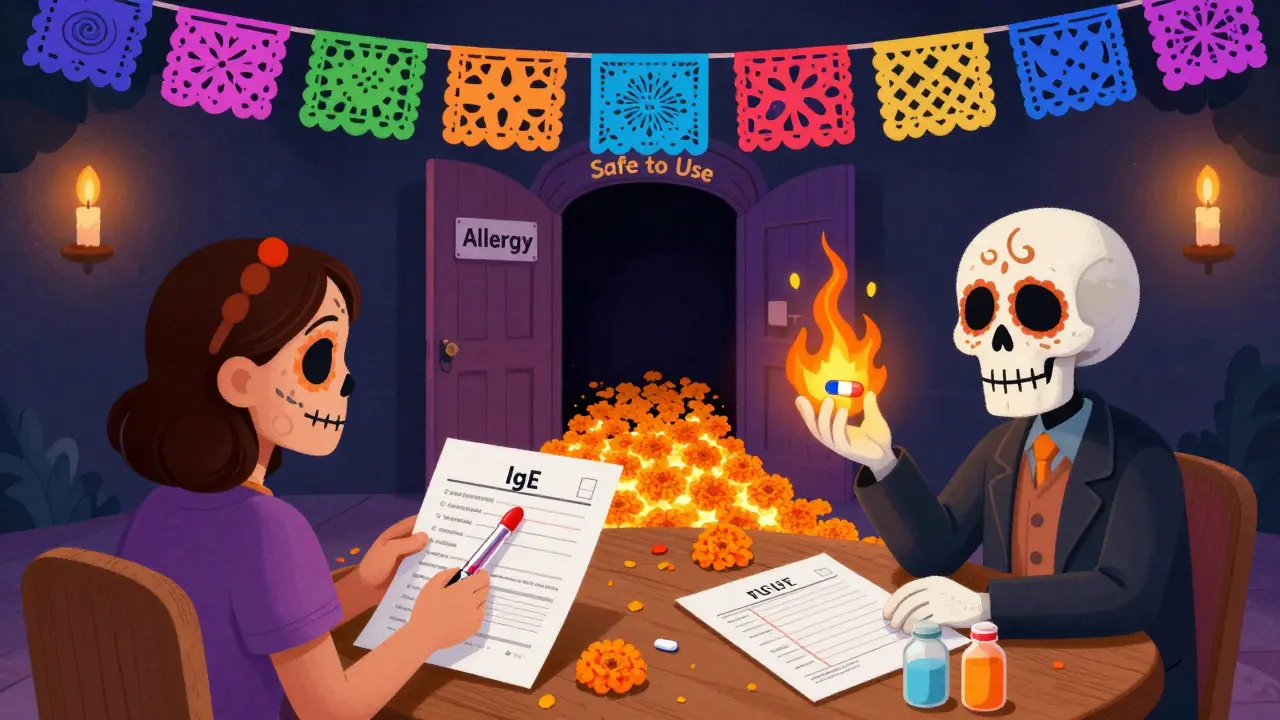
When You Might Not Need to Avoid the Whole Family
Not every reaction means permanent avoidance. Many patients are wrongly labeled allergic because their symptoms were misunderstood.For example, a maculopapular rash (flat, red spots) after amoxicillin is common in kids with mononucleosis. It’s not an allergy-it’s a viral interaction. Avoiding all penicillins for life based on that is unnecessary. Same with nausea or dizziness from statins. If you had muscle pain on one statin, you might tolerate another. Studies show only 10-15% of people cross-react between statins.
Even with antibiotics, you might not need to avoid the whole class. A 2022 study in the Journal of Allergy and Clinical Immunology found that 70-85% of patients who underwent supervised drug challenges (taking small doses under medical watch) could safely take penicillin or amoxicillin again-even if they’d been labeled allergic for 20 years.
That’s why allergy testing matters. Skin tests, blood tests for IgE, and oral challenges are now more accurate than ever. The FDA-approved ImmunoCap Specific IgE test has improved accuracy from 60% to 89%. Genetic markers like HLA-B*57:01 can tell you if you’re at risk for abacavir hypersensitivity before you even take the drug.
The Danger of Over-Avoidance
Avoiding entire drug families without proof can be just as dangerous as ignoring a real allergy.When doctors avoid penicillin because of an old rash, they often prescribe broader-spectrum antibiotics like vancomycin or clindamycin. These are more expensive, harder on the gut, and increase the risk of C. diff infections. A 2022 survey by the Asthma and Allergy Foundation of America found that 42% of patients with drug allergy labels faced treatment delays-averaging 3.2 days longer than those without labels. In emergency situations, that delay can cost lives.
One patient on Drugs.com described being denied antibiotics for a UTI because she had SJS from Bactrim years ago-even though her infection required a sulfa drug. She ended up in the ER because no one knew how to safely treat her. That’s the cost of blanket avoidance.
On the flip side, a woman on HealthUnlocked shared that after skin testing confirmed she wasn’t allergic to penicillin, she took amoxicillin for a sinus infection for the first time in 20 years-and had no reaction. Her doctors had been avoiding it out of caution. She didn’t need to.

What You Should Do After a Severe Reaction
If you’ve had a severe reaction, don’t just accept the label. Take action:- Document the reaction: Write down exactly what happened-what drug, when, symptoms, how long it lasted, treatment needed. Was it hives? Swelling? Blistering skin? Fever? Hospitalization? Details matter.
- Ask for allergy testing: If it was anaphylaxis, hives, or SJS/TEN, ask your doctor about skin or blood testing. Many hospitals now offer penicillin allergy clinics.
- Request a drug challenge: If your reaction was mild or unclear, ask if a supervised challenge is possible. This is the gold standard for confirming whether you’re truly allergic.
- Update your records: If testing shows you’re not allergic, ask your doctor to remove the allergy label from your medical chart. Many EHRs still carry outdated labels.
- Consider a medical alert: If you truly have a life-threatening allergy, wear a bracelet or carry a card. It could save your life in an emergency.
The Future: Precision Avoidance
The old way-"avoid everything in the class"-is fading. We’re moving toward precision medicine. Genetic testing, component-resolved diagnostics, and AI tools like IBM Watson for Drug Safety are helping doctors predict who’s at risk before they even take a drug.In 2023, 87% of academic medical centers in the U.S. had formal penicillin allergy de-labeling programs. That means they’re actively removing false labels, not adding more. The goal? Reduce unnecessary avoidance by 50% by 2025, as outlined in the National Action Plan for Adverse Drug Event Prevention.
What does this mean for you? You don’t have to live with a label that might not be true. If you’ve had a severe reaction, get evaluated. Don’t assume you’re allergic forever. With the right testing, you might find you’re safer than you thought.
If I had a rash after taking penicillin as a child, do I need to avoid all antibiotics forever?
Not necessarily. Most childhood rashes after amoxicillin are not true allergies-they’re often caused by viruses like Epstein-Barr. Studies show 95% of people labeled "penicillin allergic" can safely take penicillin after proper testing. Skin tests or oral challenges under medical supervision can confirm whether you’re truly allergic. Many people are unnecessarily avoiding penicillin and its family, which leads to the use of less effective or more risky antibiotics.
Can I take a different drug in the same family after a severe reaction?
Sometimes, yes-but only if the reaction wasn’t immune-mediated. For example, if you had stomach bleeding from ibuprofen, switching to a COX-2 inhibitor like celecoxib might be safe. But if you had anaphylaxis to one beta-lactam antibiotic, avoid the whole class until tested. For severe skin reactions like SJS or TEN, avoid the entire class permanently. Cross-reactivity depends on the mechanism, not just the class name.
Are all sulfa drugs dangerous if I had a reaction to Bactrim?
No. Only sulfa antibiotics (like Bactrim or Septra) are linked to severe reactions like SJS. Other sulfa-containing drugs-such as diabetes medications (glimepiride) or diuretics (furosemide)-have a different chemical structure and don’t cross-react. If you had a severe reaction to Bactrim, avoid only the antibiotic class. Always confirm with your doctor before taking any sulfa drug.
Is it safe to try a drug again after avoiding it for years?
Yes, under medical supervision. Drug challenges-where you take small, controlled doses of a drug you once reacted to-are now routine in allergy clinics. Success rates are 70-85% for penicillin and cephalosporins in patients with low-risk histories. Many people who avoided drugs for decades find they can safely take them again. This is especially important for people with limited treatment options.
How do I get my drug allergy label removed from my medical records?
After testing confirms you’re not allergic, ask your allergist or primary doctor to update your electronic health record (EHR). Provide them with the test results and a written note. Many EHR systems automatically flag allergy alerts, so the label may persist unless manually removed. Don’t assume it’s gone-you need to actively request the change. Removing false labels reduces unnecessary treatment delays and improves future care.
Anil bhardwaj
February 26, 2026 AT 15:55Been there. Got the rash after amoxicillin at 12. Got labeled "allergic" and spent 15 years avoiding all antibiotics. Turned out it was mono. Got tested last year. Took penicillin like it was water. No drama. Just a stupid label that nearly got me hospitalized with a UTI because docs wouldn't touch a sulfa drug. Glad I pushed back.
lela izzani
February 26, 2026 AT 17:33So important to clarify the difference between true IgE-mediated reactions and side effects. I work in pharmacy and see this all the time. Patients panic and refuse all NSAIDs because they got stomach upset from ibuprofen. But switching to celecoxib? Often totally fine. The key is understanding mechanism, not just the class name. Doctors need better tools to explain this.
Stephen Archbold
February 28, 2026 AT 09:20man i just had a friend who got SJS from carbamazepine and now she cant take ANY anticonvulsant. even gabapentin. but like?? the chem structure is totally different. i think the medical system is still stuck in the 90s. we got genetic testing now. why are we still playing russian roulette with meds? also i got a rash from penicillin in 2003 and they still have it in my chart. i asked to get it removed 3 years ago. they said "we'll get to it". we'll never get to it.
Nerina Devi
March 1, 2026 AT 11:08As someone from India where penicillin allergies are wildly overdiagnosed, this is so needed. My cousin was told to avoid all beta-lactams after a mild rash during a fever. Later, she got a severe pneumonia and had to be put on vancomycin. Cost? 10x more. Side effects? Severe diarrhea. If they'd just done a simple skin test, she could've been on amoxicillin in 24 hours. We need more allergy clinics here. It's not just about safety-it's about access.
Dinesh Dawn
March 3, 2026 AT 01:51My dad had a reaction to sulfa antibiotics in the 80s. They told him never again. Fast forward to 2020-he got a bad UTI. No one would give him a sulfa drug. He ended up with a kidney infection. Turned out he never had an allergy. Just a bad rash from a virus. Now he’s got a letter from his allergist saying he’s cleared. Took 40 years. We need better systems.
Nick Hamby
March 4, 2026 AT 15:18There is a profound epistemological tension here: the medical establishment, built on the principle of precautionary avoidance, often conflates correlation with causation in adverse drug events. The consequence is a cascade of therapeutic deprivation. We must recalibrate our epistemic humility: just because a drug preceded a reaction does not mean it caused it. The burden of proof must shift from the patient to the system. Testing is not optional-it is the ethical imperative of modern pharmacotherapy.
kirti juneja
March 4, 2026 AT 21:24Y’all act like drug allergies are some kind of permanent tattoo on your soul. Nah. They’re more like a typo in your Google Doc. You don’t keep the typo just because it was there once. You edit it. Test it. Fix it. I had a "penicillin allergy" since I was 5. Got tested at 32. Zero reaction. Took amoxicillin for a sinus infection. Felt like a rebel. Life’s too short to be scared of your own medical chart.
Haley Gumm
March 4, 2026 AT 22:06Let’s be real-most of these "allergies" are just people who got sick at the same time they took a pill. Blame the pill. Easy. But if you actually had anaphylaxis, yeah, avoid it. But 90% of people? You’re not allergic. You just got unlucky. Stop letting your doctor’s laziness define your treatment options.
Gabrielle Conroy
March 6, 2026 AT 09:21This is SO important!! 💯 I had a rash after amoxicillin as a kid-was told "never again"-until I got a UTI at 28 and couldn’t get treated for 3 days because everyone was scared. I finally went to an allergist, got tested, and BAM-no allergy! Now I take penicillin like it’s candy 🍬 and I feel so much more empowered. Please, if you think you’re allergic, get tested!! It changes everything!!
Spenser Bickett
March 6, 2026 AT 18:57Oh wow. So now we’re trusting "science" again? I thought we were past that. I mean, if your body says "NO" to a drug, why would you test it? That’s like asking a dog if it still hates the vacuum after 10 years. It remembers. It’s trauma. Also, who funds these "testing" programs? Big Pharma? Just saying.
Christopher Wiedenhaupt
March 7, 2026 AT 10:19There is a documented increase in Clostridioides difficile infections associated with the avoidance of narrow-spectrum antibiotics due to mislabeled penicillin allergies. This is a well-established public health concern. The 2022 study referenced in the article demonstrates a statistically significant reduction in treatment delays when allergy labels are de-identified. The clinical implications are not trivial.
John Smith
March 8, 2026 AT 20:51So what you're saying is we should just trust doctors again? After everything? After the opioid crisis? After the vaccine lies? After every drug ever sold? Nah. I'll stick with my gut. If it made me itch once, it's poison. Period. End of story. Science is a cult. I'm not signing up.
Natanya Green
March 9, 2026 AT 04:34OMG I had the exact same thing!! I got a rash on amoxicillin at 7 and now I’m 40 and they STILL won’t give me anything for my ear infection!! I cried in the ER. I had to beg them to let me do a challenge. I got through it. No reaction. I’m alive. And now I have a new tattoo on my arm that says "I’m not allergic to penicillin"!!
Sanjaykumar Rabari
March 9, 2026 AT 22:03They want you to get tested so they can put you on something else. That’s how they control you. The real cure is avoiding all chemicals. Just eat garlic and turmeric. Your body knows what to do. The system wants you dependent. Don’t fall for it.
Kenzie Goode
March 11, 2026 AT 21:15I just want to say thank you for writing this. I’ve been terrified of antibiotics for 20 years because of a childhood rash. I didn’t know I could get tested. I’m booking an appointment tomorrow. I feel like I’ve been carrying a weight I didn’t even know I had. This article? It’s a gift.