Switching Pharmacies: What Information You Need to Provide for Prescription Transfers
 Jan, 26 2026
Prescription Transfer Eligibility Checker
Check Your Prescription Transfer Eligibility
This tool helps you determine if your prescription can be transferred between pharmacies based on DEA scheduling rules and current regulations.
Switching pharmacies sounds simple-just walk in, hand over your pills, and done. But if you’re taking controlled substances, like painkillers, anxiety meds, or ADHD medications, it’s not that easy. Federal rules changed in August 2023, and now how you transfer prescriptions depends entirely on what kind of drug you’re taking. Get it wrong, and your medication could be delayed for days-or denied entirely.
What You Must Give the New Pharmacy
No matter what medication you’re switching, you’ll always need to give the new pharmacy your full legal name, date of birth, and current address. That’s non-negotiable. Pharmacists use this to match your record and avoid dangerous mix-ups. But beyond that, what you provide next depends on whether your drug is controlled or not.For non-controlled prescriptions-like blood pressure pills, antidepressants, or antibiotics-you just need the name of the medication, the dosage, your prescriber’s name, and how many refills are left. Most pharmacies can pull this up electronically from your old pharmacy in under an hour. If your old pharmacy uses an electronic system (and 87% of U.S. pharmacies do), they’ll send it directly. You might not even need to call.
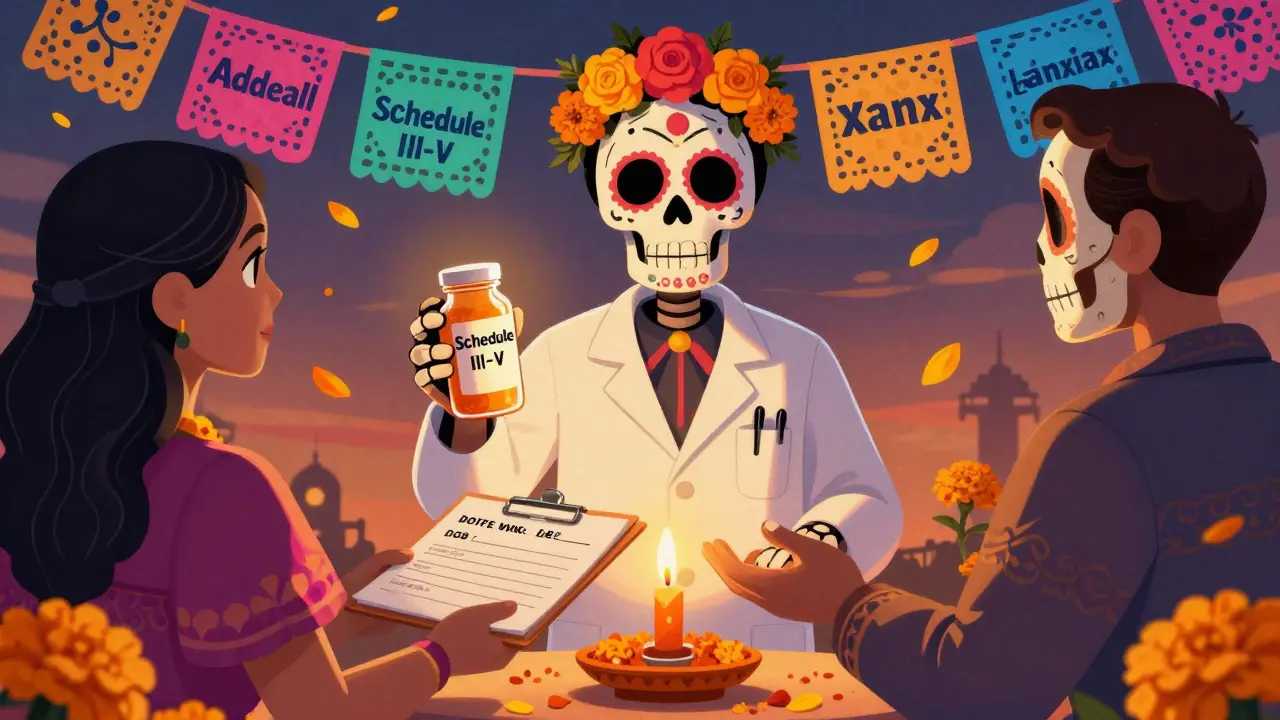
But if you’re taking a Schedule III, IV, or V controlled substance-think oxycodone (low dose), hydrocodone, Adderall, Xanax, or Tramadol-the rules get strict. You can only transfer that prescription once. That’s it. After that, if you want to switch again, you’ll need a new prescription from your doctor. This rule applies per prescription, not per patient. So you can transfer your Adderall to Pharmacy A and your Xanax to Pharmacy B, but you can’t move your Adderall from Pharmacy A to Pharmacy B after the first transfer.
What You Can’t Transfer
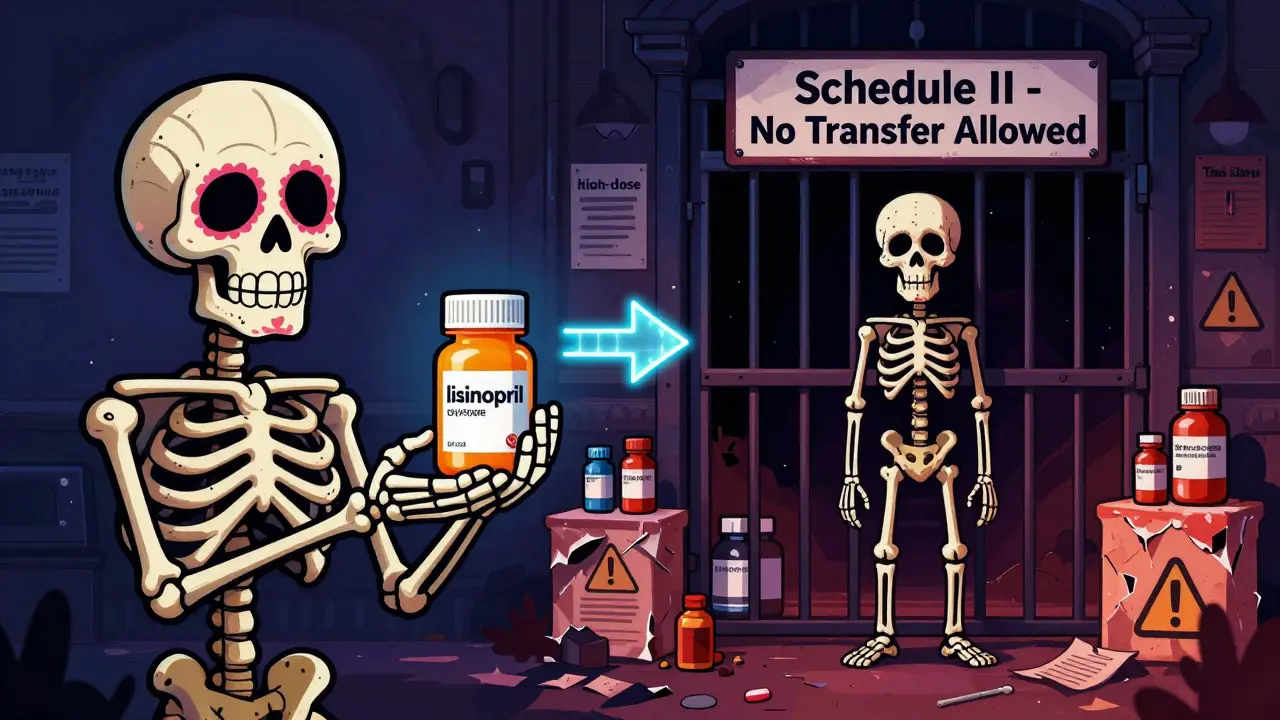
Schedule II drugs-like high-dose oxycodone, fentanyl, or methadone-can’t be transferred at all. Ever. If you’re on one of these, you must go back to your doctor, get a new prescription, and bring it to your new pharmacy. No exceptions. Even if your old pharmacy has refills left, the DEA doesn’t allow electronic transfers for these drugs. It’s a safety rule designed to prevent diversion and misuse.And if your prescription has no refills left? You’re out of luck. You can’t transfer an empty script. You need to contact your prescriber for a new one, even if it’s just a non-controlled medication like metformin or lisinopril. The pharmacy can’t refill or transfer a script that’s already used up.
How the Transfer Actually Happens
You don’t need to physically go to your old pharmacy. You just give your new pharmacy the name of your old one, your prescription number (if you have it), and your insurance info. The new pharmacy will call or electronically send a request to the old one.Here’s what happens behind the scenes: The pharmacist at your old pharmacy must mark the original prescription as “VOID” in their system. They also have to send the full transfer record-including the date, the name and DEA number of the pharmacist who sent it, the name and address of the receiving pharmacy, and the original prescription number. All of this has to be done electronically, even if they use fax or phone to communicate. The prescription itself can’t be printed, altered, or re-entered by hand.
The new pharmacy then adds “TRANSFER” to the label, writes down the original pharmacy’s info, and logs their own name and DEA number. Both pharmacies must keep this record for at least two years. Some states require longer-like five years in California or New York-so don’t assume the rules are the same everywhere.
Why Transfers Get Delayed or Denied
Most people think the delay is because the pharmacy is slow. But more often, it’s because something’s missing. Common reasons transfers get stuck:- The old pharmacy didn’t include the transferring pharmacist’s full name or DEA number.
- The prescription number was wrong or missing.
- The patient gave the wrong name or date of birth.
- The prescription was for a Schedule II drug.
- The prescription had no refills left.
- The old pharmacy doesn’t use an electronic system (rare, but happens in rural areas).
According to a 2023 Consumer Reports survey, 42% of transfer problems involved controlled substances. Another 31% were due to missing or incorrect prescription details. If your transfer gets denied, ask for the reason in writing. Pharmacies are legally required to explain why.
State Laws Can Block You
Federal rules set the baseline, but states can add more restrictions. For example:- Some states don’t allow transfers between pharmacies that aren’t under the same corporate ownership-even if they’re both CVS or Walgreens.
- Others require written consent from the patient before any controlled substance transfer.
- A few states still require a paper copy to be mailed, even if both pharmacies use electronic systems.
There’s no national database of these rules. The DEA says transfers must be “allowed under existing state or other applicable law,” which means you might hit a wall even if everything else is perfect. If you’re moving across state lines, call your new pharmacy first and ask: “Do you accept transfers of Schedule III-V controlled substances from out-of-state pharmacies?”
What to Do Before You Switch
Don’t wait until your last pill is gone. Here’s how to make this go smoothly:- Check your medication’s schedule. Look at the bottle. Schedule II? You’ll need a new script. Schedule III-V? You get one transfer.
- Call your new pharmacy. Ask if they participate in electronic transfers. Confirm they can handle your drug type.
- Have your prescription number ready. It’s on the label.
- Know your prescriber’s name and phone number. If something goes wrong, they may need to be contacted.
- Don’t assume your old pharmacy will notify your new one. You have to initiate the transfer.
- If you’re transferring multiple prescriptions, do them one at a time. Controlled substance transfers take 24-48 hours each.
What’s Changing in the Future
The DEA’s 2023 rule was the first major update to prescription transfer rules since 2007. They’re collecting data now and will review the system in 2024. Industry experts think the one-time transfer limit for controlled substances might be lifted by 2026 or 2027, especially since 92% of these prescriptions are already electronic.Right now, big chains like CVS, Walgreens, and Rite Aid updated their systems by August 2023. But 37% of independent pharmacies still needed extra time to get compliant. If you’re switching to a small, local pharmacy, ask if they’ve updated their software. If they haven’t, they might not be able to transfer your controlled meds at all.
Bottom Line
Switching pharmacies isn’t about convenience-it’s about compliance. For non-controlled meds, it’s quick and easy. For controlled substances, it’s a one-time shot with strict documentation rules. If you’re on opioids, stimulants, or benzodiazepines, plan ahead. Don’t wait until you’re out. Call your new pharmacy before you run out. Keep your prescription number handy. Know your drug’s schedule. And if something goes wrong, ask for a written explanation. You’re not being difficult-you’re following the law.Can I transfer a prescription for Adderall to a new pharmacy?
Yes, but only once. Adderall is a Schedule II controlled substance, so you cannot transfer it electronically under current DEA rules. You must get a new prescription from your doctor to fill at your new pharmacy. If you’re taking a lower-dose stimulant classified as Schedule III (like Vyvanse), you can transfer it once, but only if it’s still refillable.
How long does a prescription transfer take?
For non-controlled medications, it usually takes less than 24 hours. For controlled substances, it can take 24 to 48 hours because of extra verification steps. If the pharmacies use different systems or if paperwork is incomplete, it can take up to 3 business days. Calling your new pharmacy and giving them all details upfront speeds it up.
Can I transfer a prescription if it has no refills left?
No. Pharmacies cannot transfer or refill a prescription that has used up all its refills. You must contact your prescriber for a new prescription, whether it’s for insulin, blood pressure pills, or Adderall. The DEA does not allow transfers of expired or fully used scripts.
Why did my pharmacy refuse to transfer my Xanax?
Xanax is a Schedule IV controlled substance, so it can be transferred once-but only if the original pharmacy properly documented the transfer and your new pharmacy is set up to receive it. Common reasons for refusal: missing DEA numbers, incorrect patient info, or state laws that restrict transfers between independent pharmacies. Ask the pharmacy for the specific reason in writing.
Do I need to tell my doctor I’m switching pharmacies?
You don’t have to, but it’s a good idea. Your doctor may need to send a new prescription if your transfer fails, especially for Schedule II drugs. Also, if you’re on long-term controlled medications, your doctor might need to update your records or monitor your refill patterns. It’s not required by law, but it helps avoid gaps in care.
Can I transfer prescriptions between two CVS locations?
Yes, but only if they’re treated as separate pharmacies under DEA rules. Even if both are CVS, if they have different DEA registration numbers, the one-time transfer rule still applies. You can’t move a Schedule III-V prescription from one CVS to another CVS if it’s already been transferred once. The DEA’s rule applies per prescription, not per chain.
What if my new pharmacy doesn’t have my old pharmacy’s info?
Give them the name, address, and phone number of your old pharmacy. If you don’t have it, check your old prescription label or log into your patient portal. Most pharmacies can look up the old pharmacy using your insurance ID or name. If they still can’t find it, you may need to call your old pharmacy directly and ask them to send the transfer request.
Candice Hartley
January 27, 2026 AT 07:51Just transferred my Xanax last week - took 36 hours because the old pharmacy forgot to include the DEA number. So frustrating. Always double-check that stuff.
April Williams
January 27, 2026 AT 08:08Ugh. I hate how pharmacies treat us like criminals just because we need real medicine. You’d think we were trying to sell coke on the street. This whole system is broken and punitive.
Harry Henderson
January 27, 2026 AT 14:04Stop complaining. If you’re on Adderall or Xanax, you signed up for this. These rules exist because people abuse them. I’ve seen friends OD from diverted scripts. This isn’t about punishment - it’s about saving lives.
suhail ahmed
January 27, 2026 AT 14:24As someone who moved from Mumbai to Chicago last year, let me tell you - this system is wild. Back home, you just walk in with a bottle and a scrip. Here? You need a passport, a notarized letter, and a blood sample. But honestly? I get it. The opioid crisis is real. Still, the bureaucracy makes you feel like a suspect.
Paul Taylor
January 28, 2026 AT 09:20Let me break this down real simple because I’ve seen too many people get burned by this. Non-controlled meds? Easy. Electronic transfer. Done in under an hour. Controlled? Schedule III to V? One shot. That’s it. No do-overs. Schedule II? Forget it. You need a new script. Period. And if your script is out of refills? You’re not getting it transferred. You’re not getting it at all. You have to go back to your doctor. No exceptions. No magic. No loopholes. Just paperwork. And if your pharmacy hasn’t updated their software since 2020? They can’t do it. Call them first. Don’t wait until you’re out. I’ve had patients show up at 11pm crying because they’re out of Adderall and the pharmacy says ‘we can’t transfer it.’ I had to tell them to drive to the ER at 2am because their doctor was on vacation. Don’t be that person. Plan ahead. Write it down. Save your prescription number. It’s on the damn label. It’s not that hard.
Kegan Powell
January 29, 2026 AT 02:39It’s wild how we treat medicine like contraband. We’ve got algorithms tracking every pill, pharmacists double-checking every transfer, and yet people still find ways to abuse the system. But here’s the thing - most of us aren’t trying to get high. We’re trying to function. To work. To be parents. To not spiral into panic attacks or crippling pain. The system isn’t perfect but it’s trying. I wish it was smoother. I wish we trusted patients more. But I also know what happens when you remove the guardrails. So I’m stuck in the middle. Grateful for the safety. Angry at the friction.
John O'Brien
January 29, 2026 AT 18:17My buddy got denied because his old pharmacy used fax. Like wtf? We’re in 2024. Still faxing? That’s why it takes 3 days. If your pharmacy still uses paper, switch. Simple.
astrid cook
January 30, 2026 AT 04:34People don’t realize how easy it is to fake a prescription transfer. I’ve seen it. That’s why they make it so hard. You think this is about inconvenience? No. It’s about stopping addicts from playing pharmacy hopscotch. You want to move? Fine. But don’t act like you’re being persecuted.
Kathy McDaniel
January 30, 2026 AT 17:20i just transferred my metformin and it took 20 mins. so easy. why is everyone making this sound like a heist? lol
Patrick Merrell
January 31, 2026 AT 01:05Irish here. We don’t have this mess. You get a script, you take it to any pharmacy. No transfers, no DEA numbers, no limits. We just trust people. Guess what? We have less abuse than you do. Maybe your system is the problem, not the patients.
Conor Flannelly
February 1, 2026 AT 04:51There’s a quiet dignity in how the U.S. handles this. It’s not pretty. It’s not fast. But it’s deliberate. Every DEA number logged, every voided script, every transfer record - it’s a chain of accountability. I’ve worked in pharmacies in three countries. This is the most secure. It’s not about suspicion. It’s about responsibility. The system knows how much damage a single pill can do. And it’s trying to protect everyone - even the ones who don’t know they need protecting.
Conor Murphy
February 2, 2026 AT 22:17I’ve been a pharmacist for 18 years. I’ve seen people cry because they couldn’t get their meds. I’ve also seen people lie, steal, and manipulate. This rule? It’s not for the patients. It’s for the ones who would hurt them. The one-time transfer rule? It stops the ‘pharmacy hopper’ - the person who goes from one to the next, milking refills. I don’t like it. But I defend it. Because I’ve held someone’s hand while they overdosed. And I won’t let that happen again.
Desaundrea Morton-Pusey
February 2, 2026 AT 23:41Why do we even let foreigners tell us how to run our healthcare? Ireland? Please. They don’t even have enough doctors. You think their system works? It’s just chaos with better tea.
Andrew Clausen
February 3, 2026 AT 13:37Correction: Adderall is Schedule II, not III. The post got it wrong in the FAQ section. You cannot transfer Adderall at all. Ever. Not once. The article says you can transfer Schedule III-V - correct. But then the FAQ says Adderall is Schedule III. That’s false. It’s Schedule II. That’s a critical error. If someone reads that and tries to transfer Adderall, they’ll get denied and panic. Fix that. Now.