Pediatric Medication Dosing: How to Calculate Weight-Based Doses Safely
 Dec, 22 2025
When a child needs medicine, getting the dose right isn’t just important-it’s life-or-death. A child’s body doesn’t work like an adult’s. Their organs are still growing, their metabolism moves at a different pace, and even a small mistake in dosage can lead to serious harm. That’s why weight-based dosing is the gold standard in pediatric care. It’s not a suggestion. It’s the rule. And if you’re a parent, caregiver, or healthcare worker, understanding how to do it right matters more than you think.
Why Weight Matters More Than Age
You might think, “My child is 3 years old, so I’ll give them the 3-year-old dose.” But here’s the problem: a 3-year-old can weigh anywhere from 9 to 15 kilograms. That’s a 67% difference in body weight. If you dose by age alone, one child might get too little medicine and the illness won’t go away. Another might get too much-and risk poisoning. That’s why every major children’s hospital, from St. Louis Children’s Hospital to Children’s Hospital Colorado, uses weight as the starting point. The standard formula? Milligrams per kilogram (mg/kg). It’s simple in theory: multiply the child’s weight in kilograms by the recommended dose per kg. But in practice, it’s easy to mess up-and people do.The Three Steps to Get It Right
There are three non-negotiable steps to calculate a safe pediatric dose:- Get the weight in kilograms. If the scale says 44 pounds, you don’t use 44. You divide by 2.2. So 44 ÷ 2.2 = 20 kg. No shortcuts. No rounding until the final step. This is where 80% of errors happen-mixing up pounds and kilograms.
- Calculate the total daily dose. If the drug is 15 mg/kg/day and the child weighs 20 kg, then 15 × 20 = 300 mg per day. That’s the total amount they need in 24 hours.
- Split it into doses. If the medicine is given twice a day, divide 300 mg by 2. That’s 150 mg per dose. Then, if the liquid comes in 150 mg/5 mL, you give exactly 5 mL per dose. No guessing.
Don’t Trust the Bottle Label Alone
One of the most dangerous mistakes parents make is assuming all versions of the same medicine are the same. Take acetaminophen. There are infant drops (80 mg/0.8 mL), children’s suspension (160 mg/5 mL), and even concentrated versions (500 mg/5 mL). If you give a child 5 mL of the concentrated version thinking it’s the regular one, you’ve just given them six times the intended dose. St. Louis Children’s Hospital reports that 65% of parental dosing errors come from misreading concentration labels. Always check: How many milligrams are in each milliliter? Write it down. Compare it to the prescription. Double-check with your pharmacist if you’re unsure.When Weight Isn’t Enough: Body Surface Area
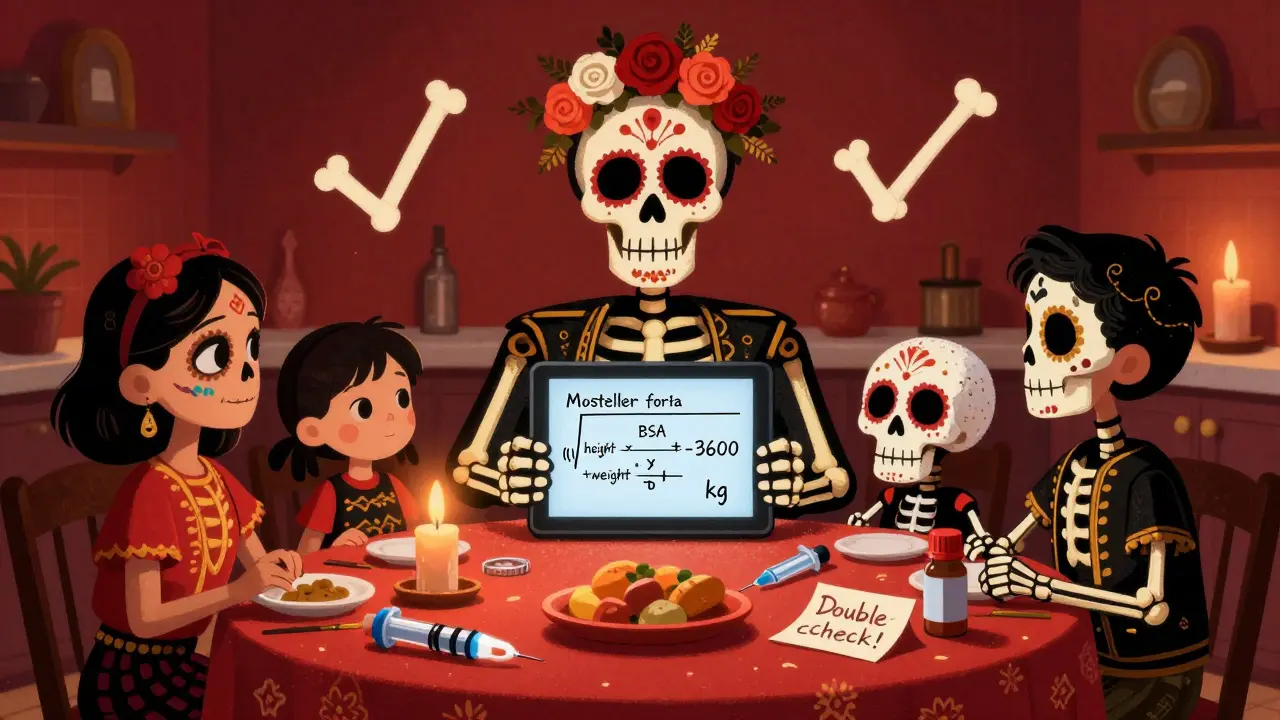
For some drugs-especially chemotherapy agents like vincristine or immunosuppressants-weight alone isn’t precise enough. That’s where body surface area (BSA) comes in. BSA takes into account both height and weight to estimate how much drug the body can handle. The standard formula? The Mosteller formula: √(height in cm × weight in kg ÷ 3600). For example, a child who is 97 cm tall and weighs 16.8 kg has a BSA of about 0.67 m². If the drug dose is 2 mg/m², then 2 × 0.67 = 1.34 mg total. This method is more complex, so it’s mostly used in hospitals under strict supervision. But if your child is on chemo or a high-risk medication, ask if BSA dosing applies. Don’t assume weight is enough.
The Hidden Traps: What No One Tells You
Even with the right math, mistakes happen. Here are the hidden pitfalls:- “mg/kg/d” is confusing. If a doctor writes “give 10 mg/kg/d,” does that mean 10 mg per kg per day-or per dose? Always clarify. The Institute for Safe Medication Practices says 15% of errors come from this vague notation.
- Decimal errors kill. Writing 1.5 mg instead of 15 mg is a 10-fold mistake. Always write leading zeros (0.5 mg, not .5 mg) and avoid trailing zeros (10.0 mg, not 10 mg).
- Age-based contraindications override weight. Just because a 1-year-old weighs 10 kg doesn’t mean they can take Benadryl. The American Academy of Pediatrics says: Never give Benadryl to children under 2 unless directed by a doctor. Weight doesn’t make it safe if the drug is unsafe for their age.
How Hospitals Prevent Errors
Hospitals don’t rely on one person doing the math. They use systems:- Double-checks: Two nurses verify every pediatric dose before giving it.
- Electronic health records: Systems like Epic and Cerner auto-calculate doses when weight is entered. If you type in 44 lb, it auto-converts to 20 kg and applies the correct formula.
- Standardized order sets: Instead of free-text orders, doctors pick from pre-approved dosing templates based on weight ranges.
What Parents Should Do
You’re not expected to be a pharmacist. But you can protect your child:- Always ask: “What is the dose in mg/kg?”
- Write down the weight used for the calculation-on the prescription or in your phone.
- Take the medicine bottle and the prescription to the pharmacy and ask: “Is this the right concentration for this weight?”
- Use a syringe, not a spoon. Measuring cups are inaccurate. Oral syringes are precise.
- If you’re unsure, don’t guess. Call your pediatrician. It’s better to wait 10 minutes than to risk giving too much.
The Bigger Picture: Safety Isn’t Optional
The Institute for Safe Medication Practices says pediatric medication errors happen twice as often as in adults. And nearly one-third of those are due to dosing miscalculations. In 2021, a 15 kg child received 10 times the correct dose of amoxicillin because someone forgot to convert pounds to kilograms. The child ended up in the hospital with severe vomiting and dehydration. These aren’t rare cases. They’re preventable. Regulatory bodies like the FDA and The Joint Commission have made pediatric dosing safety a National Patient Safety Goal. Hospitals must prove they have systems in place. But systems only work if people use them correctly.What’s Next? AI and Personalized Dosing
The future of pediatric dosing is getting smarter. Children’s Hospital of Philadelphia is testing AI tools that compare a calculated dose against thousands of past cases. If the system sees a 12 kg child getting a dose that’s way higher than usual for that age and drug, it flags it before it’s given. Early results show 92% accuracy. Long-term, researchers are looking at genetic factors. About 40% of children have gene variants that change how they process drugs. In the future, a child’s DNA might help fine-tune their dose-even if their weight is perfect. But for now, the rule hasn’t changed: Know the weight. Convert to kg. Multiply. Double-check.How do I convert my child’s weight from pounds to kilograms?
Divide the weight in pounds by 2.2. For example, if your child weighs 33 pounds, divide 33 by 2.2 to get 15 kg. Always use a calculator. Don’t estimate. Even rounding too early can throw off the dose.
What if the prescription says ‘mg/kg/day’ but I’m giving it twice a day?
The ‘mg/kg/day’ is the total daily amount. You need to divide that total by how many times you give it each day. For example, if the dose is 10 mg/kg/day and you give it twice daily, each dose is 5 mg/kg. Always confirm the frequency with your doctor or pharmacist.
Can I use a kitchen spoon to measure liquid medicine?
No. Kitchen spoons vary in size and are not accurate. Always use the oral syringe or dosing cup that comes with the medicine. If none was included, ask the pharmacy for one. A teaspoon holds about 5 mL, but it’s not reliable. A syringe gives you precision to the tenth of a milliliter.
Why can’t I just give my child half of an adult dose?
Children aren’t small adults. Their bodies process drugs differently. A child’s liver and kidneys may not break down medication the same way an adult’s do. Even if the child weighs half as much, the dose isn’t always half. Weight-based dosing (mg/kg) is the only reliable method proven to be safe and effective.
What should I do if I think I gave the wrong dose?
Call your pediatrician or Poison Control immediately at 1-800-222-1222. Don’t wait for symptoms. Even if your child seems fine, some reactions take hours to appear. Keep the medicine bottle and the prescription handy when you call-they’ll need the exact name, concentration, and amount given.
Abby Polhill
December 24, 2025 AT 00:44Let’s be real-most parents don’t even know what mg/kg means. I’ve seen moms eyeball Tylenol doses like it’s a shot of whiskey at a BBQ. The weight-to-kg conversion is the first place everything goes sideways. And don’t get me started on concentration confusion-infant drops vs. children’s suspension? If you don’t triple-check the label, you’re playing Russian roulette with your kid’s liver. Hospitals have protocols for a reason. Parents need to treat this like they’re handling live explosives.
Lindsey Kidd
December 24, 2025 AT 03:43Y’all need to stop winging it 😭 I used to be that mom who used a spoon until my kid threw up for 12 hours straight. Now I use the syringe, write down the weight in kg on my phone, and call the pharmacy every time. It’s not hard-it’s just tedious. But your kid’s life? Worth the extra 2 minutes. 💪❤️
Austin LeBlanc
December 26, 2025 AT 00:42Wow. Another article telling parents they’re dumb. Newsflash: not everyone has a nursing degree or a PhD in pharmacology. You think the average parent has time to memorize Mosteller’s formula before bedtime? This isn’t a medical journal-it’s a parenting forum. Stop shaming people for not being clinicians. If your system can’t prevent errors, don’t blame the people trying to do their best.
Aurora Daisy
December 26, 2025 AT 22:02Of course Americans need a 2000-word essay on how to count to 20. In the UK, we just use the NHS guidelines and trust our GPs instead of turning every dose into a calculus problem. You people turn medicine into a spectator sport. Next you’ll be publishing TikToks on how to calculate BSA with a spreadsheet. Honestly, it’s exhausting.
Isaac Bonillo Alcaina
December 27, 2025 AT 22:17You state that "80% of errors happen during weight conversion," yet you fail to specify whether this refers to clinical settings or parental errors. The data is misleading without context. Furthermore, the phrase "No shortcuts. No rounding until the final step" is grammatically incorrect-it should be "No shortcuts; no rounding until...". Precision in language matters as much as precision in dosing. Your article undermines its own credibility by neglecting orthographic rigor.
Harsh Khandelwal
December 29, 2025 AT 10:56Look, I get it-weight-based dosing sounds smart. But let’s be real: Big Pharma and the FDA just wanna keep us scared so we keep buying their $80 syringes and paying $200 for pediatric visits. I’ve given my kid Tylenol with a spoon for years. He’s 7, healthy, and doesn’t even know what a kilogram is. Maybe the real problem is over-medicalizing parenting? Just sayin’.
Delilah Rose
December 30, 2025 AT 20:37I really appreciate how thorough this is, but I think we need to talk about the emotional toll this takes on parents too. I’m a single mom working two jobs, and the pressure to get every dose perfect-on top of sleep deprivation, school drop-offs, and doctor appointments-is crushing. I don’t need to know the Mosteller formula. I need someone to say, "It’s okay to ask for help," and then actually make it easy for me to get that help. The system should be designed for humans, not just for people who read medical journals for fun. Can we build apps that auto-convert pounds to kg and scan bottle labels? Can we have a 24/7 hotline with real nurses? The math is simple. The stress isn’t.
Spencer Garcia
January 1, 2026 AT 14:29Use a syringe. Write down the kg. Double-check the concentration. Call the pharmacy if unsure. That’s it. You don’t need a degree. You just need to slow down.
Bret Freeman
January 3, 2026 AT 02:18They say "one in three errors is due to miscalculation"-but they never say how many of those were caused by doctors writing "10 mg/kg/d" without clarifying daily vs. per dose. I’ve seen residents scribble that on a napkin. Then the nurse, who’s been up for 16 hours, assumes it’s per dose. Kid ends up with 40 mg/kg in 24 hours. That’s not a parent error-that’s a systemic failure. And now we’re blaming moms for not being pharmacists? This isn’t safety. This is scapegoating dressed up as education.
Blow Job
January 3, 2026 AT 17:44My kid had a seizure once because we gave him the wrong concentration of amoxicillin. I thought the bottle said 160mg/5mL but it was the concentrated version. I didn’t read the fine print. I was tired. I felt like a monster for weeks. But then I called the hospital’s pediatric hotline and they walked me through everything-no judgment, just help. That’s what we need more of: support, not shame. If you’re reading this and you’re scared you messed up? You’re not alone. Call someone. Don’t wait. It’s not weakness. It’s love.