NTI Substitution Laws: Which States Block Generic Drug Swaps
 Dec, 1 2025
When you pick up a prescription for warfarin, levothyroxine, or digoxin, you might assume the pharmacist can swap the brand name for a cheaper generic version. But in many states, that’s not allowed - and the rules aren’t the same everywhere. For drugs with a narrow therapeutic index (NTI), even tiny differences in how the body absorbs the medicine can lead to dangerous side effects or treatment failure. That’s why 27 states have created their own laws to restrict or control generic substitutions, even though the FDA says these generics are just as safe and effective.
What Makes a Drug ‘Narrow Therapeutic Index’?
NTI drugs are those where the difference between a helpful dose and a harmful one is very small. Take warfarin, for example. A 0.5 mg change in daily dose can mean the difference between preventing a blood clot and causing a life-threatening bleed. Levothyroxine, used for thyroid conditions, is another. If your body absorbs slightly more or less than expected, your metabolism can go out of balance - leading to fatigue, heart problems, or weight changes. These aren’t theoretical risks. Studies show patients on these drugs can experience real, measurable changes in blood levels when switching between brand and generic versions - even if both are FDA-approved.
The FDA doesn’t officially label drugs as NTI in its Orange Book. But states, worried about patient safety, started creating their own lists in the mid-1990s. Today, those lists vary wildly. Some states ban substitution for entire drug classes. Others only block specific brands or formulations. And some don’t restrict anything at all.
How States Differ: Three Main Approaches
States handle NTI substitution in three basic ways, and knowing which one your state uses can save you time, money, or even prevent a medical emergency.
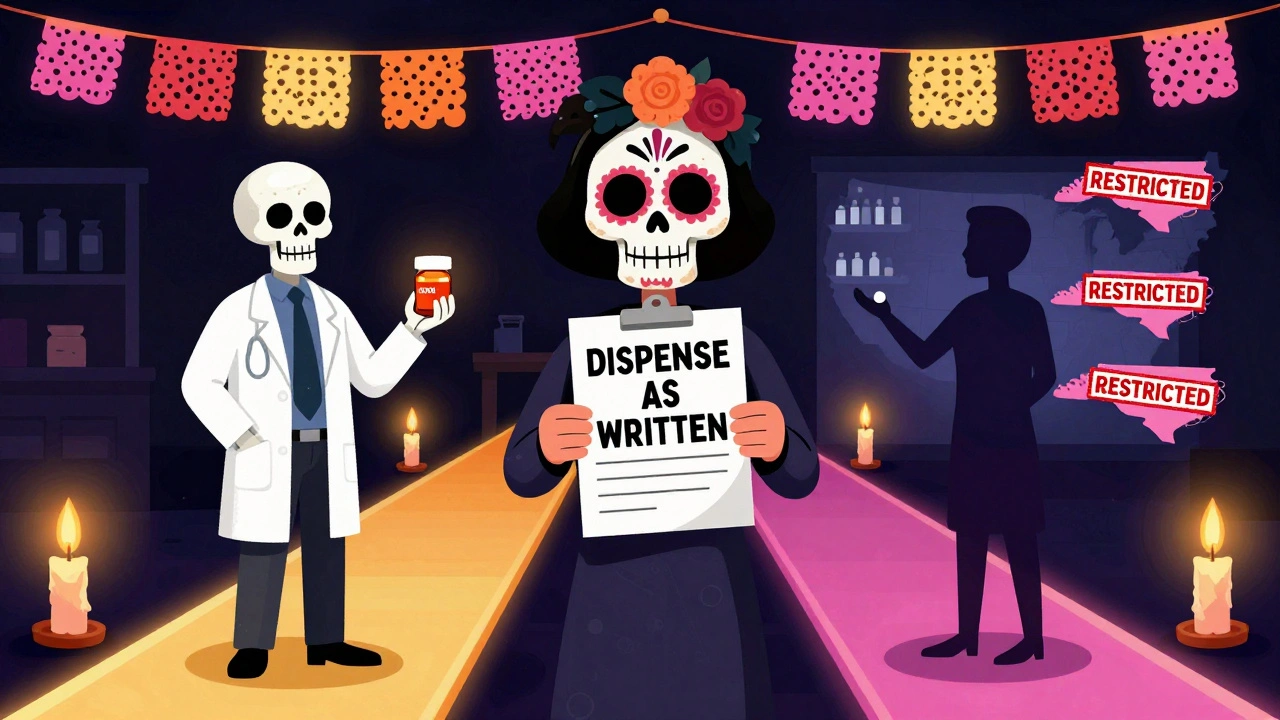
- Carve-out states (17 total): These states simply exclude NTI drugs from automatic generic substitution. If your prescription is for digoxin or lithium, the pharmacist can’t swap it unless the doctor specifically writes "dispense as written" or "no substitution." Kentucky, Pennsylvania, and North Carolina are in this group. Kentucky’s list includes 27 specific drugs - from antiepileptics to warfarin tablets - and substitution is only allowed if the prescriber gives written permission.
- Consent-required states (9 total): Here, substitution is possible - but only if both you and your doctor give clear, written approval. North Carolina requires dual signed consent for refill prescriptions. Connecticut goes further: if you’re on an anti-epileptic drug, the pharmacist must notify both you and your doctor within 72 hours of the swap. If either of you objects within 14 days, the substitution is canceled.
- Notification-only states (11 total): The pharmacist can substitute, but they must document it and often send a notice to your doctor. South Carolina, for example, recommends avoiding substitution for NTI drugs but doesn’t require it. Other states in this group include Florida and Maryland.
Meanwhile, 13 states - including California, Texas, and Virginia - follow the federal rule: if a generic is rated AB-equivalent in the Orange Book, it can be swapped without extra steps. Pharmacists in these states report smoother workflows and fewer delays. But they also see more patient questions about why their medication looks different.
Which Drugs Are Most Restricted?
Not all NTI drugs are treated the same. Some are on nearly every state’s restricted list. Others appear only in a few places - and sometimes without strong clinical backing.
- Warfarin: The most commonly restricted drug. 22 states have rules around it, even though a 2020 study of over 12,000 Medicare patients found no significant difference in INR control between brand and generic warfarin.
- Levothyroxine: Found on 20 state lists. Despite multiple studies showing bioequivalence, many doctors and patients still prefer the brand. Pharmacists in Kentucky say checking levothyroxine prescriptions adds 5-7 minutes per script.
- Digoxin: Listed in 18 states. Small changes in blood levels can trigger arrhythmias. Kentucky and Pennsylvania explicitly prohibit substitution.
- Lithium: Restricted in 17 states. Used for bipolar disorder, its narrow window makes it a high-risk candidate for substitution.
- Anti-epileptic drugs: States like Connecticut, North Carolina, and Illinois have special rules for drugs like phenytoin and carbamazepine. The Epilepsy Foundation supports these restrictions, citing a 19% drop in seizure-related ER visits after Connecticut’s law passed in 2016.
But here’s the catch: a 2021 study in Pharmacotherapy found that only 12 of the 47 drugs on state NTI lists have solid clinical evidence supporting their classification as narrow therapeutic index. That means some states are restricting drugs that may not need it - and blocking cheaper options for no clear reason.
What This Means for Patients and Pharmacists
If you’re on an NTI drug, you might be caught in a patchwork of rules. A prescription filled in Ohio might be swapped automatically. The same prescription filled in Kentucky might be held up for hours while the pharmacist checks the state’s official list. That’s not just inconvenient - it’s expensive. A 2022 study found that states with strict NTI rules have 12.4% lower generic use for these drugs, adding an estimated $1.2 billion in annual costs to the healthcare system.
For pharmacists, compliance is a burden. In states with carve-outs, the average time to verify substitution eligibility is over 3 minutes per prescription - compared to under a minute in states without restrictions. That’s nearly 9 extra hours a month spent on paperwork and checks. Many pharmacies now use software that auto-flags NTI drugs based on your state’s rules. But in smaller, independent pharmacies, it’s still done manually - and mistakes happen.
Patients, too, are confused. One woman in Pennsylvania told her pharmacist she’d been switched from brand to generic levothyroxine without notice. Her TSH levels jumped, and she developed heart palpitations. After switching back, she felt normal again. Her doctor had no idea the swap had happened - because Pennsylvania’s law doesn’t require notification to the prescriber, only to the patient.
The Big Debate: Safety vs. Access
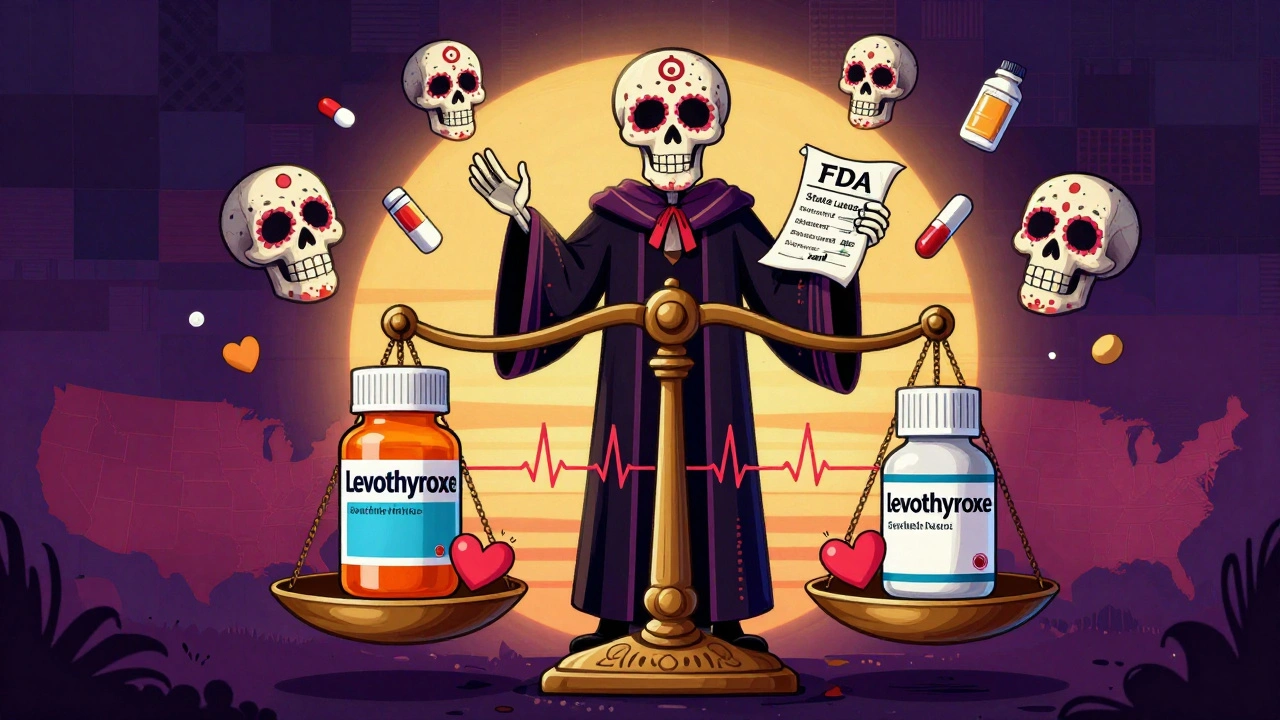
The tension between state laws and federal guidance is real. The FDA maintains that all approved generics, even for NTI drugs, meet the same quality standards. But doctors and pharmacists on the front lines see different outcomes. A 2022 survey by the American Society of Health-System Pharmacists found that 78% of hospital pharmacists believe certain NTI drugs need special handling.
On one side, groups like the Association for Accessible Medicines argue that these state rules are outdated and costly. They’ve even sued Kentucky, claiming its list violates interstate commerce laws. On the other side, the American College of Clinical Pharmacy says NTI drugs deserve extra caution because of their steep dose-response curves. The Epilepsy Foundation and patient advocates back state-level protections.
There’s also a growing push for evidence-based lists. California’s 2022 law requires its pharmacy board to base NTI designations on systematic reviews - not tradition. New York and Ohio are considering similar changes. The National Association of Boards of Pharmacy is working on a model framework to bring some consistency across states.
What You Should Do
If you take an NTI drug, don’t assume your prescription will be swapped. Here’s what to do:
- Ask your pharmacist: "Is this drug on my state’s NTI list?" If they don’t know, ask for the name of the state pharmacy board’s website.
- Check your prescription label: If it says "dispense as written" or "no substitution," that’s your doctor’s choice - not the pharmacist’s.
- Request written consent forms: In states like North Carolina or Connecticut, you may need to sign something before a swap happens. Keep a copy.
- Monitor your symptoms: If you switch from brand to generic - or vice versa - watch for changes in how you feel. For warfarin, check your INR levels more often. For thyroid meds, track your energy, weight, and heart rate.
- Know your state’s rules: Look up your state’s pharmacy board website. Most have a section on generic substitution laws. Kentucky’s list is public. So is Pennsylvania’s.
There’s no national standard. But you have the right to know what’s being done with your prescription - and to say no.
What’s Next?
The FDA’s 2023 draft guidance on NTI drugs may change things. It’s not law yet, but it offers a clear, science-based way to define which drugs truly have a narrow therapeutic index. Nine states are already reviewing their lists in light of it. If more follow, we might see fewer arbitrary restrictions - and more focus on drugs where the risk is real.
For now, though, the rules are a mess. And if you’re on warfarin, levothyroxine, or lithium, your safety depends on knowing which state you’re in - and what it allows.
Are generic NTI drugs really as safe as brand-name ones?
The FDA says yes - all approved generics must meet the same bioequivalence standards as brand-name drugs. But for NTI drugs, even small differences in absorption can matter. Studies show mixed results: some find no clinical difference, while others show changes in blood levels or patient outcomes. That’s why some states restrict substitution - not because generics are unsafe, but because the margin for error is so small.
Can a pharmacist substitute an NTI drug without my knowledge?
In some states, yes. In 13 states, including Texas and California, pharmacists can substitute NTI drugs without telling you - as long as the generic is rated AB-equivalent. In 9 states, you must give written consent. In others, your doctor must be notified. Always ask your pharmacist what the rules are in your state.
Which states have the strictest NTI substitution rules?
Kentucky, North Carolina, and Connecticut have some of the strictest rules. Kentucky bans substitution for 27 specific drugs unless the prescriber gives written permission. North Carolina requires both patient and doctor to sign off. Connecticut mandates notification and allows objections within 14 days for anti-epileptic drugs. These states prioritize safety over cost savings.
Why do some states restrict drugs like levothyroxine when studies show no difference?
Historical precedent and patient fear play a big role. Levothyroxine has been on state NTI lists since the 1990s, long before strong evidence showed bioequivalence. Many doctors still recommend staying on the same brand. Patients report feeling better on the original - even if lab results don’t show a difference. Until state laws are updated with current data, these restrictions remain.
Can I request to stay on the brand-name version of my NTI drug?
Yes. You can always ask your doctor to write "dispense as written" or "no substitution" on your prescription. This overrides state substitution laws. Some pharmacies may charge more if you insist on the brand, but your safety comes first. If cost is an issue, ask about patient assistance programs - many manufacturers offer them for NTI drugs.
amit kuamr
December 2, 2025 AT 03:16People act like generics are some kind of scam but the FDA tests them same as brand name. If you're having issues it's not the generic it's your body adjusting or your doctor not monitoring you right. Stop blaming the pharmacy.
elizabeth muzichuk
December 4, 2025 AT 02:47I switched to generic levothyroxine and my heart started racing like I'd chugged three energy drinks. My doctor didn't even know they swapped it. This isn't just about money it's about people dying because some bureaucrat thinks cost savings matter more than lives. I'm filing a complaint with the state board tomorrow.
Charlotte Collins
December 5, 2025 AT 18:15The real issue isn't the drugs it's the lack of federal standardization. States are acting like they're sovereign nations with their own pharmacopeias. Kentucky bans 27 drugs but doesn't require prescriber notification? That's not safety that's negligence dressed up as caution. And the fact that 35 of these restrictions have zero peer-reviewed backing? That's regulatory capture by pharmaceutical lobbying disguised as patient care.
Meanwhile pharmacists in small towns are spending 15 minutes per script checking state lists instead of counseling patients. We've created a system that protects nobody except the lawyers who drafted these laws.
The FDA's bioequivalence standards are rigorous. If a drug passes AB rating it's interchangeable. The real danger is letting state legislatures make medical decisions without clinical evidence. This isn't protectionism it's pathological overcorrection.
Margaret Stearns
December 7, 2025 AT 12:41I'm a pharmacist in Ohio. We swap NTI drugs all the time. I've never had a patient report a problem. I always tell them to watch for changes and call if something feels off. Most people don't even notice the difference. The states that make it so complicated are just making life harder for everyone.
Scotia Corley
December 9, 2025 AT 04:59It is a matter of profound concern that state regulatory frameworks diverge so significantly from federal pharmacological standards. The absence of a unified national protocol for narrow therapeutic index drug substitution introduces unnecessary complexity into the healthcare delivery system. This fragmentation undermines both efficiency and patient safety.
Furthermore, the empirical data cited in the original article demonstrates a lack of clinical significance in bioequivalence variance for most listed agents. The persistence of restrictive statutes appears to be driven more by historical precedent than evidence-based practice.
It is my professional opinion that these laws should be repealed or revised to align with current scientific consensus. The economic burden and administrative overhead they impose are disproportionate to the marginal risk they purport to mitigate.
Debbie Naquin
December 10, 2025 AT 06:11What if the real NTI isn't the drug but the system? We've turned medicine into a bureaucratic obstacle course where your safety depends on which zip code you live in. The FDA says generics are fine but states act like they're playing Russian roulette with your thyroid levels. Who's really protecting patients here? The regulators or the fear?
There's a philosophical gap here between bioequivalence and phenomenological experience. Just because the numbers match doesn't mean the body feels the same. That's not pseudoscience that's human biology. We measure blood levels but we don't measure fatigue, anxiety, or the quiet terror of a seizure coming on.
Maybe the answer isn't more rules but more transparency. Let patients know when a swap happens. Let them choose. Let them opt out. Don't force them into a system that treats their body like a chemistry problem.
Karandeep Singh
December 10, 2025 AT 23:43generic works fine stop whining
Mary Ngo
December 11, 2025 AT 23:53This isn't about safety. It's about the pharmaceutical industry paying off state lawmakers to keep brand drugs on the market. Look at the lobbying records. Every state with strict NTI laws has had big pharma donations in the last election cycle. They don't care about your thyroid they care about your paycheck. The FDA's data is suppressed because it would ruin the billion-dollar brand drug monopoly. Wake up.
James Allen
December 12, 2025 AT 05:05Look I get it. Some folks are scared of change. But here in the US we've got the best drug safety system in the world. If generics weren't safe the FDA wouldn't approve them. These state laws are just a relic from when we didn't have good data. We're better than this. Let's stop treating patients like they're incapable of making informed choices. Trust the science. Trust the FDA. Trust your pharmacist.
And if you're worried? Ask for the brand. No one's stopping you. But don't make the rest of us pay for your fear.