Labor Cost Differences: Generic vs Brand-Name Drug Production
 Dec, 16 2025
When you pick up a prescription at the pharmacy, you might not think about who made the pill or how much it cost to produce. But the difference between a generic drug and its brand-name counterpart isn’t just in the label-it’s in the whole system behind it. And labor is one of the biggest, most misunderstood pieces of that puzzle.
Why Generic Drugs Cost So Much Less
You’ve seen the price tags: $4 for a month’s supply of generic lisinopril, $40 for the brand version. It feels like a steal. But here’s the thing-the actual active ingredient in both pills is identical. So why the huge gap? It’s not magic. It’s math. And labor is part of that math. Generic drug makers don’t have to spend billions on research. They don’t need to run decade-long clinical trials. They copy what’s already been proven safe and effective. That cuts out the biggest cost for brand-name companies: R&D. The FDA estimates developing a new drug costs around $2.6 billion. Generic manufacturers skip that entirely. But that doesn’t mean their labor costs are zero. In fact, they’re still high-just structured very differently.Labor in Brand-Name Drug Production
Brand-name drug production is a high-touch, high-complexity operation. From early-stage formulation to clinical batch production, every step involves specialized scientists, engineers, and technicians. These aren’t assembly line workers-they’re PhDs, regulatory specialists, and process validation experts. Their salaries add up fast. In the early years of a brand drug’s life, labor can make up 30% to 40% of total production costs. Why? Because everything is new. Processes are still being fine-tuned. Equipment is being calibrated. Teams are training. Quality control isn’t just checking pills-it’s building the entire system from scratch. Each batch is scrutinized. Every deviation is logged. Documentation is exhaustive. And it’s not just internal labor. Brand companies often outsource niche steps to contract labs, hire consultants for regulatory strategy, and pay for expensive training programs to meet FDA standards. All of this adds layers of labor cost that generic producers simply don’t carry.Labor in Generic Drug Production
Generic drug manufacturing looks different. The science is settled. The formula is locked in. So the goal isn’t innovation-it’s efficiency. And that changes how labor is used. Labor makes up only 15% to 25% of total costs for generics. That’s less than half of what brand-name companies spend. But don’t mistake low labor cost for low skill. Generic plants still need trained operators, QC inspectors, and compliance officers. The difference? They do it at scale. Think of it like this: if you bake one cake, you spend a lot of time measuring, mixing, and checking the oven. But if you bake 10,000 cakes a day, you automate the measuring, standardize the mixing, and run the ovens on a schedule. Labor becomes a fixed, predictable cost-not a variable, high-skill expense. The BCG 2019 study found that generic manufacturers cut unit costs by 27% every time production volume doubles. That’s because labor becomes more efficient with repetition. Workers get faster. Mistakes drop. Training becomes streamlined. A single QC technician can inspect 500 batches a week once the process is perfected-whereas in brand production, that same technician might handle only 50 unique batches, each with different protocols.
The Hidden Labor Cost: Quality Control
One of the biggest surprises? Quality control eats up more than 20% of generic drug production costs. That’s mostly labor. Testing raw materials. Checking final products. Logging every step for FDA traceability. It’s not glamorous, but it’s mandatory. A medium-sized generic company spends about $184,000 a year just on compliance systems. Add in $1.9 million for ongoing regulatory programs and another $320,000 per new drug application. That’s not just paperwork-it’s people. Analysts. Document controllers. Auditors. These aren’t entry-level jobs. They require experience, attention to detail, and deep knowledge of FDA regulations. The Cost of Quality (COQ) model breaks this down into four parts: prevention (training), appraisal (testing), internal failure (rework), and external failure (returns). For generics, prevention and appraisal are the biggest chunks. That means the most labor goes into making sure nothing goes wrong-not into inventing something new.Geography Matters-A Lot
Here’s where things get complicated. A lot of the raw ingredients (APIs) for generic drugs come from India and China. And labor there is cheaper. Prosperous America’s 2023 analysis found API production in those countries is about 42% cheaper than in the U.S. But here’s the catch: that doesn’t mean those factories are more efficient. The HHS Office of the Assistant Secretary for Planning and Evaluation (ASPE) says the lower costs come from subsidies, weaker labor protections, and lower environmental standards. So when you buy a generic drug, you’re not just paying for U.S. labor-you’re paying for labor in a different regulatory world. That creates a strange tension. U.S.-based generic manufacturers have to compete with overseas production. To stay competitive, they cut labor wherever they can. That means fewer staff, longer shifts, or more automation. But when you cut too much, quality suffers. And that’s when drug shortages happen.How Competition Drives Labor Changes
There are over 600 generic versions of common drugs in the U.S. market. When five companies make the same pill, they fight over pennies. That pressure ripples through every cost line-including labor. The FDA reports that as more generics enter the market, prices drop fast. But here’s the trade-off: companies start cutting corners. They reduce QC staff. They outsource more to contract manufacturers. They delay equipment upgrades. The result? Higher risk of shortages. A 2021 study in PMC found that generic manufacturers are under constant pressure to reduce costs. “Competition among generic manufacturers reduces prices much below what buyers would pay,” the report says. That’s good for consumers-but bad for workers in the industry. Some companies respond by investing smarter. Instead of cutting labor, they invest in better training and automation to reduce errors. The BCG study found that manufacturers who focus on prevention-better training, better processes-end up with lower total costs. Fewer reworks. Faster approvals. Less waste. That’s labor efficiency, not labor reduction.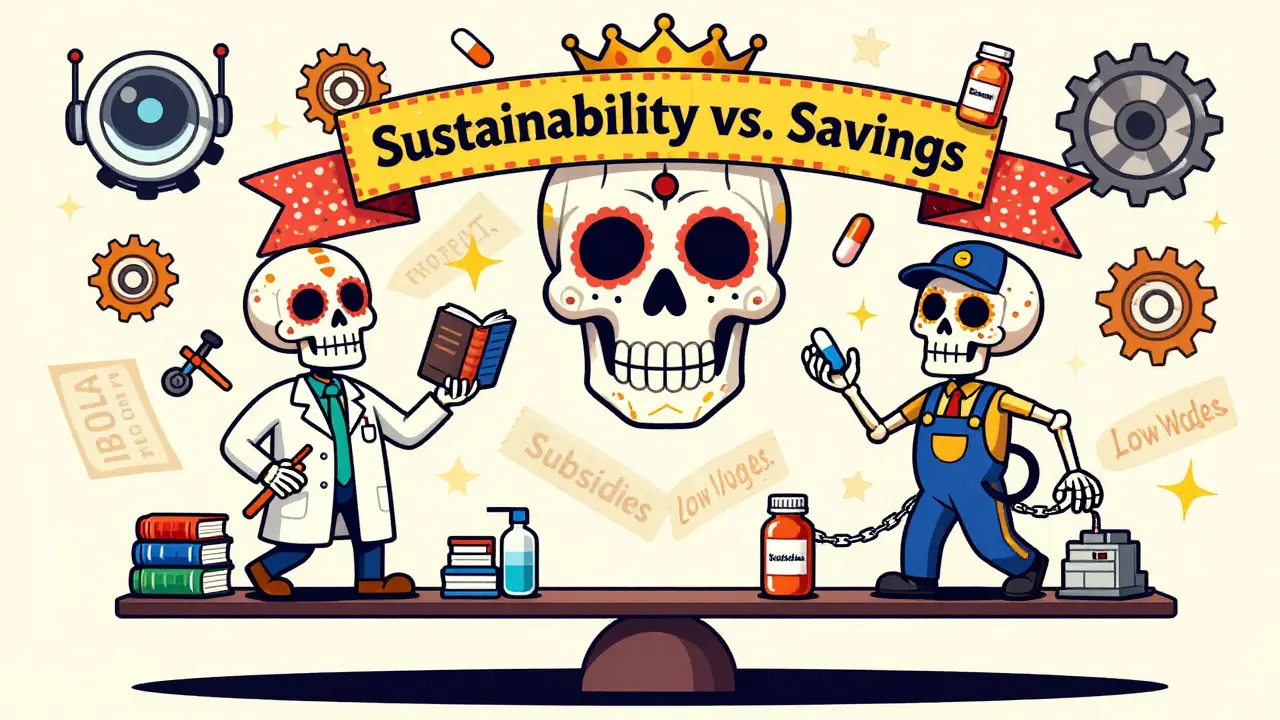
Steven Lavoie
December 16, 2025 AT 14:20It’s wild how much labor structure shapes the price of medicine. I worked in pharma QC for a decade, and yeah-generic plants run like clockwork. But the people? They’re not interchangeable parts. They’re the ones catching errors before a whole batch gets recalled. And nobody sees them.
When you buy a $4 pill, you’re not just saving money-you’re relying on someone’s attention to detail after a 12-hour shift. That’s not a feature. It’s a vulnerability.
Anu radha
December 17, 2025 AT 11:48I work in a factory in India making APIs. We do not have fancy labs. We do not get bonuses. But we follow the papers. The pills work. That is what matters. Why make it expensive if it does the same job?
Jigar shah
December 19, 2025 AT 02:40Interesting breakdown. I’ve always assumed generics were cheaper because they skipped R&D, but the labor efficiency angle is new to me. The BCG study’s 27% cost reduction per volume doubling is huge. Makes me wonder-how much of that efficiency is from automation vs. just squeezing more output from the same staff?
Also, curious if any data exists on worker turnover rates in generic vs brand plants. That could tell us a lot about sustainability.
Sachin Bhorde
December 20, 2025 AT 03:43Bro, the real story ain’t in the lab-it’s in the supply chain. APIs from China? Yeah, cheaper, but you’re playing Russian roulette with heavy metals and unregulated solvents. I’ve seen batch logs from some CMOs-half the docs are in broken English. FDA says ‘compliance,’ but they’re understaffed and overworked. So we’re all just hoping the QC guy didn’t nap during the HPLC run.
Automation’s coming, but until then, we’re all one typo away from a nationwide shortage. And yeah, someone’s getting paid $3/hr to make that happen.
Victoria Rogers
December 20, 2025 AT 09:44So let me get this straight-we’re outsourcing life-saving medicine to countries that don’t care about workers or the environment, then acting shocked when people get sick? Classic American hypocrisy. We want cheap pills but won’t pay a living wage to our own engineers. Meanwhile, China’s got solar panels and mRNA vaccines. We got ‘generic lisinopril’ and a debt crisis.
Bring it home. Or stop pretending this is about ‘efficiency.’ It’s about greed.
Jane Wei
December 20, 2025 AT 11:35so like… if i buy the generic, am i basically trusting a guy in bangalore who’s been doing the same job for 15 years to not mess up? because that’s wild when you think about it.
Jonathan Morris
December 21, 2025 AT 00:19They’re not just cutting labor-they’re erasing accountability. Did you know the FDA inspects less than 2% of foreign drug facilities annually? That’s not oversight. That’s negligence. And the people who run these plants? They’re not even required to speak English. How is that legal? How is that safe?
This isn’t capitalism. This is a biotech Ponzi scheme where the only thing being produced is profit-and the collateral damage is your health.
Linda Caldwell
December 22, 2025 AT 12:11Look, I get the fear. But here’s the truth: generics saved my kid’s life. We couldn’t afford the brand. Period.
Yes, the system’s flawed. Yes, workers are underpaid. But if you want to fix it, don’t rage-build. Support companies that pay fair wages. Push for policy that rewards quality over cost. Don’t just complain-be part of the solution.
Medicine shouldn’t be a luxury. But neither should dignity. We can have both.
Anna Giakoumakatou
December 24, 2025 AT 05:22Oh, so the ‘low-cost’ pill is a product of global exploitation and regulatory capture? How novel. I suppose the real tragedy isn’t that we’ve outsourced the labor-it’s that we’ve outsourced our moral imagination.
Meanwhile, the CEO of the brand-name company who spent $2.6 billion on R&D? He’s on a yacht in Monaco. The generic worker? She’s in a dormitory in Hyderabad, earning $2.30/hour, and we call that ‘market efficiency.’
How poetic. How utterly, devastatingly human.
Donna Packard
December 25, 2025 AT 01:48My dad worked in a U.S. generic plant for 22 years. He retired last year. The company bought new automation. Cut 40% of the staff. Said it was ‘to stay competitive.’
He never complained. Just said, ‘I’m glad they’re still making the pills.’
I don’t know what to feel. Proud? Angry? Guilty?
Sam Clark
December 25, 2025 AT 11:09Thank you for this thorough and nuanced analysis. The distinction between labor intensity in R&D-driven brand production versus scale-optimized generic manufacturing is critical and often overlooked. The Cost of Quality model provides a robust framework for evaluating not just cost, but systemic resilience.
I would urge policymakers to consider incentivizing investments in preventive quality systems-training, process standardization, and digital traceability-rather than penalizing companies for higher labor costs. Sustainability must be baked into the model, not bolted on as an afterthought.
Jessica Salgado
December 26, 2025 AT 08:18Wait-so the reason my generic blood pressure med is $4 is because someone in India is working 14-hour days in a factory with no AC, and the FDA hasn’t inspected it in 5 years?
And we’re supposed to be okay with that?
That’s not capitalism. That’s a moral failure dressed up as economics.
Someone needs to tell the people who vote for ‘lower prices’ that the cost isn’t just on the sticker. It’s in the blood, sweat, and silence of people we’ll never meet.