How to Read Prescription Labels for Inhalers, Patches, and Injectables
 Jan, 7 2026
Reading a prescription label for a pill is one thing. But when your medication comes in an inhaler, patch, or syringe, the stakes go up fast. A small mistake - misreading the dose, applying a patch to the wrong spot, or confusing one injector for another - can land you in the ER. In 2022, over 1,400 adverse events were tied directly to people misunderstanding how to use these specialized delivery systems. And it’s not just older adults. A 2023 Consumer Reports survey found that 63% of patch users didn’t realize "change every 72 hours" meant exactly 72 hours, not "about three days."
Why Inhaler Labels Are Trickier Than They Look
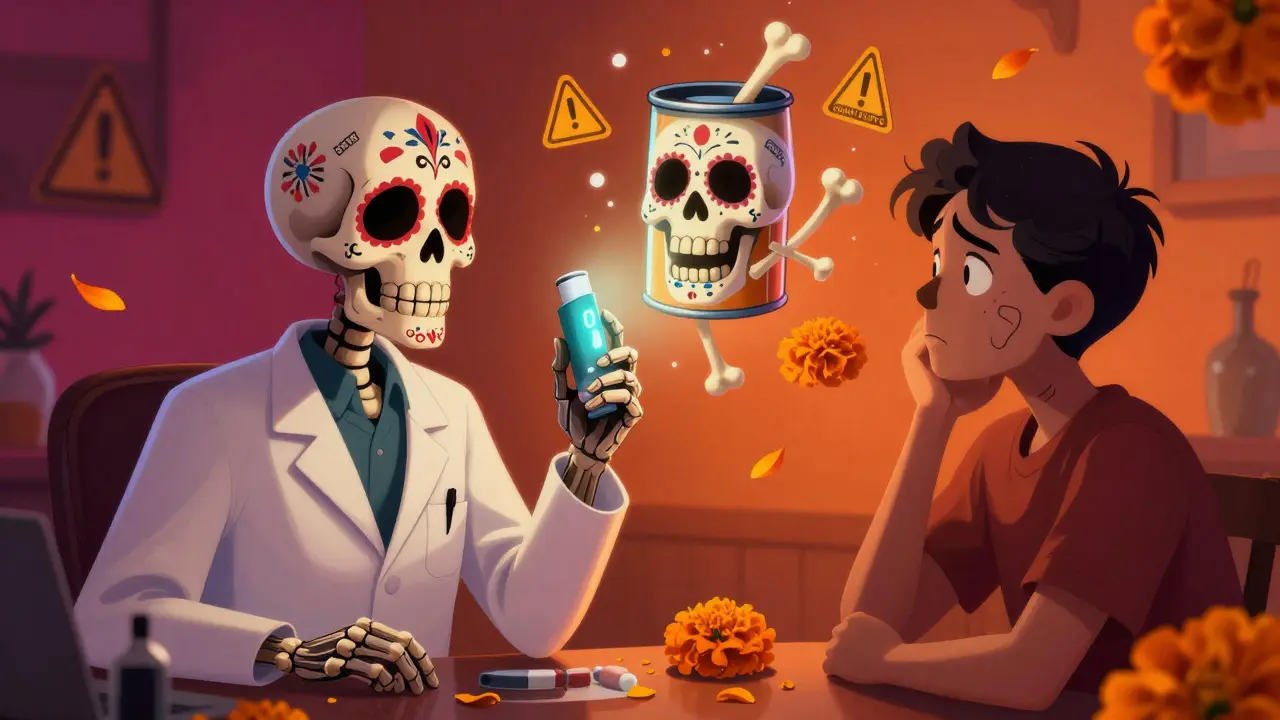
Inhalers are everywhere. Asthma, COPD, even allergies - if you’ve been prescribed one, you’ve probably seen the little metal canister with a mouthpiece. But here’s what most people miss: just because it feels full doesn’t mean it still has medicine. The canister might still rattle, but the dose counter could be at zero. That’s why every inhaler label now must show a clear dose counter - a requirement the FDA pushed through in May 2024. If yours doesn’t have one, ask your pharmacist for a replacement.Look for the dosage per puff. It’ll say something like "albuterol sulfate 90 mcg per actuation." That’s the amount you get with one press. Don’t guess. If your doctor says "two puffs twice a day," that’s 4 puffs total. Multiply that by 30 days: you need 120 puffs. If your inhaler has 200 puffs, it’ll last about 50 days. No need to count days - count puffs.
Some inhalers need to be primed before first use. That means spraying it into the air four times. If you skip this, your first few puffs might be air, not medicine. The label will say "prime before first use" or "shake well." But here’s the catch: only shake suspension inhalers. Solution inhalers don’t need shaking. Mixing them up can lead to underdosing. The American Lung Association says 62% of metered-dose inhalers are suspension types, so this matters.
And don’t forget the spacer. If your doctor gave you one, the label should mention it. Using a spacer with your inhaler makes sure more medicine reaches your lungs, not your throat. It’s simple: spray into the spacer, then breathe in slowly. No spacer? Ask for one. It’s free at most pharmacies.
Transdermal Patches: More Than Just Stick and Go
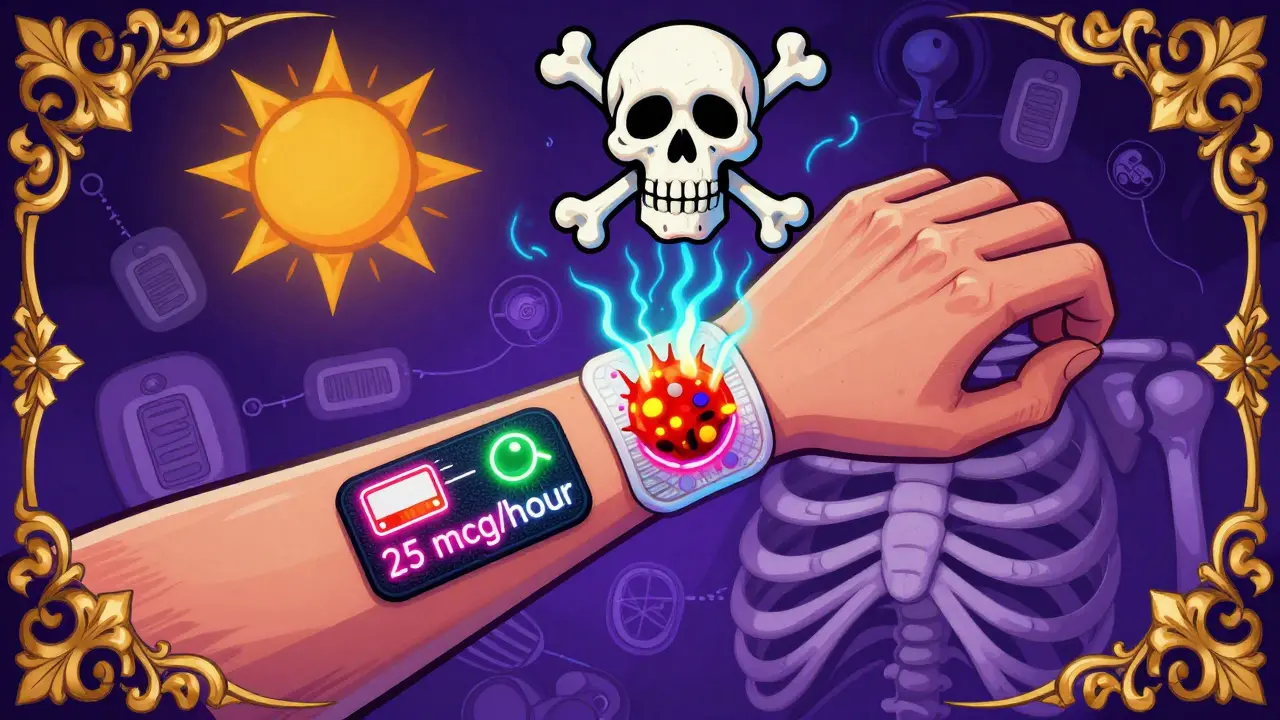
Patches seem easy. Stick it on, wait, feel better. But the label holds critical details most people ignore. First, the dose isn’t "how strong it feels." It’s written as a rate: "fentanyl 25 mcg/hour." That means every hour, your body gets 25 micrograms. If you cut the patch - which 89% of fentanyl patches warn against - you double the risk of overdose. The FDA says cutting can increase absorption by up to 4.7 times.Application site matters too. Most patches say "apply to clean, dry skin" and "rotate sites." That’s not just advice. Applying the same patch to the same spot every time can cause skin irritation or even slow down how the drug gets into your system. Try your upper arm, chest, or back - but never on the same spot two weeks in a row.
Heat is a silent danger. A hot shower, sauna, or even a heating pad can make your patch release medicine faster. A 2022 study in the Journal of Clinical Pharmacology found heat can boost absorption by up to 50%. That’s why labels now say "avoid heat exposure" in bold. If you’re sick and running a fever, talk to your doctor before using a patch.
Disposal is a hidden risk. Used fentanyl patches still contain half the medicine. The FDA issued a safety alert in June 2022 after 147 cases of accidental exposure - mostly from kids or pets finding discarded patches. Always fold the patch in half with sticky sides together, put it in the original container, and flush it down the toilet. Or return it to your pharmacy. Never throw it in the trash.
Injectables: The Most Dangerous Label to Misread
Injectables are the most high-risk. Insulin, epinephrine, biologics - if you’re using one, you’re managing a serious condition. The biggest mistake? Misreading concentration. Insulin comes in U-100 (100 units per mL) and U-500 (500 units per mL). If you think you’re getting 10 units from a U-500 vial, you’re actually getting 50. That’s a fivefold overdose. The American Diabetes Association found 19.3% of insulin errors in 2023 came from this confusion.Look for the concentration right after the drug name. It’ll say "insulin glargine 100 units/mL" or "octreotide 1,000 mcg/mL." If it’s not clear, ask your pharmacist to circle it. Never assume. Even small print can be misleading.
Some injectables need mixing. If your label says "reconstitute before use," you need to add liquid to the powder. Do it exactly as written. Use the right syringe. Don’t use a regular insulin syringe for a different concentration - they’re not interchangeable. The American Society of Health-System Pharmacists says 68% of injectable errors happen during preparation, not injection.
Storage is another pitfall. Some injectables need refrigeration. Others shouldn’t be frozen. Check the label for "store between 36°F and 46°F" or "keep at room temperature." If you’re traveling, use a cooler with ice packs - but don’t let the vial freeze. And never use a vial if the liquid looks cloudy, discolored, or has particles.
What the Label Isn’t Telling You (But Should)
Most labels now include pictograms - simple drawings showing how to use the device. A 2023 study in the Journal of the American Pharmacists Association found that pictograms reduced errors by 37%. If yours doesn’t have them, ask for a version that does. Many manufacturers now include QR codes on labels that link to short videos showing proper use. Scan it with your phone. Watch it once. Then again before your next dose.Auxiliary labels - those little stickers on the bottle - are just as important. They say things like "do not expose to heat," "apply to clean skin," or "shake well." These aren’t extras. They’re warnings. If your label has one, read it. If it’s missing, ask your pharmacist why.
And if you use more than one device - say, an inhaler for asthma and a patch for pain - you’re at higher risk of mixing them up. A 2023 study found 43.2% of patients using multiple systems confused their techniques. Keep them in separate places. Label the storage box. Write down the name, dose, and frequency on a card. Tape it to your fridge.
What to Do If You’re Still Confused
You’re not alone. A 2023 JAMA Internal Medicine study found only 38% of patients got a full 15- to 20-minute counseling session from their pharmacist. That’s not enough. Demand it. Ask your pharmacist to walk you through each device - out loud, step by step. Have them show you the dose counter, point out the concentration, demonstrate how to prime the inhaler.If you have vision problems, ask for large-print labels or audio instructions. Many pharmacies now offer these. If you’re on Medicare, you can get free medication therapy management services - that includes label review. Call your plan.
And if you ever feel unsure - stop. Don’t guess. Call your doctor or pharmacist. Better to ask once than risk a mistake. Medication safety isn’t about being perfect. It’s about being careful. And that starts with reading the label - really reading it - every single time.
What’s Changing in 2025 and Beyond
The FDA is pushing hard for better labeling. By January 2025, every new inhaler, patch, or injector must include standardized pictograms. QR codes are now on 67% of new devices - up from just 12% in 2021. And by 2026, AI systems in pharmacies will scan your label and flag mismatches before you leave the counter.Soon, you’ll be able to point your phone at your inhaler and see a 3D animation showing exactly how to breathe in. Johns Hopkins tested this in 2023 and saw a 37% drop in technique errors. The World Health Organization wants to cut global errors from these devices by half by 2030. That starts with you - reading the label, asking questions, and never assuming.
What should I do if my inhaler feels full but the counter says zero?
Stop using it immediately. Even if the canister rattles, the medicine may be gone. Many inhalers have dose counters that track puffs used, not liquid left. Replace it with a new one. Never try to refill or shake it harder - that won’t bring back the medicine.
Can I cut my pain patch to lower the dose?
No. Cutting a patch like fentanyl can cause a dangerous spike in drug delivery. The FDA warns this increases overdose risk by nearly five times. If the dose is too strong, talk to your doctor about switching to a lower-strength patch or a different medication. Never adjust the patch yourself.
Why does my insulin label say "U-100"? What does that mean?
"U-100" means 100 units of insulin per milliliter. That’s the standard for most insulin. But some insulin, like U-500, is five times stronger. If you use a U-100 syringe with U-500 insulin, you’ll give five times the dose you think you’re giving. Always check the concentration before drawing up your shot.
How do I know if my injectable medication is still good?
Check the expiration date first. Then look at the liquid. If it’s cloudy, discolored, or has particles, don’t use it - even if it’s before the expiration date. Some injectables, like insulin, should be clear. Others, like certain biologics, may be slightly cloudy but must never have clumps. When in doubt, throw it out and get a new one.
What should I do with used patches or needles?
Fold used patches in half with sticky sides together, put them in the original container, and flush them down the toilet. For needles, use a sharps container - never throw them loose in the trash. Many pharmacies offer free sharps disposal programs. If you’re unsure, ask your pharmacist. Improper disposal has caused over 147 accidental exposures in the U.S. since 2022.
Donny Airlangga
January 8, 2026 AT 04:10My grandma used to cut her fentanyl patch in half because she thought it’d be "gentler." She ended up in the ER. Don’t be like her. Read the label. Every. Single. Time.
Evan Smith
January 9, 2026 AT 17:43So let me get this straight - we’re trusting our lives to tiny print on a canister that looks like it’s from a 1990s air freshener? And the FDA only just made dose counters mandatory? Bro, I’ve seen more safety info on a pack of gum. This is wild.
Manish Kumar
January 11, 2026 AT 00:48Think about it - we live in a world where a patch can kill you if you stick it on your leg instead of your chest, and yet we still treat medication like a magic trick you’re supposed to figure out by instinct. It’s not negligence - it’s design. The system isn’t broken, it’s designed to make you afraid to ask questions. And that’s the real tragedy.
We’ve outsourced our health to corporations who profit from your confusion. The QR code? That’s not help - it’s a distraction. A shiny object to keep you from asking why your pharmacist only has 3 minutes to explain your life-saving device.
And don’t get me started on the "flush it down the toilet" advice. That’s not safety - that’s environmental sabotage dressed up as responsibility. Who benefits from flushing half a dose of fentanyl into our water supply? Not you. Not me. But definitely not the planet.
Maybe the real solution isn’t better labels - it’s a system that doesn’t hand you a loaded gun and call it "medicine."
christy lianto
January 11, 2026 AT 02:46THIS. I’ve been using an inhaler for 8 years and just learned last month that shaking it wrong can mean I’m breathing in AIR. I’m not even mad - I’m just glad I found this post before I had a panic attack from a fake dose.
PS: Got my spacer for free at CVS. They gave me a sticker too. I put it on my fridge next to my grocery list. Small wins.
Annette Robinson
January 12, 2026 AT 10:25If you’re using insulin and you’re not 100% sure about the concentration - STOP. Walk to your pharmacy. Ask them to show you the vial. Have them write it down for you. You’re not being annoying - you’re being smart. Your life is worth that 5 minutes.
And if you’re reading this and you’re a caregiver? Do this for the person you love. Don’t assume they know. Don’t assume they’re okay. Ask. Show. Repeat.
Luke Crump
January 12, 2026 AT 15:32So the FDA finally made dose counters mandatory after 1,400 ER visits? Wow. Took them long enough. I bet the pharmaceutical lobby fought it tooth and nail. Meanwhile, my cousin died because he thought his inhaler was empty because it didn’t rattle - and he didn’t know the counter existed. Now it’s mandatory. Too late for him. But hey - at least the next guy won’t die the same way. Progress, I guess.
Aubrey Mallory
January 14, 2026 AT 01:12For anyone using multiple devices - I made a color-coded system. Blue for inhaler, red for patch, green for insulin. I wrote the name, dose, and time on each one with a Sharpie. I tape them to the devices themselves. My 72-year-old mom uses it now too. Simple. No apps. No QR codes. Just clear labels on the thing you’re holding.
And if your pharmacist gives you a blank stare when you ask about pictograms? Tell them you’re filing a complaint with the state board. They’ll suddenly remember they’re supposed to help you.
Dave Old-Wolf
January 14, 2026 AT 11:34I didn’t know patches could get dangerous if you took a hot shower. I used to sit in the sauna after applying mine. I stopped. No joke - I just read this and went to check my patch. Scary stuff.
Also - the part about not refilling inhalers? Yeah, I thought you could just buy the liquid and refill it. Turns out that’s a myth. Thanks for the reality check.
Molly Silvernale
January 15, 2026 AT 07:49Medication isn’t a puzzle - it’s a promise. A promise that someone, somewhere, cared enough to make sure you lived. But somewhere along the line, that promise got buried under jargon, tiny fonts, and corporate indifference. We don’t need more QR codes. We need more humanity. We need pharmacists who listen. We need labels that scream, not whisper. We need to stop treating patients like they’re supposed to be scientists just to stay alive.
And if you’re reading this and you’re a pharmacist - thank you. For the ones who take the extra minute. For the ones who write it down. For the ones who don’t just hand you the bottle and walk away. You’re the quiet heroes. Don’t let the system make you forget that.
Prakash Sharma
January 16, 2026 AT 00:50Why are we still using paper labels in 2025? My phone can scan a barcode and tell me the calories in my cereal - but I need to squint at a tiny "U-100" to avoid dying? This is colonial-era thinking in a digital age. We need smart labels. Voice-guided instructions. AI that yells at you if you try to inject the wrong thing. Stop treating patients like dumb kids and start treating them like humans who deserve tech that keeps them alive.