How to Prevent Medication Errors During Care Transitions and Discharge
 Dec, 2 2025
Why Medication Errors Happen When Patients Move Between Care Settings
Every year, hundreds of thousands of patients in the U.S. are harmed because their medications get mixed up during hospital discharge or transfer to a nursing home, rehab center, or primary care office. These aren’t rare mistakes-they’re predictable, preventable, and happening far too often. The medication reconciliation process is supposed to fix this, but in practice, it’s often incomplete, rushed, or skipped entirely.
Here’s the hard truth: about 60% of all medication errors occur during care transitions. That means when a patient leaves the hospital, gets moved to a different unit, or goes home, there’s a very high chance their medication list is wrong. One wrong dose of blood thinner, a missed antidepressant, or a duplicate painkiller can lead to a fall, a bleed, a seizure, or even death.
It’s not because doctors or nurses are careless. It’s because the system is broken. Electronic health records don’t talk to each other. Pharmacists are overworked. Patients don’t know what drugs they’re on. And no one has enough time to double-check everything.
The Four Steps of Real Medication Reconciliation
Medication reconciliation isn’t just copying a list from one form to another. It’s a structured, four-step process that must happen at every transition-admission, transfer, and discharge.
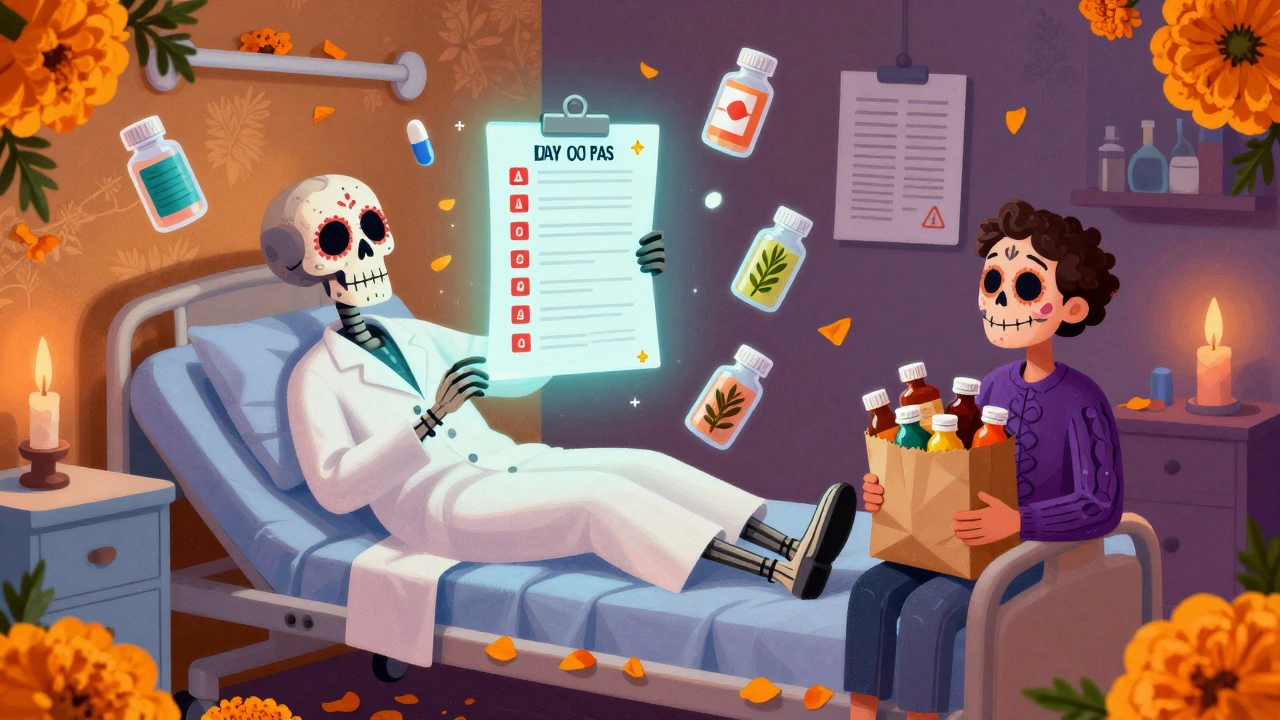
- Create a complete list of all current medications. This includes prescriptions, over-the-counter drugs, vitamins, herbal supplements, and even topical creams. Don’t assume the patient remembers everything. Ask them to bring in all their bottles or call their pharmacy.
- Build the intended medication list. What should they be taking after discharge? This list comes from the care team’s decisions-new prescriptions, discontinued meds, changed doses.
- Compare the two lists. Look for omissions, duplications, incorrect doses, or drug interactions. A patient might be on warfarin at home, but the hospital adds rivaroxaban without realizing it. That’s a major bleeding risk.
- Make clinical decisions and communicate them. Resolve any discrepancies. Document changes clearly. And make sure the patient, their family, and the next provider all get the updated list in plain language.
Skipping any of these steps is like driving with your eyes closed. The AHRQ MATCH toolkit, updated in 2023, gives hospitals detailed guidance on how to do this right. But most facilities only do half the work.
Technology Helps-But Only If Used Right
Computerized Physician Order Entry (CPOE), barcode scanning, and electronic health records (EHRs) have cut medication errors by nearly half in some hospitals. That’s huge. But here’s the catch: when EHRs are poorly implemented, they can actually make things worse.
A 2021 study in JAMA Internal Medicine found that during the first six months after a new EHR launch, medication discrepancies jumped by 18%. Why? Because staff were trying to adapt to a confusing interface. They’d copy-paste old lists without checking. They’d miss alerts. They’d rely on auto-fill that got the dose wrong.
Technology works best when it’s paired with human judgment. A 2023 study in the Journal of the American Pharmacists Association showed that when pharmacists lead reconciliation, post-discharge errors drop by 57% and hospital readmissions fall by 38%. That’s not because the software is smarter-it’s because pharmacists know what to look for. They spot drug interactions, catch duplicate therapies, and ask patients the right questions.
But here’s the problem: only 37% of U.S. hospitals can electronically share medication data with community pharmacies. That means a pharmacist at the hospital might not know what meds the patient got from CVS or Walgreens. So they call. And call. And call again. One pharmacist on Reddit said they spend 20 minutes per patient just trying to get a complete list.
Who’s Responsible? Clear Roles Save Lives
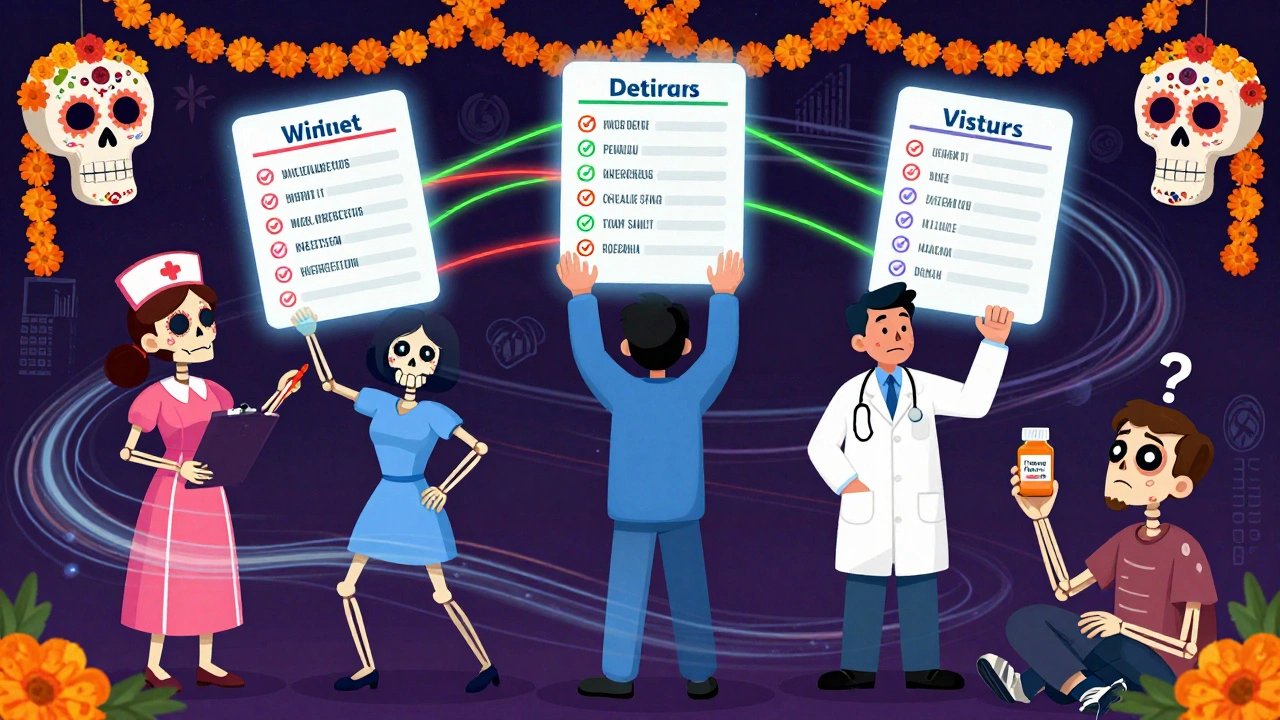
Too many hospitals assign medication reconciliation to whoever is available-nurses, residents, interns. That’s a recipe for failure. The MARQUIS study found that when staff were trained to take medication histories without clear roles, harmful discrepancies went up by 15%.
Successful programs assign specific roles:
- Pharmacists lead reconciliation at admission and discharge. They’re trained to interpret complex regimens and spot hidden risks.
- Nurses verify the list with the patient at bedside, asking: “Do you take this every day? What does it do?”
- Physicians approve the final discharge list and sign off on changes.
- Discharge coordinators make sure the patient gets a printed, easy-to-read list and a follow-up appointment.
Facilities with dedicated transition pharmacists see 53% fewer adverse drug events. That’s not a suggestion-it’s a proven strategy. The American Society of Health-System Pharmacists (ASHP) now recommends pharmacists be embedded in every transition team.
Patients Need to Be Part of the Solution
Most patients don’t know their own medication list. A 2024 Kaiser Family Foundation survey found 72% don’t understand why it matters during transitions. But here’s the flip side: 85% of patients who were actively involved in reconciliation said they felt more confident about their meds.
So how do you get patients involved? Don’t just hand them a sheet of paper. Do this:
- Ask them to bring all their medications to every appointment.
- Use the “brown bag” method-have them empty their pill bottles onto a table.
- Give them a simple, one-page list with the drug name, dose, purpose, and when to take it. No medical jargon.
- Ask: “If you ran out of this, what would you do?” If they say, “I’d just take another one,” that’s a red flag.
Patients who understand their meds are less likely to miss doses, double up, or stop taking something because they think it’s not working. And they’re more likely to call their doctor if something feels off.
Why So Many Programs Fail (And How to Fix Them)
Eighty-seven percent of U.S. hospitals say they have a medication reconciliation process. But only 43% consistently verify information with community pharmacies. Why the gap?
Here are the top reasons programs fail-and how to fix them:
- Too slow. Doctors say reconciliation takes 12-15 minutes per patient. That’s a lot when you’re already behind. Solution: Build it into existing workflows. Don’t add a new task-attach it to admission paperwork or discharge planning.
- Physician resistance. Sixty-three percent of hospitals report doctors won’t participate. Solution: Make it easy. Use templates. Automate reminders. Show them data: “This saved a patient from a bleed last week.”
- No follow-up. Discharge lists get printed, but no one checks if the patient filled the prescriptions. Solution: Partner with community pharmacists. Send a notification when a discharge script is filled.
- Training without accountability. Staff get trained, then go back to old habits. Solution: Track performance. Measure error rates before and after. Reward teams that improve.
The most effective programs take 6-9 months to implement fully. They don’t rely on one tool or one person. They combine people, process, and technology-with clear ownership at every step.
What’s Changing in 2025?
The rules are tightening. The 2025 National Patient Safety Goals, released in December 2024, now require hospitals to verify high-risk medications against at least two independent sources. That means you can’t just rely on the patient’s word or one EHR record. You need to check the pharmacy, the previous provider, and the patient’s own list.
Also in 2024, the FDA cleared MedWise Transition, an AI-powered tool that analyzes medication lists and flags interactions in seconds. In a pilot across 12 hospitals, it reduced discrepancies by 41%. It’s not magic-it’s a decision support tool that helps pharmacists work faster and smarter.
The World Health Organization’s Phase 2 of “Medication Without Harm” is now focused on transitions, with a goal to reduce harm by 30% in high-risk scenarios by 2027. And CMS is watching. Hospitals that don’t meet reconciliation standards risk payment reductions of up to 1.5%.
What You Can Do Right Now
If you’re a patient: Bring your meds to every appointment. Keep a list in your phone or wallet. Ask your pharmacist to review it every six months.
If you’re a provider: Start with one unit. Pick a high-risk group-elderly patients on five or more meds. Assign a pharmacist to lead reconciliation. Track your error rate for 30 days. You’ll see improvement fast.
If you’re a hospital leader: Don’t just buy new software. Fix the workflow. Train your team. Involve patients. Measure results. And don’t wait for the next audit to act.
Medication errors during transitions aren’t inevitable. They’re a system failure. And systems can be fixed-with the right focus, the right tools, and the right people.
What is medication reconciliation?
Medication reconciliation is the process of creating the most accurate list possible of all medications a patient is taking, then comparing it to the list of medications ordered during a care transition-like admission, transfer, or discharge. The goal is to catch and fix any mistakes, such as missing drugs, duplicate prescriptions, or unsafe doses.
Why do medication errors happen most often during discharge?
Discharge is a high-risk moment because multiple providers are involved, communication gaps are common, and patients are often overwhelmed. The hospital team may change medications, but the primary care doctor doesn’t get the update. Patients may not understand new instructions or forget to pick up prescriptions. Without a clear, verified list handed off to the next provider, errors are almost guaranteed.
Can electronic health records prevent medication errors?
Yes-but only if they’re used correctly. EHRs with built-in decision support can reduce errors by up to 32%. But if staff don’t use them properly-copying old lists, ignoring alerts, or entering data incorrectly-they can actually increase discrepancies by 18%. The key is combining technology with trained staff who understand what to look for.
How important is pharmacist involvement?
Critical. Pharmacist-led reconciliation reduces post-discharge medication errors by 57% and hospital readmissions by 38%. Pharmacists are trained to spot drug interactions, duplicate therapies, and inappropriate dosing. They also know how to communicate clearly with patients and other providers. Facilities with dedicated transition pharmacists see 53% fewer adverse drug events.
What’s the biggest barrier to preventing these errors?
The biggest barrier is poor communication between care settings. Only 37% of U.S. hospitals can electronically share medication data with community pharmacies. That means staff waste hours calling pharmacies just to get a complete list. Without seamless data sharing, even the best tools and training can’t fully prevent errors.
Katherine Gianelli
December 3, 2025 AT 02:55Joykrishna Banerjee
December 4, 2025 AT 05:01Myson Jones
December 4, 2025 AT 09:05parth pandya
December 5, 2025 AT 21:08Rashi Taliyan
December 6, 2025 AT 21:01Kara Bysterbusch
December 7, 2025 AT 23:12Gene Linetsky
December 9, 2025 AT 00:38Ignacio Pacheco
December 9, 2025 AT 08:10Jim Schultz
December 10, 2025 AT 04:37