How to Compare Generic Manufacturers and Pill Appearance
 Jan, 11 2026
When you pick up a prescription, you might notice your pills look different than last time. Same name, same dose, but now they’re orange instead of blue, oval instead of round, or have a weird imprint like IP 203 instead of 30. It’s not a mistake. It’s just another generic manufacturer. And if you’re paying out of pocket, you probably don’t care - as long as it works. But what if it doesn’t? Should you worry about the color, shape, or imprint? Here’s how to actually compare generic manufacturers and pill appearance - without falling for myths or panic.
Why Do Generic Pills Look Different?
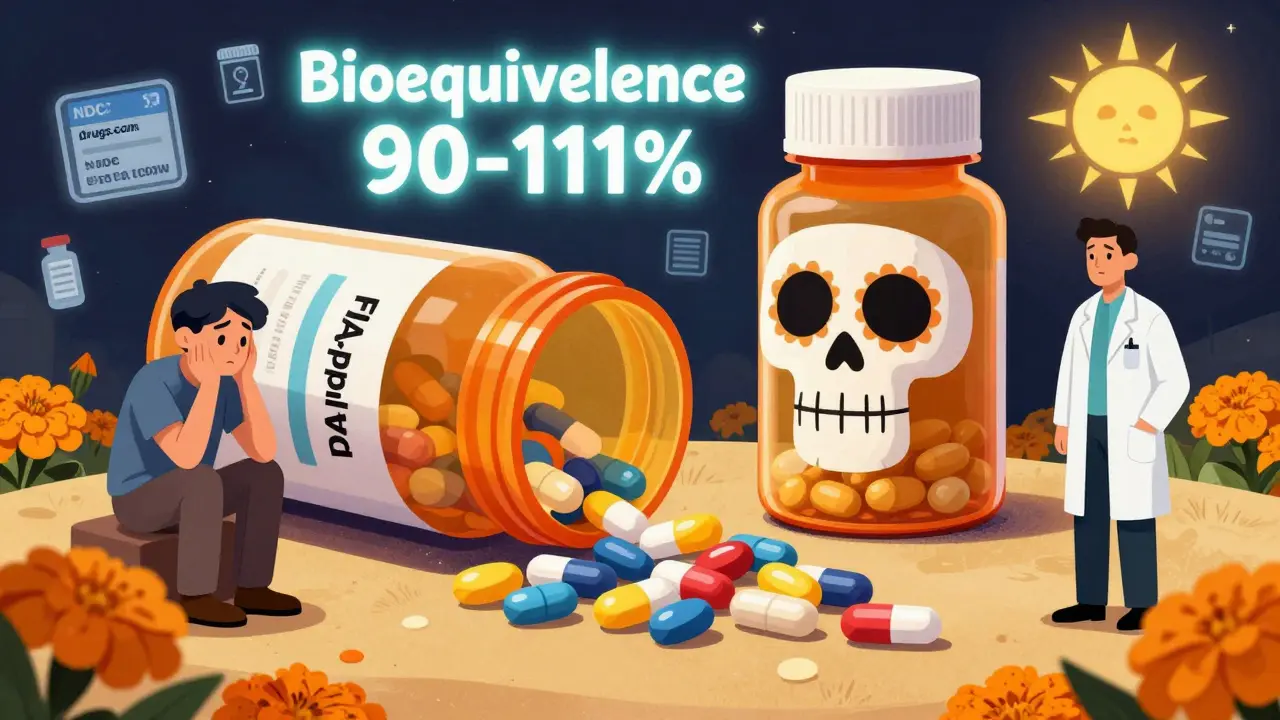
Generic drugs aren’t copies of brand-name pills. They’re legally required to be different in appearance. That’s not a bug - it’s a rule. The U.S. Food and Drug Administration (FDA) bans generic manufacturers from making pills that look exactly like the brand-name version. Why? To avoid trademark infringement. If a generic looked identical, it could confuse patients into thinking they were still getting the brand. So, color, shape, size, and imprint are all changed by law. But here’s the catch: the active ingredient - the part that actually treats your condition - must be identical. The FDA requires generics to deliver the same amount of medicine into your bloodstream at the same rate as the brand. That’s called bioequivalence. For most pills, that means the generic must match the brand within 80-125% of the absorption rate. For high-risk drugs like warfarin or levothyroxine, the range is even tighter: 90-111%. A 2013 FDA study of over 2,000 bioequivalence tests found the average difference in absorption between brand and generic was just 3.5%. That’s less than the variation you’d see between two batches of the same brand-name drug. So appearance doesn’t equal effectiveness.What to Look For: The Pill Identification System
Every prescription pill - brand or generic - must have an imprint. That’s a letter, number, or symbol pressed into the tablet. It’s not decorative. It’s a legal requirement under the 1970 Federal Food, Drug, and Cosmetic Act. The imprint, combined with color and shape, creates a unique identifier. Pharmacists and patients use this to confirm they’re getting the right medication. For example:- A brand-name Lexapro tablet is white, oval, and imprinted with 10.
- A generic version made by Teva is yellow, oval, and imprinted with 93 5.
- Another generic from Mylan is white, round, and imprinted with 54 421.
How to Identify Your Generic Pill
You don’t need to memorize every pill shape. There are tools for that.- Drugs.com Pill Identifier: Used by over 12 million people monthly, this free tool lets you select color, shape, and imprint to find your pill. It shows brand and generic versions side by side.
- Drugs@FDA: The FDA’s official database. Search by drug name or NDC code to see all approved versions, including manufacturer, imprint, and appearance.
- National Drug Code (NDC) Directory: Every pill has a unique 10-digit NDC code. It’s printed on your prescription label. Use it to look up the exact manufacturer and formulation in the FDA’s database.
Which Generic Manufacturers Are Reliable?
Not all generic makers are the same. There are big players, niche players, and low-cost newcomers.- Teva: The world’s largest generic manufacturer. Makes over 1,000 generic drugs in the U.S. Known for consistency and wide availability.
- Mylan (now Viatris): Major player with strong presence in psychiatric and cardiovascular generics.
- Sandoz: A Novartis spin-off. Focuses on complex generics like inhalers and injectables.
- Hikma Pharmaceuticals: Specializes in hard-to-make generics. Often the first to market for complex drugs.
- Local or obscure manufacturers: Some generics come from smaller companies, often overseas. These are still FDA-approved, but may have less consistent supply.
When Appearance Changes Actually Matter
For most people, switching generics is perfectly safe. But there are exceptions. Narrow Therapeutic Index (NTID) drugs are the big concern. These are medications where even a small change in blood level can cause serious side effects or make the drug stop working. Examples:- Warfarin (blood thinner)
- Levothyroxine (thyroid hormone)
- Lamotrigine (seizure and bipolar medication)
- Cyclosporine (organ transplant drug)
Why Some People Feel Different on a New Generic
It’s not all in your head. A 2022 Consumer Reports survey found 41% of patients worry about pill appearance changes. 18% said they’d question their pharmacist if the pill looked different. And 22% of Reddit users reported noticing changes in how they felt after switching generics - especially with antidepressants or anti-seizure meds. This isn’t always pharmacological. Sometimes, it’s psychological. If you believe a different-looking pill is “weaker,” your brain might amplify side effects or downplay benefits. But there’s also a real biological factor: inactive ingredients. For example, some generics use different fillers. One might use lactose, another cornstarch. If you’re sensitive to one, you might get bloating, nausea, or headaches - not because the drug isn’t working, but because your body reacts to the filler. Or a coating might dissolve slower, making the pill take longer to kick in. If you notice a change in how you feel after a generic switch, write down:- What the pill looked like before
- What it looks like now
- When you noticed the change
- Any new symptoms
Cost vs. Consistency: The Real Trade-Off
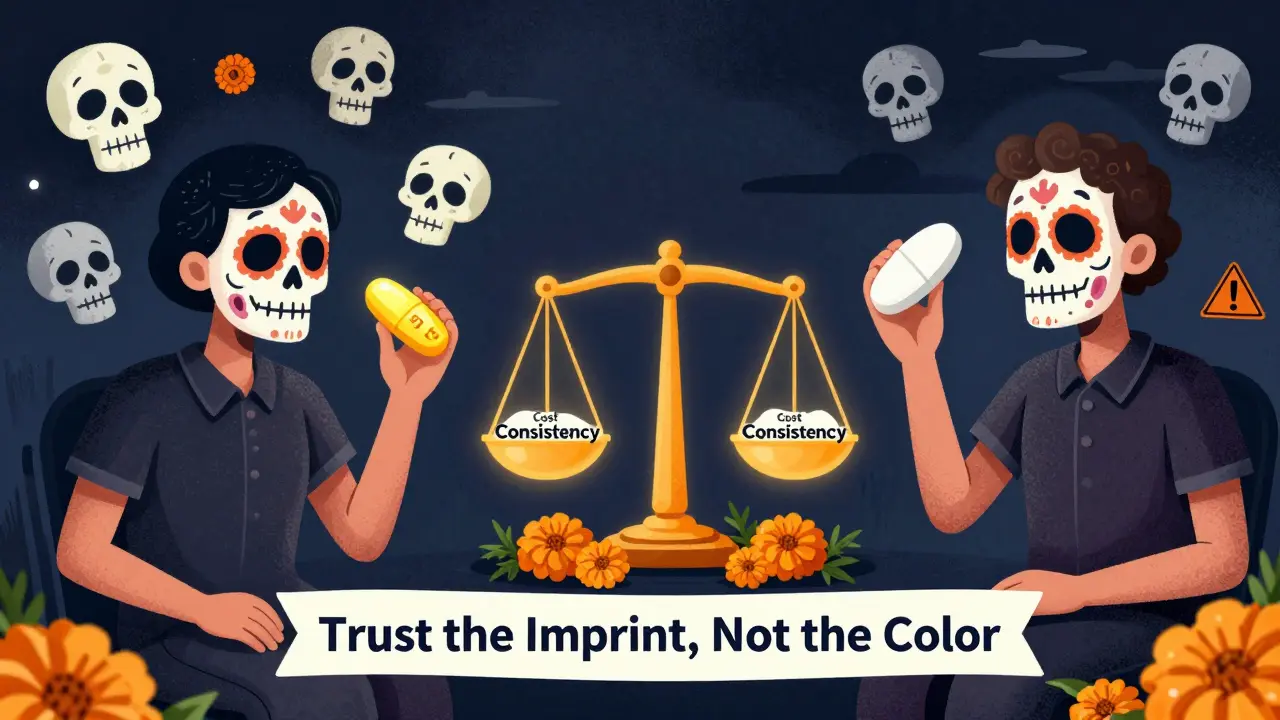
Generics save money - a lot of it. In the U.S., generics make up 90% of prescriptions but only 23% of drug spending. The average patient saves $265 a month by switching from brand to generic. But price drops fast. When a new generic enters the market, the first one often costs 80% of the brand. With three competitors, it drops to 60%. With ten or more, it can fall to 15-20% of the original price. That’s great for insurers and Medicare. But it also means manufacturers are under pressure to cut costs. That can lead to:- More frequent switches between manufacturers
- Shorter supply chains
- Higher risk of shortages
What to Do If You’re Unsure
If you’re confused about your pill, don’t guess. Don’t stop taking it. Don’t assume it’s fake. Here’s what to do:- Check the prescription label. It should list the generic manufacturer’s name.
- Use Drugs.com or Drugs@FDA to look up the imprint, color, and shape.
- Call your pharmacy. Ask: “Is this the same medication I got last time? What manufacturer is this?”
- If you’re on an NTID drug and it changed, call your doctor. Ask if you can stick with your previous generic.
Final Takeaway: Trust the Science, Not the Color
Generic drugs work. The FDA, the European Medicines Agency, Harvard Medical School, and the American Medical Association all agree: for 99.9% of prescriptions, generics are just as safe and effective as brand-name drugs. The pill’s color doesn’t tell you if it’s good or bad. The imprint does. The manufacturer’s history does. The NDC code does. But not the shape. If you’re on a routine medication - blood pressure, cholesterol, diabetes - don’t stress about appearance. Save the money. Use the tools. Talk to your pharmacist. If you’re on a high-risk drug - thyroid, seizure, blood thinner - ask to stay on the same generic. It’s worth the few extra dollars. And if you ever feel off after a switch? Don’t ignore it. Document it. Ask questions. Your health isn’t about the color of the pill. It’s about knowing exactly what’s inside it.Why do generic pills look different from brand-name pills?
Generic pills must look different from brand-name pills by law to avoid trademark infringement. The FDA requires changes in color, shape, size, or imprint so patients don’t confuse generics with the original brand. But the active ingredient - the medicine that treats your condition - must be identical in strength, dosage, and how it works in your body.
Are generic drugs as effective as brand-name drugs?
Yes, for the vast majority of medications. The FDA requires generics to prove they deliver the same amount of medicine into your bloodstream at the same rate as the brand. Studies show the average difference in absorption is only 3.5%, which is less than the variation between two batches of the same brand-name drug. Over 90% of prescriptions in the U.S. are filled with generics because they’re proven safe and effective.
Can switching between generic manufacturers cause side effects?
Usually not. But for drugs with a narrow therapeutic index - like warfarin, levothyroxine, or lamotrigine - even small changes in inactive ingredients (like fillers or coatings) can affect how your body responds. Some patients report mood changes, seizures, or unstable lab results after switching manufacturers. For these drugs, it’s best to stick with the same generic brand unless your doctor says otherwise.
How do I know if my pill is the right generic?
Use the imprint, color, and shape to identify it. Search the exact details on Drugs.com’s Pill Identifier or the FDA’s Drugs@FDA database. You can also check the National Drug Code (NDC) on your prescription label - it tells you the exact manufacturer and formulation. If you’re unsure, call your pharmacy. They can confirm you got the correct medication.
Should I always use the same generic manufacturer?
For most drugs, no - switching is safe and saves money. But for narrow therapeutic index drugs (NTIDs), staying with the same manufacturer is recommended. These include medications for thyroid, epilepsy, blood thinning, and organ transplants. Ask your doctor to write “Dispense as Written” (DAW-1) on your prescription to avoid automatic substitutions.
What should I do if I feel worse after switching to a new generic?
Don’t stop taking your medication. Write down the old and new pill’s appearance (color, shape, imprint), when you noticed the change, and any new symptoms. Call your pharmacist to confirm the manufacturer changed. Then talk to your doctor. They can check the NDC code and request your previous generic if needed. Sometimes, the issue is a reaction to an inactive ingredient - not the medicine itself.
gary ysturiz
January 11, 2026 AT 13:23Just had my generic Lexapro switch from white oval to yellow oval last week. Thought I was getting ripped off. Checked the imprint - 93 5 - and looked it up on Drugs.com. Same active ingredient. Saved $40 this month. No side effects. Trust the code, not the color.
Pharmacists aren’t there to scare you. They’re there to help.
Craig Wright
January 12, 2026 AT 07:32It is a matter of public record that the United States permits inferior pharmaceuticals to be distributed under the guise of "generic" equivalents. In the UK, we maintain stricter standards. The active ingredient may be identical, but the excipients - the fillers, binders, and coatings - are held to far higher purity thresholds. This is why British patients report fewer adverse reactions to generics. The FDA’s 80-125% bioequivalence window is a scandal.
Lelia Battle
January 12, 2026 AT 08:51I’ve been on levothyroxine for 12 years. Switched generics three times. The first time, I felt foggy for two weeks. Didn’t tell anyone. Thought it was stress. Then I started tracking the NDC codes. Turns out, the Teva version always worked best for me. My doctor was surprised I knew to ask. Turns out, your body remembers the formulation. It’s not placebo. It’s biology.
Don’t just accept the change. Ask for the code. Write it down. Your thyroid will thank you.
Rinky Tandon
January 14, 2026 AT 08:06OMG YOU GUYS. I switched to some random Indian generic for my lamotrigine and had a seizure. Like, full-on convulsions. Turned out the pill had magnesium stearate instead of microcrystalline cellulose. My neurologist said it’s a known issue with 3rd-tier manufacturers. You think you’re saving money? You’re risking your brain. The FDA doesn’t even inspect half these factories. Read the NDC. If it ends in 82 or 99, RUN. Those are the bad ones. I’m telling you - this is a death sentence waiting to happen.
Ben Kono
January 15, 2026 AT 14:15Why do people care so much about pill color I dont get it
Its the same drug
Same dose
Same thing
Stop overthinking it
Unless you on warfarin or something then yeah check the code
But for ibuprofen just take the damn pill
Cassie Widders
January 16, 2026 AT 03:18I used to panic every time my pills changed. Then I started using Drugs.com. Now I just glance at the imprint and move on. It’s like recognizing a friend’s face even if they changed their hairstyle. The core is still there.
Also, my pharmacist gave me a little card with my usual generic’s imprint. I keep it in my wallet. Saved me last month when they tried to swap me out again.
Konika Choudhury
January 16, 2026 AT 13:53India makes the best generics in the world and you people are scared of them
My mom takes 6 different generics from Indian companies and she’s 78 and still hikes every weekend
Stop listening to American fearmongering
They just want you to pay more for brand names
Trust the science not the color
Darryl Perry
January 17, 2026 AT 11:39The FDA’s bioequivalence standards are a joke. 80-125%? That’s a 45% swing. No other regulated product in America gets that leeway. You wouldn’t accept a 45% variance in brake pads or insulin syringes. Why accept it in your bloodstream?
And yes, I’ve seen patients crash on NTID switches. It’s not anecdotal. It’s systemic. Stop normalizing this.
Windie Wilson
January 18, 2026 AT 21:49So let me get this straight - we’ve spent decades conditioning people to associate pills with colors and shapes, then the FDA says ‘lol nope, now they all look like alien candy’ - and we’re supposed to chill?
It’s like if your favorite cereal suddenly switched from Frosted Flakes to neon green flamingo-shaped flakes. The sugar’s the same, but now you’re crying in the aisle wondering if it’s still breakfast.
Psychology + capitalism = pharmaceutical chaos.
Daniel Pate
January 18, 2026 AT 22:43There’s an interesting epistemological question here: if two pills are chemically identical but differ in inert components, and one causes a subjective change in the user, is the drug still the same? Or has the entire pharmacological experience been redefined by the vehicle, not the payload?
We treat the pill as a black box, but the body doesn’t. The coating, the filler, the dissolution rate - these aren’t just packaging. They’re part of the delivery system. And if the system changes, the signal changes. Even if the source is unchanged.
Amanda Eichstaedt
January 19, 2026 AT 17:37I’m a nurse and I’ve seen this so many times. A patient comes in saying ‘I feel different’ after a generic switch. We check the NDC. Sure enough - new manufacturer. Sometimes it’s the filler. Sometimes it’s the coating. Sometimes it’s just the stress of thinking it’s different.
But here’s the thing - if they say they feel off, we don’t dismiss it. We look up the manufacturer. We check for recalls. We call the pharmacy. We don’t assume it’s ‘in their head.’
Because sometimes, it’s not.
And that’s why we have tools. And why we ask questions.
Jay Powers
January 20, 2026 AT 21:09My dad’s on warfarin and we’ve stuck with Teva for 5 years now. Even when the price jumped 30%, we paid it. Because we learned the hard way - last time they switched to a cheaper one, his INR went wild. Took three weeks to stabilize.
Generics are great. But some things aren’t worth the gamble. If your life depends on it, pay the extra bucks. Your body knows the difference even if the label says it shouldn’t.