How Pharmacists Verify Generic Equivalence: Practice Standards
 Jan, 13 2026
When a pharmacist hands you a pill bottle with a different name than what your doctor wrote, you might wonder: is this really the same thing? It’s not just a label swap. There’s a rigorous, science-backed system in place to make sure that generic drugs work just like their brand-name counterparts - and pharmacists are the ones who check it every single day.
What Does "Therapeutic Equivalence" Actually Mean?
Generic drugs aren’t copies. They’re exact matches in active ingredients, strength, and how they’re taken - but proving they work the same way in your body takes more than just matching ingredients. That’s where therapeutic equivalence comes in. It means the generic drug delivers the same amount of medicine into your bloodstream at the same rate as the brand-name version. If it doesn’t, it’s not approved for substitution.The U.S. Food and Drug Administration (FDA) sets the bar. For most drugs, the generic must show that the amount of drug absorbed (called AUC) and the peak concentration in your blood (Cmax) fall within 80% to 125% of the brand-name drug. That’s not a guess - it’s a statistically proven range developed over decades of clinical data. For most people, this tiny variation has zero impact on how the drug works.
But some drugs are trickier. Think levothyroxine for thyroid issues, warfarin for blood thinning, or seizure medications. These have a narrow therapeutic index - meaning even a small change can cause harm. For those, the FDA sometimes tightens the range to 90-111%. Pharmacists know this. They don’t just look at the name on the bottle. They check the rating.
The Orange Book: The Pharmacist’s Bible
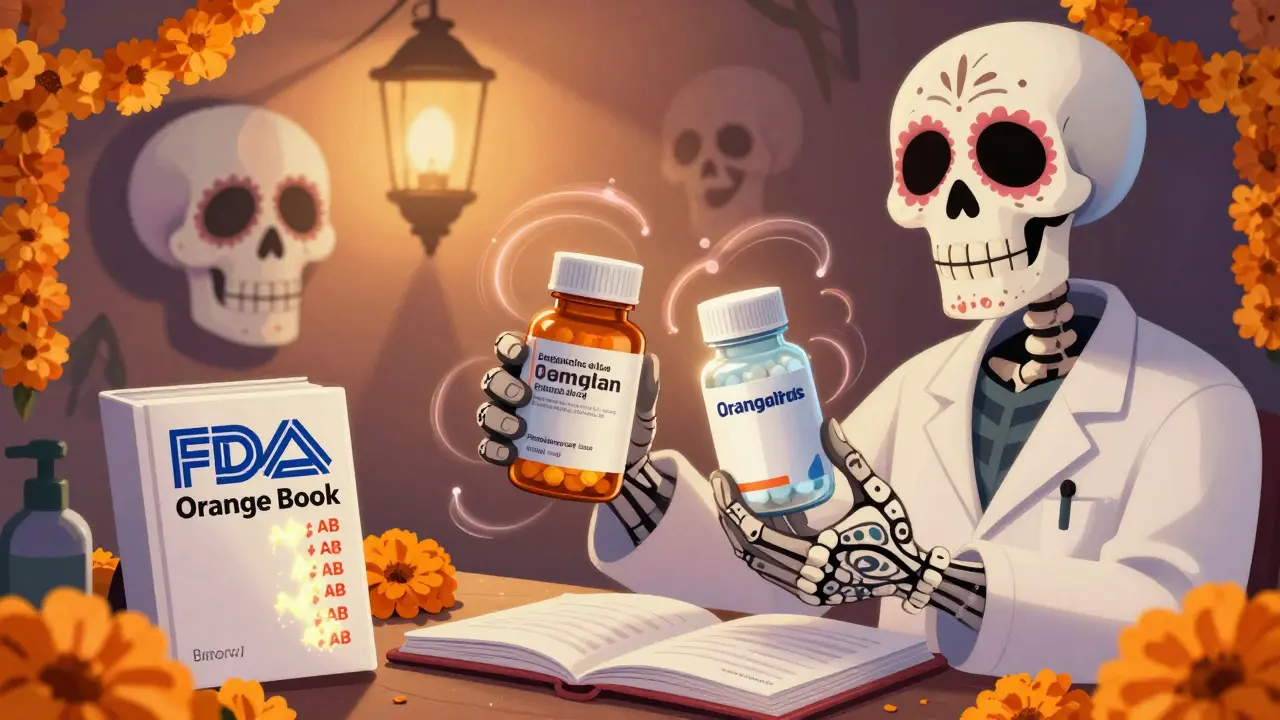
The official tool every U.S. pharmacist uses is called the Approved Drug Products with Therapeutic Equivalence Evaluations. Everyone calls it the Orange Book. First published in 1980, it’s updated monthly and lists over 16,500 drug products as of 2024. Of those, more than 15,900 are rated as therapeutically equivalent - meaning they can be swapped without risk.The ratings use a simple two-letter code. If you see "AB," that’s the gold standard. It means the generic is pharmaceutically equivalent (same ingredients, same dose, same form) AND bioequivalent (proven to work the same in your body). That’s the only rating that allows automatic substitution under state law.
Other codes exist. "AN" for nasal sprays, "AO" for oral liquids, "AT" for topical creams - these tell pharmacists what kind of product it is and how it was tested. But only "A" ratings mean substitution is legally allowed. "B" ratings? Those are flagged. They’re not approved for substitution. Pharmacists don’t even consider them as alternatives unless the prescriber specifically orders them.
And here’s the key: the Orange Book isn’t just a reference. It’s the law. Every state except Massachusetts requires pharmacists to use it as the primary tool for verifying equivalence. In Texas, a pharmacist was sanctioned in 2019 for substituting a drug not listed in the Orange Book. The court ruled: no Orange Book rating, no substitution.
How Pharmacists Actually Check It - Step by Step
It doesn’t take long. Most checks take 8 to 12 seconds. Here’s how it works in real time:- Find the reference drug. The prescription says "Lipitor 20mg." The pharmacist looks up the brand name in the Orange Book to find the official Reference Listed Drug (RLD).
- Match the active ingredient and strength. The generic bottle says "atorvastatin 20mg." That matches. If it said 10mg or 40mg? No substitution.
- Check the TE code. Is it "AB"? If yes, it’s approved. If it’s "B" or no code at all? Stop. Call the prescriber.
- Look for "Do Not Substitute" flags. Even if the drug is rated "AB," if the doctor wrote "Dispense as Written" or "DAW 1," the pharmacist must fill the brand name. No exceptions.
Most pharmacists use the free FDA Orange Book mobile app - downloaded over 450,000 times by March 2024. Others use pharmacy software like PioneerRx or QS/1 that pulls the data directly into their dispensing system. Either way, the Orange Book is the source.
Commercial databases like Micromedex or Lexicomp are helpful for extra info - but they’re not legal substitutes. A 2021 study found 99.3% of pharmacists rely on the Orange Book as their main tool. Only 62.7% use other databases at all, and only as backup.
What Happens When a Drug Isn’t in the Orange Book?
About 5.7% of generic substitutions involve drugs not yet listed. This happens with new products, complex formulations like inhalers or topical creams, or when the FDA is still reviewing data.When that happens, pharmacists don’t guess. They follow the FDA’s "Non-Orange Book Listed Drugs" framework. They check the FDA’s product-specific guidance documents, review published bioequivalence studies, and consult with the prescriber. Some complex drugs - like certain nasal sprays or topical steroids - require special testing because traditional blood-level measurements don’t fully capture how they work in the body.
That’s why the FDA has developed over 1,850 product-specific guidances as of mid-2024. These give detailed instructions on how to test equivalence for tricky drugs. Pharmacists aren’t expected to know them all by heart - but they know where to find them and when to escalate.
Why This System Works - And Why It’s Trusted
Critics sometimes say generics aren’t as good. But the data says otherwise. A 2020 FDA meta-analysis looked at over 1.2 million patient records and found no difference in adverse events between brand and generic drugs - 0.78% for brand, 0.81% for generic. The difference? Statistically meaningless.A 2023 study of 2,147 bioequivalence studies showed that 97.8% of generics had less than a 5% difference in how much drug reached the bloodstream. That’s tighter than most manufacturing tolerances for brand-name drugs.
And the system is safe. The American Society of Health-System Pharmacists reports substitution error rates of just 0.03% when pharmacists follow the Orange Book correctly. That’s fewer than 3 mistakes per 10,000 prescriptions.
Dr. Lawrence Yu, former FDA deputy director, put it simply: "The 80-125% window isn’t arbitrary. It’s the point where you can be confident the patient won’t notice a difference in effect."

The Bigger Picture: Why This Matters
In 2023, 90.7% of all prescriptions filled in the U.S. were generics. That’s 8.9 billion prescriptions. Without this verification system, the entire $621 billion generic drug market would collapse under fear and uncertainty.Pharmacists aren’t just dispensing pills. They’re gatekeepers of safety. Every time they check the Orange Book, they’re protecting patients from ineffective or dangerous substitutions. And they’re saving the healthcare system billions. The average generic saves $15-$30 per prescription. Multiply that by billions - that’s where the $12.7 billion annual safeguard comes from.
But the system is evolving. Biosimilars - complex biologic drugs that mimic things like Humira or Enbrel - are entering the market. The FDA’s "Purple Book" lists them, but only 47 out of 350 approved biosimilars are currently rated for substitution as of June 2024. Pharmacists are learning how to verify these too - but it’s harder. Blood levels don’t tell the whole story. Immune responses matter. Manufacturing processes matter more.
The FDA has allocated $28.5 million through GDUFA III to develop better methods for testing complex generics. That means pharmacists will soon have new tools - but the principle stays the same: verify, don’t assume.
Training and Accountability
New pharmacists don’t learn this in a lecture. They learn it by doing. The National Community Pharmacists Association says 92.4% of pharmacies require formal Orange Book training during onboarding. It’s usually 2 to 4 hours of hands-on practice - searching, interpreting codes, handling edge cases.After training, competency tests show 89.3% accuracy in equivalence verification. That’s not perfect - but it’s good enough to keep patients safe. And when mistakes happen, they’re rare, and they’re usually traced back to skipping the Orange Book.
There’s no room for shortcuts. The law doesn’t allow it. The science doesn’t support it. And the patients deserve better.
Can a pharmacist substitute a generic drug without the doctor’s permission?
Yes - but only if three conditions are met: the drug is rated "AB" in the FDA Orange Book, the prescription doesn’t say "Dispense as Written," and state law allows substitution. In 49 states, pharmacists can swap an "AB"-rated generic unless the prescriber explicitly blocks it. Massachusetts is the only state that doesn’t allow automatic substitution.
Are all generic drugs listed in the Orange Book?
No. Only generics that have been reviewed and approved by the FDA for therapeutic equivalence are listed. New generics may take weeks or months to appear. Some complex products - like inhalers, nasal sprays, or topical creams - may not yet have established bioequivalence standards, so they’re not rated. Pharmacists must use alternative guidance for these.
Why do some generic drugs look different from the brand name?
The active ingredient is the same, but the inactive ingredients - like color, shape, or filler - can differ. U.S. law doesn’t allow generics to look identical to brand drugs to prevent confusion. That’s why the label, not the appearance, matters. Pharmacists check the active ingredient and strength, not the pill color.
What happens if a pharmacist substitutes a drug not rated "AB"?
It’s a violation of state pharmacy law and opens the pharmacist to liability. In the 2019 Texas case State Board of Pharmacy v. Smith, a pharmacist was disciplined for substituting a non-Orange Book-rated generic. Even if the drug worked fine, the lack of official approval made the substitution illegal. Pharmacists are trained to avoid this risk.
Do biosimilars use the same verification system as generics?
No. Biosimilars are complex biological products, not small-molecule drugs. They’re tracked in the FDA’s Purple Book, not the Orange Book. Verification is more complicated because they can’t be exact copies - their structure is too complex. Pharmacists need specialized training and rely on FDA’s "interchangeability" designations, which are still rare. Only 47 of 350 approved biosimilars have that designation as of mid-2024.
Alvin Bregman
January 13, 2026 AT 17:17so like if my pill looks different now but same name its still good right
Andrew Freeman
January 14, 2026 AT 17:04the orange book is just a glorified spreadsheet and half these pharmacists dont even read it they just trust the software
Sarah -Jane Vincent
January 15, 2026 AT 02:01you think the FDA actually checks this stuff or do they just rubber stamp whatever Big Pharma pays for? i’ve seen generics that made me dizzy and others that just did nothing. the 80-125% window? that’s not science thats a corporate loophole
says haze
January 16, 2026 AT 18:31It’s not merely a regulatory framework-it’s a hermeneutic of pharmaceutical trust. The Orange Book functions as a semiotic artifact, mediating between the ontological certainty of chemical composition and the phenomenological uncertainty of bodily response. When a pharmacist consults it, they are not merely verifying equivalence-they are performing a ritual of epistemic authority in an age of pharmacological alienation.
Dylan Livingston
January 17, 2026 AT 13:51oh wow so the pharmacist is the hero of modern medicine? how touching. meanwhile i’m paying $4 for a pill that makes me feel like i swallowed a rock, and you’re over here writing poetry about the orange book like it’s the dead sea scrolls. someone’s getting rich off this charade and it ain’t me.
shiv singh
January 19, 2026 AT 04:40you americans think you invented medicine but we in india make 70% of the world’s generics and no one checks anything there. if you want real safety stop pretending your bureaucracy is flawless
Vicky Zhang
January 20, 2026 AT 03:11thank you for explaining this so clearly. i used to panic every time my pill changed color but now i know it’s not about the shape or the dye-it’s about the science behind it. pharmacists are quiet heroes and we should all be more grateful
Sarah Triphahn
January 20, 2026 AT 18:12you know what’s funny? the same people who scream about generics being unsafe are the ones who buy $300 brand name insulin. the system works fine. you just don’t like that it saves you money
Susie Deer
January 20, 2026 AT 19:30we dont need some federal book telling us what to take. this is america. let the people decide. if you dont like your generic go buy the brand and shut up about it
Robert Way
January 20, 2026 AT 21:58wait so if the orange book says AB but the pharmacy software says B which one do they use? i think i got a bad batch once and its still haunting me
Anna Hunger
January 22, 2026 AT 09:05Thank you for your comprehensive and meticulously researched exposition on therapeutic equivalence. The rigor with which pharmacists uphold public safety through adherence to FDA-established standards is both commendable and essential. This system, while imperfect, remains the most scientifically defensible framework for ensuring equitable access to safe, effective medication across socioeconomic strata.
Allison Deming
January 22, 2026 AT 21:12It is deeply concerning that the public perceives pharmacists as mere dispensers rather than clinical gatekeepers. The Orange Book is not a suggestion-it is a codified legal and ethical mandate. To disregard it is not merely negligence; it is a betrayal of the Hippocratic oath. Every pharmacist who skips verification is gambling with lives, and the system must hold them accountable-not with platitudes, but with discipline.
TooAfraid ToSay
January 23, 2026 AT 22:18so you’re telling me the FDA approves a drug that’s 20% weaker and calls it safe? that’s not equivalence that’s corporate fraud. and now you want me to trust a 47 out of 350 rating system for biosimilars? laughable. the real story is they’re just trying to push cheaper drugs while hiding behind science