Health Literacy and Generics: Closing the Knowledge Gaps That Cost Lives and Money
 Jan, 30 2026
Every year, millions of people stop taking their meds-not because they feel better, but because they don’t understand what’s in the pill they’re holding. A little white capsule today, a big blue one tomorrow. Same prescription. Same doctor. But the brand name is gone. And suddenly, something feels wrong.
This isn’t just confusion. It’s a crisis in health literacy. And it’s costing lives, hospitals, and wallets.
Here’s the hard truth: 80 million American adults struggle to understand basic health information. That means when a pharmacist hands them a generic version of their blood pressure pill, 63% of those with low health literacy can’t even find the active ingredient on the label. They see a different shape, a different color, a different name-and they think it’s not the same drug. So they stop taking it. Or worse, they double up because they’re scared it’s not working.
The FDA says generics are identical in strength, safety, and effectiveness to brand-name drugs. But 68% of patients still believe generics are weaker. Why? Because no one ever explained it to them in plain language.
What Exactly Is a Generic Medication?
A generic drug isn’t a copy. It’s not a knockoff. It’s the exact same medicine, just without the marketing budget.
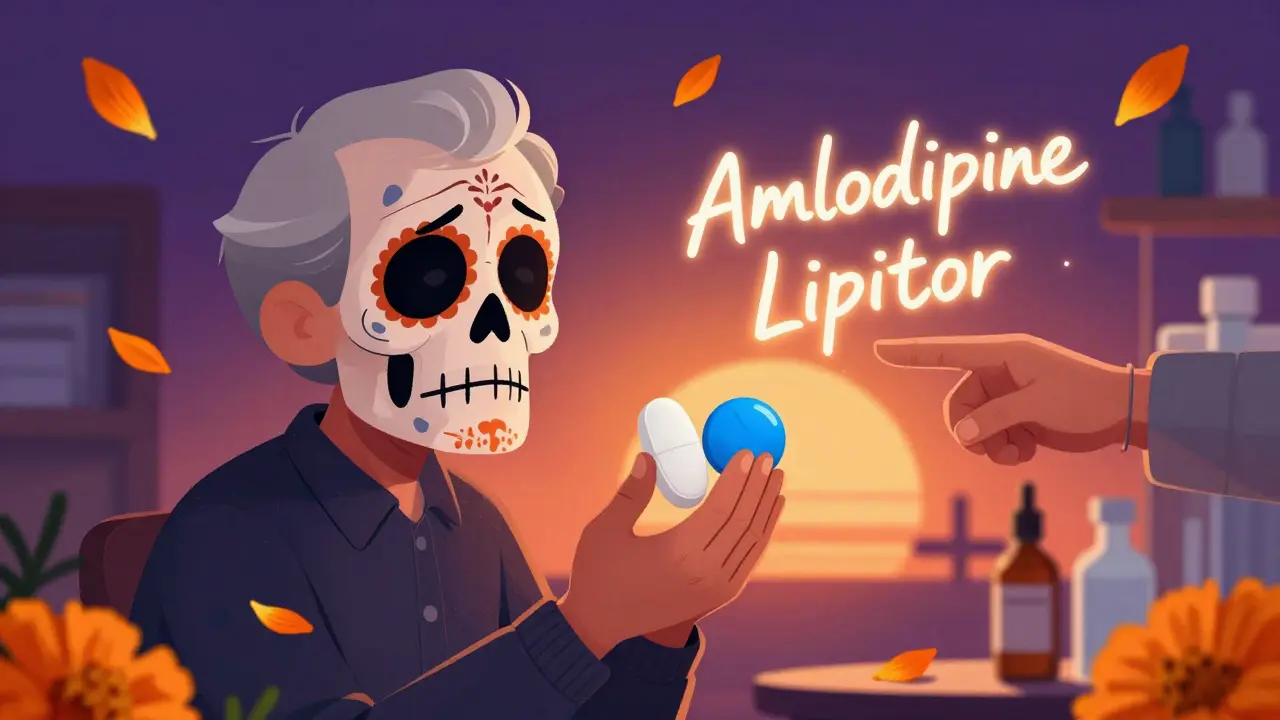
Every generic must contain the same active ingredient, in the same dose, and work the same way in your body as the brand-name version. The FDA requires it. The difference? The inactive stuff-dyes, fillers, coatings. That’s why a generic version of Lipitor might be oval and white, while the brand is blue and round. Those extras don’t affect how the drug works. But they sure mess with your head if you don’t know that.
And yes, generics have to prove they’re absorbed the same way in your bloodstream. That’s called bioequivalence. It means the amount of drug in your blood is within 80-125% of the brand-name version. That’s not a loophole. That’s science. It’s the same standard used for every drug approved in the U.S.
Yet, 47% of people with low health literacy don’t realize generics contain the same active ingredients. That’s not a lack of intelligence. It’s a lack of clear communication.
Why People Stop Taking Generics
Let’s look at real stories.
One man on Reddit stopped his blood pressure med because the generic looked nothing like what he’d been taking. He thought his doctor had switched him to a weaker drug. His pharmacist had to sit down with him, show him the label, point out the active ingredient-amlodipine-and explain: “It’s the same medicine. Just a different pill.”
Another woman switched to a generic antidepressant and didn’t realize it was the same as her old one. She thought it was a new prescription. She took both-brand and generic-together. She ended up in the ER with serotonin syndrome.
These aren’t rare cases. They’re symptoms of a broken system. When patients don’t understand what’s happening, they don’t trust it. And when they don’t trust it, they stop.
Studies show patients with low health literacy are 32% more likely to be hospitalized because of medication errors. And 23% less likely to take their meds as prescribed. That’s not just about pills. It’s about fear, confusion, and silence.
The Cost of Not Knowing
It’s not just personal. It’s financial.
Generics make up 90% of all prescriptions filled in the U.S. But they account for only 23% of total drug spending. That’s billions saved-if people take them.
When patients refuse generics because they think they’re inferior, they end up on expensive brand-name drugs they don’t need. That costs employers and insurers $1.2 billion a year in wasted spending. And when people skip doses or take too much because they’re confused, emergency room visits spike. One study found that when patients understand generics, they’re 14% less likely to end up in the ER. That’s $675 saved per person, every year.
And here’s the kicker: hospitals spend more treating complications from medication errors than they save by prescribing generics. It’s a self-inflicted wound.
Who’s Most at Risk?
This isn’t a problem that affects everyone equally.
Older adults? They’re more likely to take multiple meds. And more likely to struggle with reading small print or remembering instructions.
Immigrants and non-English speakers? They’re 3.2 times more likely to misunderstand generic labels. And most medication instructions are only available in English.
People with lower incomes? They’re more likely to be switched to generics-and more likely to lack access to a pharmacist who takes time to explain.
These aren’t just “vulnerable populations.” They’re our neighbors, our parents, our coworkers. And they’re being failed by a system that assumes everyone can read a label like a pharmacist.
What Works: Real Solutions That Help
There’s good news. We know how to fix this.
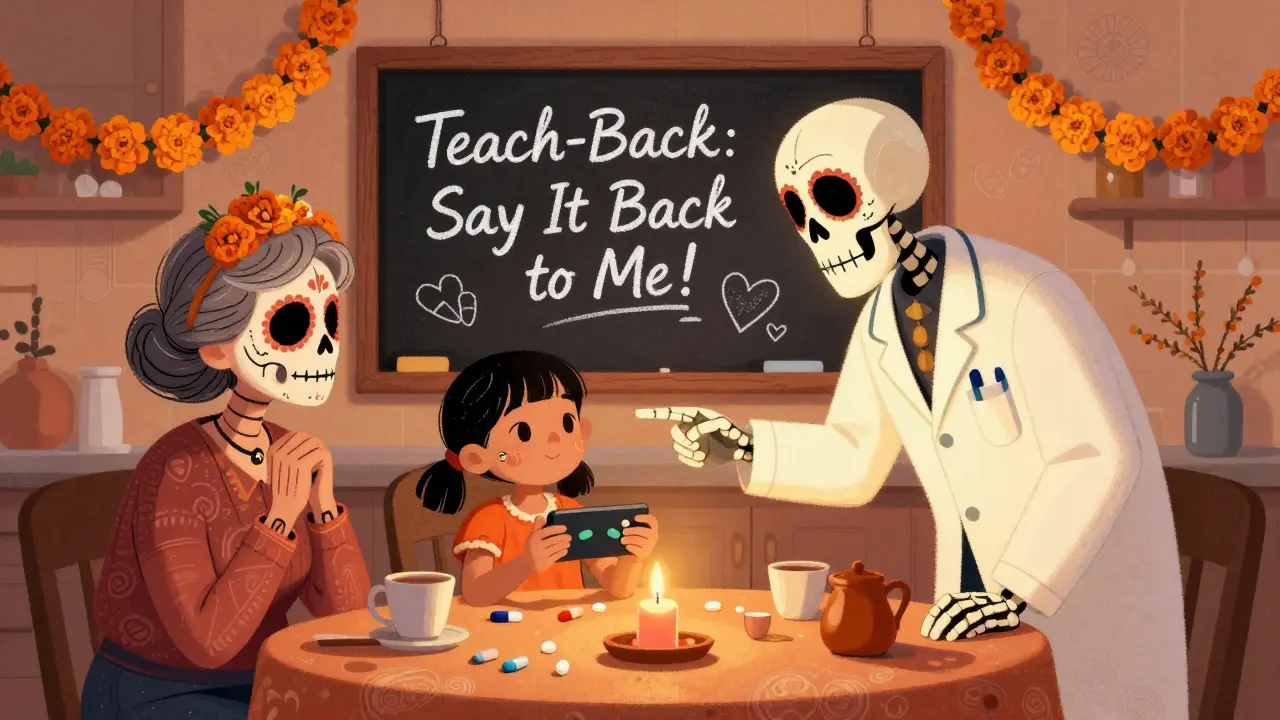
One of the most powerful tools? The Teach-Back method. Instead of asking, “Do you understand?”-which most people say yes to, even if they don’t-pharmacists ask: “Can you tell me in your own words how you’ll take this pill?”
Studies show this cuts misunderstandings by 42%. When patients can explain it back, they remember it. And they’re 83% more likely to stick with their meds.
Visual aids help too. A simple side-by-side picture of the brand and generic pill, with the active ingredient circled, makes all the difference. A 2022 study found patients using an app with pill images recognized generics 35% better than those who just got verbal instructions.
Plain language labels matter. Instead of “Take one tablet by mouth daily,” try: “Take one pill every morning with water.” No jargon. No Latin. No assumptions.
And it’s not just the pharmacist’s job. Doctors need to say it too. When your doctor says, “I’m switching you to a generic-it’s the same drug, just cheaper,” that’s a teachable moment. Don’t assume they’ll get it. Say it clearly.
What’s Being Done-and What’s Not
The FDA launched a “Generics Awareness Campaign” in early 2023. The CDC added generic medication understanding to its 2023 Health Literacy Action Plan. Medicare Part D plans now have to assess patient health literacy starting in 2024.
But here’s the gap: only 38% of healthcare organizations have any program at all focused on helping patients understand generics. Most still treat it like a billing issue-not a health issue.
And most training for pharmacists? It’s still focused on filling prescriptions, not explaining them.
Health systems that do invest in this see results: a 27% drop in generic-related errors within 18 months. That’s not magic. That’s training. That’s time. That’s care.
What You Can Do Right Now
If you’re taking a generic:
- Check the label. Find the active ingredient. Write it down.
- Compare it to your old prescription. Are they the same? If not, ask.
- Ask your pharmacist: “Is this the same medicine as before? What’s different?”
- Use the Teach-Back trick: “So, just to make sure I got this right-you’re saying this pill works the same as the blue one, right?”
If you’re a caregiver or family member:
- Help them read the label. Don’t assume they know what “amlodipine” means.
- Take pictures of old and new pills. Put them side by side.
- Call the pharmacy. Ask them to explain it again. You’re not being annoying-you’re saving a life.
If you’re a healthcare provider:
- Stop saying “It’s the same.” Say “It has the same active ingredient, same dose, same effect. The only difference is the color and the price.”
- Use plain language. Always.
- Use the Teach-Back method. Every time.
- Don’t assume your patient knows what “generic” means. Ask them to explain it back.
The Bigger Picture
This isn’t just about pills. It’s about trust.
When people don’t understand their meds, they don’t trust the system. They don’t trust their doctor. They don’t trust the pharmacy. And they don’t trust themselves.
Health literacy isn’t about reading level. It’s about dignity. It’s about giving people the power to make informed choices about their own bodies.
Generics aren’t the enemy. Confusion is.
And closing that gap? It’s not expensive. It’s not complicated. It just takes time. And care.
Next time you hand someone a generic pill, don’t just hand it over. Explain it. Show it. Let them say it back.
That’s how you save money. That’s how you save lives.
Jodi Olson
January 30, 2026 AT 20:47It’s not about the pill. It’s about the silence between the doctor and the patient. We hand out prescriptions like they’re coupons and expect people to magically understand the stakes. No one teaches you how to read a label. No one says, ‘This is your body, and this is how it works.’ We treat health like a transaction, not a relationship.
Generics aren’t inferior. But the system that delivers them is broken.
Amy Insalaco
January 31, 2026 AT 12:50Let’s be clear: the pharmacoeconomic absurdity of this issue stems from a fundamental epistemological failure in public health communication. The FDA’s bioequivalence thresholds-80–125% AUC-are statistically valid, yet the layperson’s phenomenological experience of pill morphology overrides empirical data. This is not ignorance; it’s embodied epistemic dissonance. The cognitive dissonance induced by visual discontinuity triggers a primal mistrust response, which, when unmediated by linguistic scaffolding, manifests as nonadherence. The real problem isn’t literacy-it’s the absence of semiotic reconciliation between pharmaceutical identity and perceptual schema.
owori patrick
February 2, 2026 AT 12:29This hits home for me. In Nigeria, many people think generics are ‘second-hand’ medicine because they look different. I’ve sat with elders in my village and drawn pictures of pills side by side-brand and generic-with the active ingredient circled. They didn’t need a PhD to understand. They needed someone to sit with them. No jargon. Just patience.
Health isn’t about who speaks the loudest. It’s about who shows up.
Claire Wiltshire
February 3, 2026 AT 20:22I’m a pharmacist, and I use the Teach-Back method every single time. It’s not extra work-it’s the work. I ask patients to show me how they’d take the pill. If they hesitate, I know I didn’t explain well enough. I’ve had patients cry because they thought they’d been poisoned. One woman said, ‘I didn’t know the medicine could look different and still be the same.’ That’s not a failure of intelligence. It’s a failure of systems.
Simple changes: printed images on the bag, a QR code linking to a 30-second video of the pill dissolving, and always-always-using the word ‘active ingredient.’ It’s not complicated. It’s just human.
Donna Fleetwood
February 4, 2026 AT 07:46My grandma took her blood pressure med for 15 years. Then the pill changed color. She stopped for three weeks. Said she didn’t want to ‘poison herself with cheap stuff.’ We found her in the kitchen with the old bottle and the new one side by side, crying. She didn’t know they were the same. We sat down. Showed her the label. She said, ‘Oh. So it’s just a different outfit?’ I laughed. She laughed. She started taking it again. It’s not rocket science. It’s just… talking.
Melissa Cogswell
February 5, 2026 AT 19:08My dad’s on three generics. I started keeping a little notebook: pill name, color, shape, active ingredient. We keep it in his wallet. He doesn’t remember names, but he remembers the pictures. Last month, his pharmacy switched the generic again. He pulled out the notebook, pointed to the old image, and asked, ‘Is this the same?’ The pharmacist smiled. Said, ‘You’re the first one who came prepared.’
Small things matter.
Bobbi Van Riet
February 6, 2026 AT 18:07I’ve worked in community health for 18 years, and I’ve seen this exact scenario play out a thousand times. It’s not that people are dumb. It’s that we’ve made the system deliberately confusing. We use Latin terms on labels. We print tiny fonts. We assume ‘generic’ means ‘same’ without ever defining what ‘same’ means. And then we blame patients for not understanding.
One time, a woman came in because her cholesterol med changed from a yellow oval to a white round. She thought the new one was for diabetes. She’d been taking it with her insulin. Her glucose spiked. She didn’t know the difference between active and inactive ingredients. She didn’t need a lecture. She needed a picture, a voice, and five minutes of quiet attention.
We’re not failing because of lack of science. We’re failing because of lack of humanity.
Beth Beltway
February 7, 2026 AT 04:37Wow. Another ‘poor people are too stupid to read labels’ narrative. Newsflash: most people don’t care about bioequivalence. They care about results. If they feel different on a generic, they’re right to be suspicious. Placebo effect isn’t placebo. It’s real. And if your body reacts to a different filler, that’s not ‘low literacy’-that’s physiology. Stop blaming patients for the industry’s greed.
Also, generics aren’t always identical. Sometimes the fillers cause side effects. You think that’s not real? Try living with a rash from a generic’s dye. Then tell me to ‘just read the label.’
Rob Webber
February 8, 2026 AT 07:25THIS IS WHY AMERICA IS FALLING APART. People don’t know what’s in their pills because schools stopped teaching basic science. Pharmacies don’t explain because they’re paid by volume, not by care. Doctors don’t have time because they’re running 20 patients an hour. It’s not a health crisis. It’s a moral collapse. We turned medicine into a vending machine. And now we’re surprised people are taking the wrong pills?
Fix the system. Not the patients.
April Allen
February 10, 2026 AT 02:04The bioequivalence range of 80–125% is often misunderstood as a ‘loophole,’ but it’s actually a rigorously validated pharmacokinetic window derived from population-level absorption curves. The FDA’s criteria are based on statistical confidence intervals, not arbitrary thresholds. What’s more, the variability in absorption is often due to individual factors-gastric pH, motility, CYP enzyme polymorphisms-not formulation differences. So yes, generics are pharmacologically equivalent, but the perception of difference is amplified by cognitive biases like the ‘brand halo effect’ and the ‘visual novelty bias.’
What’s missing isn’t just communication-it’s contextual framing. We need to teach patients that variability in absorption is normal, even with brand-name drugs. The real issue isn’t the generic-it’s the myth of perfect consistency.
Sheila Garfield
February 10, 2026 AT 03:26I’m from Ireland and we’ve had this same issue. We call them ‘copy meds’ here. Older folks get nervous. So our pharmacists started using these little cards with photos of pills-brand and generic-side by side, with the active ingredient in bold. Simple. Free. Effective. One lady said, ‘It’s like comparing two coats. Different buttons, same lining.’ Perfect.
It’s not about making people smarter. It’s about making the system kinder.
Shawn Peck
February 11, 2026 AT 06:51My cousin took a generic for anxiety and got panic attacks. She said it felt like her brain was melting. She went back to the brand. She’s fine now. So don’t tell me generics are always the same. They’re not. And people who say they are are either lying or clueless.
Niamh Trihy
February 12, 2026 AT 12:59I’ve seen this in my work with refugees. One man took his diabetes med for years. Then the pill changed from white to blue. He stopped. Thought it was a different drug. He didn’t speak English. The pharmacy had no translator. He ended up in the hospital. We made a picture card in Arabic: same active ingredient. Same dose. Different color. He cried when he saw it. Said, ‘I thought I was being lied to.’
Language isn’t just words. It’s trust.
Jason Xin
February 13, 2026 AT 13:38Wow. So we’re supposed to feel bad for people who can’t read a label? Maybe if they spent less time scrolling TikTok and more time in school, they wouldn’t be confused by a pill. This isn’t a tragedy. It’s a consequence. And now we’re going to spend billions on ‘teach-back’ programs because people didn’t learn to read?
Let them pay for the brand. Problem solved.
Yanaton Whittaker
February 15, 2026 AT 09:56AMERICA IS BEING DESTROYED BY THIS KIND OF WEAKNESS. We give out free pills and then act like people are too fragile to understand them. No one in my family ever needed a diagram to take medicine. We just took it. Now we’ve turned healthcare into a therapy session. Grow up. Take the pill. Stop whining.
Generics save money. Use them. End of story.
Jodi Olson
February 16, 2026 AT 08:03And yet, the people who say ‘just take the pill’ are the same ones who never had to choose between rent and refills. Or who never had to read a label in a language they barely speak. Or who never had a doctor walk out of the room before explaining what ‘amlodipine’ even means.
Calling it ‘weakness’ is just another way to look away.