Evening Primrose Oil and Seizure Risk: What You Need to Know About Antipsychotic Interactions
 Nov, 28 2025
If you’re taking antipsychotic medication and considering evening primrose oil for PMS, eczema, or joint pain, you’re not alone. But here’s the problem: one doctor might say it’s safe, another will tell you it could trigger a seizure. And both could be citing real science. So who do you believe?
What Even Is Evening Primrose Oil?
Evening primrose oil (EPO) comes from the seeds of a wildflower called Oenothera biennis. It’s packed with omega-6 fatty acids - mostly linoleic acid (74%) and gamma-linolenic acid (GLA, about 9%). GLA is the part people care about. Your body turns GLA into prostaglandin E1, which has anti-inflammatory effects. That’s why people take it for inflamed skin, painful breasts, or arthritis.
It’s not a new supplement. People have used it for decades. But the big question - especially if you’re on antipsychotics - is whether it lowers your seizure threshold. That means: could it make seizures more likely?
The Controversy: Does EPO Trigger Seizures?
The fear started in the 1980s with a few case reports. Someone with epilepsy took EPO, then had a seizure. Boom - the supplement got blamed. Since then, warnings popped up everywhere. Mayo Clinic says: "Don’t take it if you have epilepsy or schizophrenia." Walgreens’ medication guide warns it "may interact with seizure and antipsychotic medications." Familiprix lists it as a known risk with drugs like flupentixol and chlorpromazine.
But here’s the twist: a major 2007 review by Dr. B.K. Puri from Imperial College London looked at all the evidence and said, "This link is spurious." He found that in animal studies, EPO’s components - especially linoleic acid - actually protected against seizures. How? By blocking sodium channels in brain cells and reducing overactive nerve signaling. Prostaglandin E1, made from GLA, also showed anticonvulsant activity in lab tests.
So why the conflicting advice?
Why Do Some Experts Say It’s Dangerous?
Most of the warnings come from case reports, not controlled studies. For example, one paper mentions a patient who had a seizure under anesthesia after taking EPO - but they were also on multiple other meds. Was it EPO? Or the anesthesia? Or the combination?
DrugBank (updated April 2025) confirms a clear interaction with amifampridine, a drug used for Lambert-Eaton syndrome. That combo can raise seizure risk. But amifampridine isn’t an antipsychotic. It’s a different beast.
Still, some antipsychotics are flagged. Flupentixol (Fluanxol) and chlorpromazine (Largactil) are specifically named by European drug databases as risky with EPO. Why? Because they already lower the seizure threshold on their own. Add something else that *might* do the same - even if weakly - and you’re stacking risks.
The American Academy of Neurology calls the evidence "Class IV" - the lowest level. That means: no solid clinical trials. Just theory, case reports, and biological plausibility. Yet they still recommend caution.
What About People Who Actually Take It?
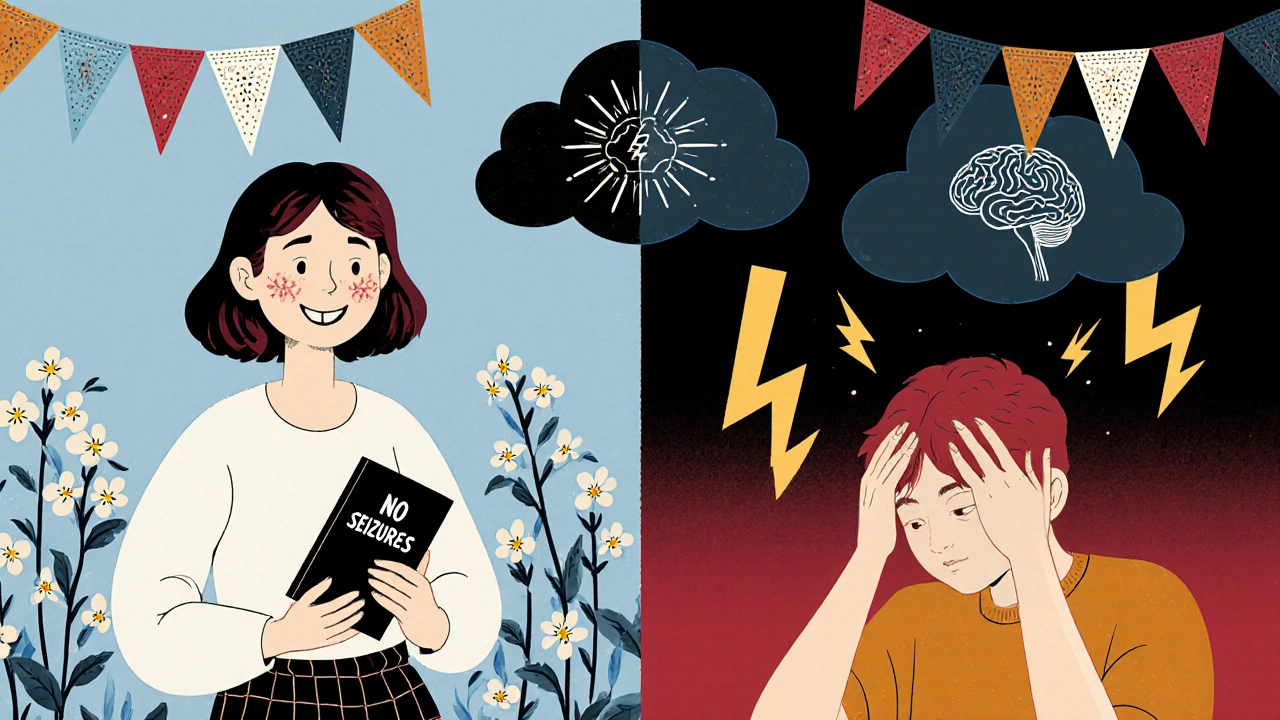
Real people aren’t waiting for guidelines. On Drugs.com, Sarah K., who’s had epilepsy for 12 years, says: "I’ve taken EPO for PMS for two years. No seizures. No issues." On Reddit’s r/Epilepsy, 57% of 142 respondents said EPO didn’t change their seizure frequency. But 32% said it did - especially when combined with quetiapine.
HealthUnlocked’s epilepsy forum had 43 posts in 2023. Of those, 15 users reported more seizures after starting EPO. Most of them were also on antipsychotics. Nine couldn’t tell if EPO was the cause. The rest - 19 - saw no change.
That’s not random noise. It’s a pattern: for some, EPO is fine. For others, especially those on certain antipsychotics, it’s a red flag.
Which Antipsychotics Are Most Concerning?
Not all antipsychotics are equal when it comes to seizure risk. Some are known to lower the seizure threshold more than others.
- Chlorpromazine (Largactil) - High risk on its own
- Flupentixol (Fluanxol) - Also high risk, especially with EPO
- Quetiapine (Seroquel) - Moderate risk; several users report increased seizures with EPO
- Clozapine - Known to cause seizures at high doses
- Amisulpride, Risperidone, Olanzapine - Lower seizure risk
DrugBank’s 2025 update added three more antipsychotics to the watchlist: brexpiprazole, lumateperone, and pimavanserin. We don’t yet know how strong the interaction is - but it’s enough to warrant caution.
If you’re on chlorpromazine or flupentixol, the risk is higher. If you’re on risperidone or aripiprazole? The risk is likely low - but not zero.
What Do the Guidelines Actually Say?
Let’s compare the big players:
| Source | Position | Evidence Level |
|---|---|---|
| Mayo Clinic (2023) | Contraindicated for epilepsy and schizophrenia | Case reports, theoretical risk |
| Dr. B.K. Puri (2007) | Seizure link is spurious; may be protective | Animal studies, mechanistic analysis |
| DrugBank (2025) | Interaction confirmed with amifampridine; possible with new antipsychotics | Pharmacokinetic data, case reports |
| Epilepsy Foundation (2022) | Theoretical concern; limited clinical evidence | Expert consensus |
| Walgreens (2024) | May interact with seizure and antipsychotic meds | Pharmacist-reported interactions |
| European Medicines Agency (2024) | No proven causal link; more research needed | Preliminary assessment |
The divide isn’t just academic. It’s life-changing. One person stops EPO and feels safer. Another stops it and loses relief from painful breasts - then wonders if the trade-off was worth it.

What Should You Do?
You’re not a lab rat. You’re a person trying to manage your health. Here’s how to think about this:
- Don’t stop your antipsychotic. That’s far riskier than any supplement.
- Don’t start EPO without talking to your doctor. Especially if you’re on chlorpromazine, flupentixol, quetiapine, or clozapine.
- Check your dose. Most EPO capsules are 500mg. Some are 1,000mg or more. Higher doses = higher GLA = potentially higher risk.
- Track your seizures. If you start EPO, keep a simple log: date, time, seizure type, meds taken that day. Even a note in your phone helps.
- Watch for red flags. If you notice more auras, twitching, confusion, or unusual fatigue after starting EPO - stop it and call your neurologist.
There’s no one-size-fits-all answer. But there is a smart way forward: personalized, cautious, informed.
What’s Next?
A major study is underway. Launched in January 2024 by Imperial College London and Johns Hopkins, it’s tracking 300 epilepsy patients taking EPO for 18 months. The goal? To finally answer this question with real data.
The NIH has put $2.3 million into this research. That’s a sign they know this isn’t just about supplements - it’s about patient safety.
Until then, we’re stuck in the middle. The science says one thing. The warnings say another. Real people report both sides.
Here’s the bottom line: Evening primrose oil might be safe for you. Or it might not be. It depends on your meds, your history, and your body. Don’t guess. Don’t rely on Reddit. Talk to your doctor - and bring this article with you.
What If You’ve Already Started Taking It?
You’re not alone. About 22% of epilepsy patients use supplements. EPO is in the top 10. Many people take it without knowing the risk.
If you’ve been taking EPO for months and haven’t had a seizure - great. But don’t assume it’s safe forever. Your meds might change. Your dose might change. Your brain might react differently.
If you’ve had a seizure since starting EPO - even one - stop it. Tell your doctor. Don’t blame yourself. This is a gray area. You’re not the first person caught in it.
And if you’re thinking about starting it? Pause. Ask: "Is the benefit worth the risk?" For PMS? Maybe. For severe epilepsy? Probably not.
Edward Hyde
November 28, 2025 AT 23:31This whole thing is a fucking circus. Doctors warn you, then some guy in a lab coat says it’s safe? Meanwhile, real people are out here taking EPO like it’s gummy vitamins and not playing Russian roulette with their brains. If your meds already make you one seizure away from a coma, why the hell are you adding a plant oil that might as well be a firecracker in a gunpowder factory? Stop pretending this is science-it’s just corporate greed with a side of anecdotal luck.
And don’t even get me started on the ‘research underway’ bullshit. That study’s gonna take three years. People are already having seizures right now. We don’t need more papers-we need warnings that actually mean something.
Charlotte Collins
November 29, 2025 AT 02:56The contradiction between clinical guidelines and mechanistic data is not a flaw-it’s a reflection of how poorly we translate pharmacology into practice. The in vitro anticonvulsant properties of GLA are biologically plausible, yet case reports persist because human physiology doesn’t operate in isolation. Polypharmacy, metabolic variability, and blood-brain barrier permeability create conditions where theoretical safety collapses into clinical risk. The EMA’s ‘no proven causal link’ is technically accurate but ethically negligent when layered over real-world polypharmacy scenarios.
What’s missing is a risk stratification model-not blanket warnings, not dismissive meta-analyses. We need pharmacogenomic data tied to seizure thresholds, not just anecdotal Reddit logs.
Margaret Stearns
November 30, 2025 AT 10:41I’ve been taking EPO for my eczema for over a year and I’m on risperidone. No seizures. No issues. I know people say ‘don’t guess’ but I talked to my doctor, we checked my blood levels, and he said my risk is low. I don’t need a 300-person study to tell me what my body’s telling me. If it ain’t broke, don’t fix it.
Also, I hate when people act like supplements are all dangerous. Some of us need them. Not everyone’s a lab rat.
amit kuamr
November 30, 2025 AT 23:22Scotia Corley
December 1, 2025 AT 06:13It is imperative to recognize that the absence of controlled clinical trials does not equate to evidence of safety. The pharmacodynamic interactions between gamma-linolenic acid and dopaminergic antagonists are not trivial. While case reports are inherently limited, their cumulative weight, particularly in vulnerable populations, demands a precautionary principle. The burden of proof lies not with the patient, but with the proponent of the intervention.
Further, the commercialization of botanical supplements under minimal regulatory oversight constitutes a public health liability. This is not a debate about anecdote-it is a failure of pharmaceutical governance.
elizabeth muzichuk
December 2, 2025 AT 10:51Let me tell you something they don’t want you to know. The pharmaceutical industry hates natural remedies because they can’t patent them. That’s why they pump out these scary warnings-to scare people away from cheap, plant-based solutions and keep them hooked on expensive, toxic antipsychotics that make billions for Big Pharma.
My cousin took EPO for years while on quetiapine. She had zero seizures. But when she switched to a ‘safer’ drug the company pushed? She got seizures. Coincidence? Or did they bury the truth?
They’re lying to you. And they’re lying to me. And they’re lying to your grandma. Wake up.
Debbie Naquin
December 3, 2025 AT 19:18The epistemological tension here is fascinating. On one hand, we have reductionist pharmacology: GLA → PGE1 → sodium channel modulation → anticonvulsant potential. On the other, clinical empiricism: case reports → precautionary warnings → institutional inertia.
But what if the real variable isn’t the oil or the drug-but the individual’s neurochemical landscape? The seizure threshold isn’t binary. It’s a dynamic equilibrium shaped by epigenetics, gut microbiota, sleep architecture, and stress load. EPO may be neutral in 70% of cases, dangerous in 20%, and protective in 10%.
Yet we force binary decisions on a multidimensional problem. That’s not medicine. That’s administrative simplification disguised as caution.
Karandeep Singh
December 4, 2025 AT 06:00Mary Ngo
December 4, 2025 AT 22:37Have you ever wondered why every time someone questions a supplement, the medical establishment panics? It’s not about safety. It’s about control. The same people who told you SSRIs were harmless are now warning you about EPO. They’ve been wrong before. They’ll be wrong again.
And let’s not forget: the FDA doesn’t regulate supplements. So who’s really behind these warnings? Big Pharma. They don’t want you to have alternatives. They want you dependent. This isn’t science-it’s surveillance capitalism disguised as healthcare.
They’re watching you. They’re tracking your searches. They’re profiling your meds. And they’re using fear to keep you buying pills.
Ask yourself: who profits when you’re scared to take EPO? Not your doctor. Not your body. A corporation.
James Allen
December 5, 2025 AT 22:40Man I get it. I’m American and I’ve seen this shit before. Back in the 90s they said butter was gonna kill you. Then it wasn’t. Then carbs were evil. Now it’s EPO. We’re scared of everything that doesn’t come in a bottle with a barcode.
My uncle took EPO for his arthritis while on olanzapine. Lived to 87. Never had a seizure. Meanwhile, the doctors who warned him? They all got rich selling him more pills.
Trust your body. Talk to your doc. But don’t let fear sell you out. We’re not rats in a cage. We’re people.
Kenny Leow
December 6, 2025 AT 22:24As someone who grew up in Singapore and now lives in the U.S., I’ve seen how different cultures handle this. In Asia, herbal remedies are often part of daily life-no big drama. In the West, everything’s either a miracle or a poison.
Maybe the answer isn’t in the oil or the drug-but in how we think about health. We treat medicine like a switch: on or off. But it’s a dimmer. You adjust. You monitor. You listen.
I know someone in Delhi who takes EPO with risperidone and tracks her sleep and mood. No seizures. No panic. Just quiet awareness.
Maybe the real lesson isn’t ‘avoid EPO’-it’s ‘learn to observe yourself.’
And hey, if you’re gonna take it, go for cold-pressed. Not the cheap stuff from Walmart. 😊