Complex Regional Pain Syndrome: Burning Pain After Injury Explained
 Dec, 1 2025
After a broken wrist, a sprained ankle, or even a minor surgery, most people expect pain to fade over weeks. But what if the pain doesn’t just stick around-it burns? What if your skin feels like it’s on fire from a light touch, your limb swells for no reason, and the pain feels way out of proportion to what happened? That’s not normal healing. That’s Complex Regional Pain Syndrome (a chronic neurological condition where the nervous system misfires after an injury, causing severe, persistent burning pain, often in an arm or leg), or CRPS.
It’s Not Just ‘Bad Pain’-It’s a Nervous System Glitch
CRPS isn’t a muscle strain that didn’t heal. It’s not even a typical nerve injury like sciatica. It’s a malfunction in how your brain and nerves talk to each other. After an injury-sometimes even a small one-your nervous system gets stuck in overdrive. It keeps sending pain signals even when there’s no tissue damage left to cause them. Think of it like a car alarm that won’t turn off after the thief is gone. The alarm (your nerves) is screaming, but there’s no reason anymore.
This isn’t just in your head. Brain scans show real changes in how pain is processed in people with CRPS. The areas of the brain that handle pain become hyperactive. The nerves in the affected limb start releasing inflammatory chemicals, making the area red, warm, or swollen. Skin can become shiny, thin, or discolored. Hair and nails may grow faster-or stop growing altogether. Some people report their limb feels colder or hotter than the other side-sometimes by as much as 1.5°C. That’s measurable. That’s physical.
Who Gets CRPS-and Why?
CRPS doesn’t pick people at random. About 70% of cases happen in women, especially between the ages of 40 and 60. But younger people can get it too. You don’t need a major trauma. The most common trigger? A fracture-especially a broken wrist. About 40% of CRPS cases follow a fracture. Other triggers include surgery (like carpal tunnel repair or knee arthroscopy), deep cuts, burns, or even a cast that’s too tight. And yes, sometimes there’s no clear injury at all.
Why do some people get it and others don’t? No one knows for sure. Genetics might play a role. So might your body’s inflammatory response or how your immune system reacts. Some studies have found autoantibodies in about 30% of CRPS patients-meaning the body might be accidentally attacking its own nerves. But there’s no single test to confirm this yet.
The Burning Pain-What It Really Feels Like
People with CRPS describe the pain in ways that sound extreme: like glass under the skin, like a constant electric shock, or like the limb is being stabbed with a red-hot poker. It’s not dull. It’s not occasional. It’s constant, deep, and often worsens with the slightest touch. A breeze, a bedsheet, or even a light pat on the shoulder can trigger a spike in pain. This is called allodynia-pain from something that shouldn’t hurt at all.
It’s not just pain, either. You might notice your hand or foot feels stiff, weak, or shaky. Fine motor skills vanish-buttoning a shirt, typing, holding a coffee cup becomes impossible. Muscles can spasm. Joints lock up. The limb might swell, sweat excessively, or lose hair. In later stages, skin and muscles can shrink. Bones can thin out. If left untreated, CRPS can permanently limit movement.
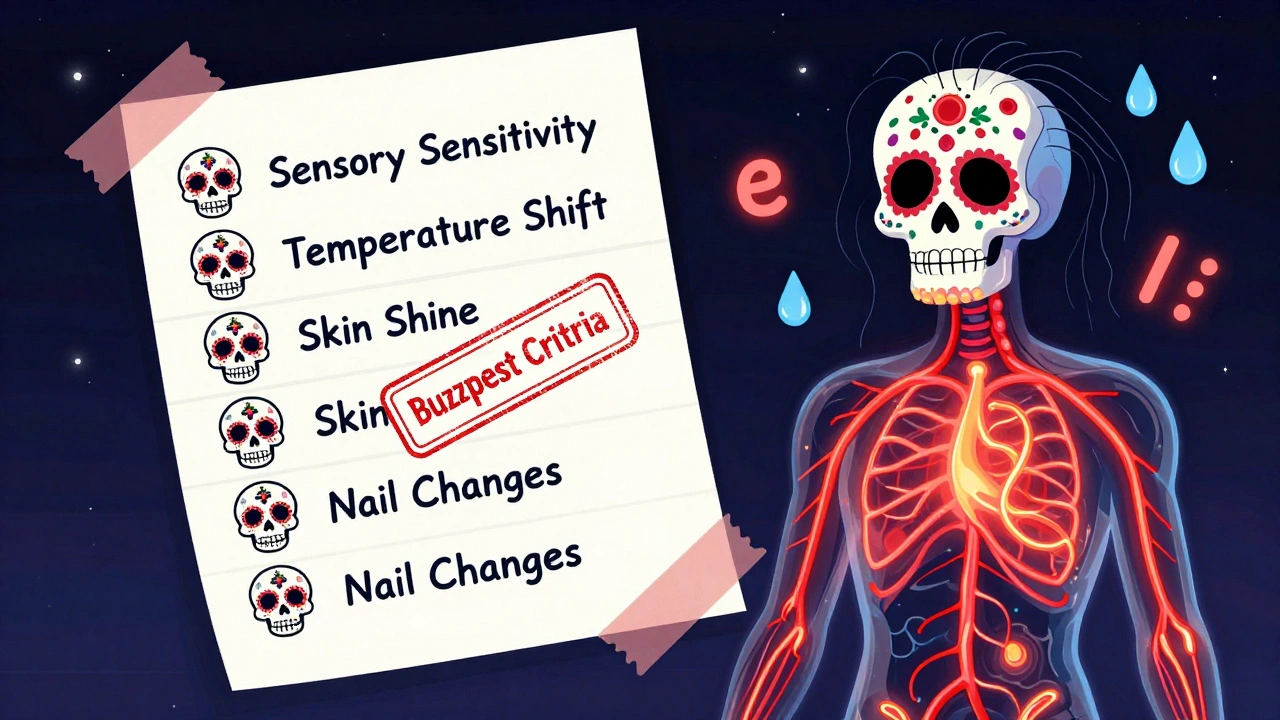
Diagnosis: No Scan Can Confirm It-But There’s a Checklist
There’s no X-ray, MRI, or blood test that can say, “Yes, this is CRPS.” Diagnosis is clinical. Doctors use the Budapest Criteria (a standardized set of signs and symptoms used to diagnose CRPS, developed by the International Association for the Study of Pain), which looks for four things:
- Pain that’s ongoing and disproportionate to any initial injury
- Symptoms in at least three of these categories: sensory (like extreme sensitivity), vasomotor (temperature or color changes), sudomotor/edema (swelling or sweating), and motor/trophic (weakness, tremors, or skin/nail changes)
- Evidence of at least two signs in two or more of those categories during a physical exam
- No other condition that explains the symptoms
That’s it. No lab results. No imaging. That’s why CRPS is often missed or misdiagnosed as arthritis, tendonitis, or even depression. If you’ve had an injury and your pain is burning, spreading, or getting worse after four to six weeks, ask your doctor about CRPS. Early diagnosis is your best shot at stopping it.
Treatment: Early Action Can Change Everything
CRPS isn’t hopeless-but time is your enemy. The first three months after symptoms start are critical. That’s when treatment has the highest chance of stopping progression-or even reversing it.
The cornerstone of treatment? Physical therapy (A structured, gentle movement program designed to restore function and prevent stiffness in the affected limb). Yes, moving hurts. But staying still makes it worse. A skilled therapist will use graded exposure-slowly, safely increasing movement to retrain your nervous system. Hydrotherapy, mirror therapy, and desensitization techniques are all part of this.
Medications help too, but they’re not magic bullets. NSAIDs like ibuprofen can reduce early inflammation. Corticosteroids (like prednisone) are sometimes used short-term if swelling and redness are strong. For nerve pain, drugs like gabapentin, pregabalin, or amitriptyline are common. Opioids? Not recommended. They don’t fix the nerve glitch and carry serious risks.
If pain doesn’t improve, more advanced options exist. Sympathetic nerve blocks-injecting numbing medicine near nerves in the spine-can temporarily reset the nervous system. Spinal cord stimulators, which send mild electrical pulses to block pain signals, help many people. Ketamine infusions are being studied for severe cases. In rare, long-standing cases, intrathecal drug pumps deliver pain meds directly to the spinal fluid.
What Doesn’t Work-and What to Avoid
Don’t wait and see if it gets better. CRPS doesn’t always resolve on its own. Studies show up to 70% of untreated cases become chronic, with pain lasting years. Don’t rely on rest alone. Immobilizing the limb with a cast or sling for too long can make CRPS worse.
Also avoid unproven “miracle cures.” There’s no evidence that acupuncture, CBD oil, or supplements like turmeric cure CRPS-though some people find them helpful for symptom relief. Don’t let anyone tell you it’s “all in your head.” The pain is real. The biology is real. You need a team that understands it.
The Emotional Toll Nobody Talks About
Living with constant burning pain changes you. Sleep disappears. You cancel plans. You stop working. You feel isolated. Anxiety and depression are common-not because you’re weak, but because your body is in constant survival mode. Many people with CRPS report feeling like a burden, or that doctors don’t believe them. That’s why mental health support is part of treatment. Cognitive behavioral therapy (CBT) helps reframe how you respond to pain. Support groups connect you with others who get it.
What’s Next? Hope on the Horizon
Research is moving fast. Scientists are now looking for biomarkers-like specific autoantibodies or inflammatory proteins-that could lead to a blood test for CRPS. Clinical trials are testing immunotherapies, gene therapies, and new neuromodulation devices. The goal? Personalized treatment. If your CRPS is driven by inflammation, you get anti-inflammatories. If it’s nerve-driven, you get nerve-targeted drugs. If it’s autoimmune, you get immune modulators.
For now, the best advice is simple: if you’ve had an injury and your pain is burning, spreading, or getting worse after a few weeks-don’t ignore it. See a pain specialist. Ask about CRPS. Get physical therapy started. Early action doesn’t guarantee a cure-but it gives you the best shot at reclaiming your life.
Can CRPS go away on its own?
Some cases do improve without treatment, especially if caught early. But studies show up to 70% of people with untreated CRPS develop long-term pain and disability. Waiting is risky. Early intervention gives you the best chance at recovery.
Is CRPS the same as neuropathy?
No. Neuropathy usually means nerve damage from diabetes, alcohol, or chemotherapy, causing numbness or tingling. CRPS is more complex-it involves the nervous system overreacting after trauma, with inflammation, skin changes, and movement problems. It’s not just damaged nerves-it’s a faulty pain signal system.
Can children get CRPS?
Yes. While most common in adults 40-60, children and teens can develop CRPS too-often after a minor injury like a sprain or fracture. Kids tend to respond better to early physical therapy than adults, but it’s still serious and needs prompt attention.
Will I need surgery for CRPS?
Surgery isn’t used to treat CRPS itself. But if you had surgery that triggered it (like carpal tunnel repair), that’s the cause-not the treatment. Some people get spinal cord stimulators or nerve blocks, which are minimally invasive procedures, not major surgery. Avoid unnecessary operations on the affected limb-they can make CRPS worse.
What’s the difference between CRPS Type I and Type II?
Type I (about 90% of cases) happens without a confirmed major nerve injury-like after a fracture or sprain. Type II (formerly called Causalgia) occurs after a clear, major nerve injury. The symptoms are nearly identical. The distinction matters mostly for research, not treatment. Both need the same early, aggressive approach.
What to Do Now
If you’re experiencing burning pain after an injury that won’t fade:
- See a pain specialist or neurologist-not just your GP
- Ask specifically about CRPS and the Budapest Criteria
- Start physical therapy immediately, even if it hurts
- Keep a pain journal: note triggers, intensity, and changes in skin color or temperature
- Avoid immobilizing the limb for long periods
- Seek mental health support if anxiety or sleep loss is affecting you
CRPS is rare, but it’s real. And it doesn’t have to define your life. With the right care, started early, many people regain function and reduce pain significantly. Don’t wait. Your nervous system is screaming. Listen-and act.
Gareth Storer
December 1, 2025 AT 11:30So let me get this straight-your body’s alarm system won’t shut off after the thief is gone, so you’re stuck with a screaming siren for the rest of your life? Cool. Just great. And the doctors say ‘try moving it’ like it’s a stubborn jar lid. Yeah, I’m sure that helps when your skin feels like it’s been dipped in acid and then rubbed with sandpaper. Thanks for the laugh, OP.
Shofner Lehto
December 2, 2025 AT 19:25This is one of the clearest explanations of CRPS I’ve ever read. The car alarm analogy is spot-on. I’ve seen patients go from active runners to bedridden because no one recognized the signs early enough. The key is early PT-even if it’s agonizing. The nervous system rewires itself, but only if you give it the right input. Silence = progression. Movement = potential recovery.
Karl Barrett
December 3, 2025 AT 04:24What’s fascinating from a neurophenomenological standpoint is the somatosensory cortical reorganization observed in fMRI studies-where the homunculus representation of the affected limb becomes distorted, leading to a mismatch between efferent motor commands and afferent sensory feedback. This isn’t just pain amplification; it’s a full-blown perceptual cascade where the brain’s predictive coding model has been corrupted by trauma-induced neuroinflammation. The autoantibody findings in 30% of cases suggest an autoimmune component, which opens the door for targeted immunomodulatory interventions. We’re not talking about nociception anymore-we’re talking about maladaptive neuroplasticity with systemic immune dysregulation.
George Graham
December 5, 2025 AT 00:38I know someone who went through this after a simple ankle sprain. Took over a year to get diagnosed. The worst part wasn’t the pain-it was being told they were ‘overreacting’ by three different doctors. They finally found a pain clinic that used the Budapest Criteria and started mirror therapy within weeks. It wasn’t a cure, but it gave them back their life. If you’re reading this and you’ve got burning pain after an injury-don’t wait. Find a specialist. Even if it’s hard. You’re not crazy. Your body is screaming, and someone needs to listen.
Elizabeth Crutchfield
December 5, 2025 AT 05:31so i had this weird thing after my wrist fracture… skin was all shiny and i couldnt even wear a watch and it felt like fire but no one believed me… then i found this post and i was like… ohhhhh thats what that was… thank u for writing this
Augusta Barlow
December 5, 2025 AT 15:00Let’s be real-this whole CRPS thing is probably just Big Pharma’s way of selling more gabapentin. They don’t want you to know that the real cause is electromagnetic pollution from 5G towers messing with your autonomic nervous system. That’s why it’s more common in women-hormones are more sensitive to microwave radiation. And don’t get me started on casts-they’re basically Faraday cages that trap the bad energy. You think they’re helping? They’re trapping the chaos. The only real cure is grounding yourself barefoot in the earth for 4 hours a day and drinking lemon water with Himalayan salt. But no, the medical system won’t tell you that. They’re too busy pushing their toxic pharmaceutical agenda.
Jenny Rogers
December 6, 2025 AT 21:32It is, without question, a moral failing of modern medicine that such a debilitating, well-documented condition remains so woefully under-recognized. The persistence of diagnostic inertia, the reliance on subjective symptom reporting in lieu of objective biomarkers, and the systemic dismissal of chronic pain patients as psychologically compromised-all of these represent a profound epistemic injustice. One cannot help but observe that the disproportionate incidence among middle-aged women reflects not biological predisposition, but rather the historical marginalization of female pain narratives within clinical paradigms. This is not merely a neurological disorder; it is a sociopolitical one.
Michael Feldstein
December 7, 2025 AT 03:47My cousin had CRPS after a bike accident. She was terrified to move her leg at first, but her PT told her to start with just wiggling her toes for 30 seconds a day. Slowly, she added more. Now, two years later, she hikes again. It wasn’t easy. It wasn’t fast. But she didn’t give up. If you’re reading this and you’re scared-start small. One toe wiggle. One breath. One step. You’ve got this.
Heidi Thomas
December 7, 2025 AT 21:34Stop glorifying physical therapy like it’s a magic cure. Most people can’t even afford it. And yeah, the ‘Budapest Criteria’ sounds fancy, but doctors still ignore it. This post is just feel-good fluff for people who already know the system is broken. You want to help? Fix the healthcare system. Not tell people to ‘move it’ while their insurance denies the PT referral.
Libby Rees
December 8, 2025 AT 22:19Thank you for this detailed and accurate overview. CRPS is severely under-discussed, and the lack of diagnostic tools creates significant barriers to care. The emphasis on early intervention is critical. Many patients are misdiagnosed for months or years, leading to irreversible changes. I hope this reaches those who need it most.