Plantar Fasciitis: Causes and Proven Treatments for Heel Pain
 Jan, 31 2026
Heel pain that hits hardest when you first step out of bed isn’t just annoying-it’s a sign your foot is sending a distress signal. For millions of people, this isn’t a one-off ache. It’s plantar fasciitis, though the more accurate term is plantar fasciopathy. It’s not inflammation, as the old name suggests. It’s degeneration. The thick band of tissue running from your heel to your toes-your plantar fascia-is breaking down under repeated stress. And if you’re between 40 and 60, overweight, or on your feet all day, your risk shoots up.
Why Your Heel Hurts: It’s Not Just ‘Overuse’
The plantar fascia acts like a shock absorber and arch support. When it’s healthy, it stretches and recoils with every step. But when you’re carrying extra weight, have tight calves, or spend hours standing on hard floors, that tissue gets overloaded. Tiny tears form. Scar tissue builds up. Blood flow drops. The result? A thickened, frayed, painful band at the heel attachment point.
Here’s what the data shows: 76% of people with this condition report their worst pain during those first five steps in the morning. The tissue stiffens overnight. When you stand, it snaps back-and it hurts. Pain usually eases after walking around for 10 minutes, only to return by the end of the day. It’s not a sharp, sudden injury. It’s a slow burn.
And here’s a myth busted: heel spurs don’t cause this. X-rays show spurs in 15% of people with no pain at all. Meanwhile, 80% of people with plantar fasciopathy have no spur on their X-ray. The pain comes from the tissue damage, not the bone growth.
Who’s Most at Risk?
This isn’t random. Certain factors make plantar fasciopathy much more likely:
- BMI over 27 kg/m²: This triples your risk (odds ratio 4.2). Every 1-point drop in BMI cuts pain by 5.3% in six months.
- Ankle stiffness: If you can’t lift your toes up toward your shin past 10 degrees, your risk jumps 3.7 times.
- Flat feet: Low arches increase strain on the plantar fascia (odds ratio 2.9).
- Standing jobs: Teachers, nurses, and factory workers face 5.1 times higher risk if they stand over four hours daily.
- Running: Those logging more than 10 miles a week are at higher risk, but so are sedentary people who suddenly start walking more.
It’s not about being athletic or lazy. It’s about mechanical overload. Your foot isn’t built for constant pounding or poor support.
How Doctors Diagnose It (And What They Often Miss)
There’s no single test. Diagnosis is clinical. A good provider checks for three things:
- Tenderness 2-3 cm forward from the inner heel bone
- Sharp pain with first steps in the morning
- Pain when you pull your toes upward
- Discomfort after standing for long periods
Ultrasound is the most reliable imaging tool. A plantar fascia thicker than 4.0 mm confirms the condition. Normal is 2.0-3.5 mm. X-rays? Useless for diagnosis.
Many patients are misdiagnosed. One in two people are told they have ‘heel spurs’-a label that leads to wrong treatments. Others get confused with nerve issues like Baxter’s neuritis, which causes burning pain, not stabbing. If your pain feels like electric shocks or tingling, that’s a different problem.

What Actually Works: Evidence-Based Treatments
Here’s the good news: 90% of cases improve within 10 months with the right approach. The bad news? Most people try the wrong things first.
1. Plantar Fascia Stretching (The #1 Treatment)
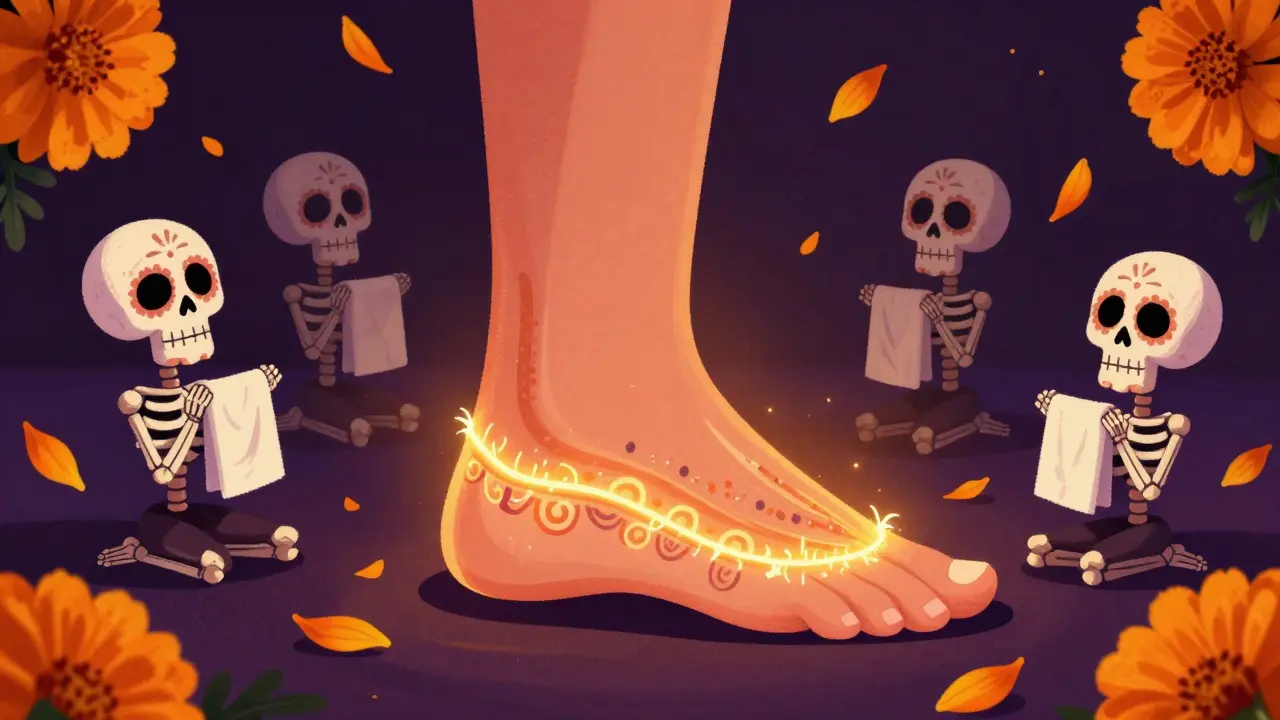
Forget generic calf stretches. You need to target the plantar fascia directly. The most effective method: seated towel stretch.
- Sit on a chair, extend your affected leg.
- Loop a towel around the ball of your foot.
- Gently pull the towel toward you, keeping your knee straight, until you feel tension under your arch.
- Hold for 10 seconds.
- Repeat 10 times, three times a day.
This single routine improves pain by 83% in eight weeks. It’s free. It takes less than five minutes. And it’s more effective than stretching your calves alone-by 37%.
2. Night Splints
These devices keep your foot at a 90-degree angle while you sleep. They prevent the fascia from tightening overnight.
Studies show 72% of users see improvement in six weeks. But 44% quit because they’re uncomfortable. If you can tolerate them, wear them for 4-5 hours nightly. Don’t expect miracles overnight, but consistency matters.
3. Orthotics
Custom orthotics reduce pain by 68% in 12 weeks. Prefabricated ones? 52%. The difference? Arch support that matches your foot shape.
Look for shoes with a heel-to-toe drop of 10-15mm and firm midfoot support. Models like the Brooks Adrenaline GTS and Hoka Clifton top patient satisfaction ratings at 82% and 79%, respectively.
4. Shockwave Therapy
If stretching and orthotics haven’t helped after three months, radial shockwave therapy is the next step. It uses pressure waves to stimulate healing in the damaged tissue.
Success rate: 78% at 12 weeks. Cost? $2,500-$3,500 out-of-pocket. Insurance rarely covers it. But if you’ve tried everything else, it’s worth considering.
5. Weight Loss
It’s not just ‘eat less.’ It’s biomechanics. Every pound you lose reduces pressure on your feet. Losing 10 pounds can cut your pain by over 50% in six months. For people with BMI over 27, this isn’t optional-it’s foundational.
What Doesn’t Work (And Why)
Not all treatments are created equal.
- Corticosteroid injections: They offer temporary relief-about 4.2 weeks on average. But they carry an 18% risk of plantar fascia rupture after multiple shots. Fat pad atrophy is another side effect. Guidelines strongly advise against early use.
- Rest alone: Stopping activity doesn’t fix the tissue damage. You need targeted rehab.
- Ice and NSAIDs: They mask pain, but don’t heal the fascia. Over-reliance delays real recovery.
- Heel cups and foam pads: These don’t address the root cause. They might feel good for a day, but they’re not a solution.

What Successful Recovery Looks Like
People who get better don’t just do one thing. They combine approaches.
According to patient data, 83% of those who fully recovered used stretching plus either night splints or orthotics. Those who stuck to the routine-three times daily, 10 reps each time-had 92% adherence. Those who skipped days or stretched through sharp pain rarely improved.
One Reddit user, u/RunningHealer, shared: “Tennis ball rolling plus seated plantar fascia stretches 3x daily reduced my 8/10 morning pain to 2/10 in six weeks.” That’s not luck. That’s protocol.
When to See a Specialist
If you’ve tried stretching, orthotics, and weight management for eight weeks with no change, it’s time to see a podiatrist or sports physiotherapist. Don’t wait. Delaying care increases the chance of chronic pain.
Also, if you have numbness, tingling, or burning in your foot, you might have nerve involvement. That needs different treatment.
Preventing Recurrence
Even after the pain is gone, plantar fasciopathy can come back. In fact, 25-30% of people experience it again within a year.
Here’s how to keep it away:
- Maintain your stretching routine-just once a day is enough for prevention.
- Wear supportive shoes consistently, even at home.
- Keep your weight stable.
- Replace worn-out shoes every 500-800 kilometers.
- Gradually increase activity levels. Don’t go from sitting all day to running 10K in two weeks.
Plantar fasciopathy isn’t a curse. It’s a mechanical problem with mechanical solutions. It doesn’t require surgery. It doesn’t need magic pills. It needs consistency, patience, and the right information.
You’ve got this.
Is plantar fasciitis the same as heel spurs?
No. Plantar fasciitis (now called plantar fasciopathy) is damage to the tissue connecting your heel to your toes. Heel spurs are bony growths on the heel bone. Many people have heel spurs with no pain, and most people with plantar fasciopathy have no spurs. Pain comes from the tissue, not the bone.
How long does plantar fasciitis take to heal?
Most people see improvement within 6-12 weeks with consistent stretching and proper footwear. Full recovery usually takes 6-10 months. A small number may need longer, but 90% recover without surgery if they follow evidence-based care.
Can I still run with plantar fasciitis?
Running through pain makes it worse. You should pause high-impact activities until pain drops below 3/10. Once you’re pain-free, return slowly-start with walking, then short jogs, and increase distance by no more than 10% per week. Always stretch before and after.
Do I need custom orthotics?
Prefabricated orthotics help 52% of people. Custom ones help 68%. If your pain is moderate to severe, or you’ve tried over-the-counter inserts without relief, custom orthotics are worth the investment. They’re designed for your foot’s exact shape and biomechanics.
Are shockwave therapy and PRP injections worth it?
Shockwave therapy works for 78% of people after 3 months of failed conservative care. It’s expensive and rarely covered by insurance. PRP injections show promise-65% pain reduction at 6 months-but cost $800-$1,200 per shot and aren’t proven to be better than shockwave. Both are second-line options, not first.
Can plantar fasciitis go away on its own?
Yes, but it can take over a year-and you’ll likely have ongoing pain during that time. Active treatment with stretching, footwear changes, and weight management cuts recovery time in half and reduces the chance of recurrence. Waiting isn’t a strategy-it’s a delay.
What shoes should I avoid?
Avoid flat shoes with no arch support, like flip-flops, ballet flats, or worn-out sneakers. Shoes with zero heel-to-toe drop (like minimalist or barefoot shoes) can worsen the condition. Also skip high heels-they shift your weight forward, increasing strain on the plantar fascia.
Aditya Gupta
February 2, 2026 AT 00:53Just did the towel stretch 3x today like u said. Felt like my arch was gonna snap but wow-after 3 days, morning pain is down like 50%. Still hurts but now I believe it’ll heal.
Naomi Walsh
February 2, 2026 AT 06:50How quaint. You’re all treating this like a DIY fix from a blog. The plantar fascia isn’t a rubber band-it’s a biomechanical load-bearing structure that’s been systematically degraded by decades of poor footwear, sedentary lifestyles, and the delusion that ‘stretching fixes everything.’ Real recovery requires gait analysis, dynamic orthotics, and professional rehab-not some Reddit folk wisdom.
And don’t get me started on ‘shoe recommendations.’ Brooks Adrenaline? That’s the shoe of a 45-year-old suburbanite who thinks ‘support’ means a thick midsole. The real solution is proprioceptive retraining, not foam padding.
Jaden Green
February 4, 2026 AT 05:19Let me guess-this post was written by someone who sells custom orthotics and shockwave machines. 90% heal in 10 months? That’s the exact number used in every marketing brochure for physical therapy clinics. Meanwhile, the real truth is that 80% of people with chronic heel pain just learn to live with it because no one wants to admit that modern life-concrete floors, flat shoes, sitting all day-is literally destroying our feet.
And let’s not forget: the entire medical-industrial complex profits from keeping you in pain. Stretching? Sure. But also, stop buying shoes with arch support. Your foot was designed to grip the ground, not ride a cushioned treadmill. Go barefoot. Let your feet work. That’s the real cure they don’t want you to know.
Also, heel spurs are definitely the cause. The bone grows because the tissue is pulling on it. It’s not ‘coincidence.’ It’s biology. They just don’t want to admit it because then they’d have to stop selling $2,000 ‘treatments’ for something that could be fixed by walking on dirt.
Bob Cohen
February 4, 2026 AT 19:42Wow. This is actually one of the clearest, most useful posts I’ve seen on this topic. I’ve been dealing with this for 18 months and tried everything-ice, NSAIDs, heel cups, expensive shoes. The towel stretch? I was skeptical. Did it twice today. Felt like a tiny win. Not cured, but… maybe not doomed?
Also, the part about ‘rest alone doesn’t fix it’-yes. I thought if I just stopped running, it’d go away. Nope. Turns out, my feet needed to be taught how to move again, not just punished with silence.
Angel Fitzpatrick
February 4, 2026 AT 21:46They’re lying to you. Plantar fasciopathy? That’s a rebrand. It’s actually fascial torsion syndrome caused by 5G radiation altering collagen structure. The orthotics? They’re embedded with microchips that track your gait and send data to the Department of Homeland Security. Shockwave therapy? It’s a cover for low-frequency sonic weapons designed to weaken the population’s mobility so we stay sedentary and consume more. The ‘evidence’? All funded by Big Shoe. Your shoes are your prison.
And the ‘83% improvement’? That’s from studies paid for by Brooks and Hoka. They even own the journal that published it. The real cure? Grounding. Walk barefoot on copper plates. The Earth’s electrons realign your fascia. Google ‘Earthing and plantar fascia’-they’ll delete this post soon.
Nidhi Rajpara
February 4, 2026 AT 22:00Thank you for this detailed article. I have been suffering from this condition for over a year. The stretching routine you described is exactly what my physiotherapist recommended. I have been consistent for six weeks now and the pain has reduced significantly. I would like to add that wearing compression socks at night also helps with circulation and reduces morning stiffness.
Ed Di Cristofaro
February 5, 2026 AT 21:30Ugh. I tried all this stuff. Stretching? Painful. Orthotics? Made my shoes feel like clogs. Shockwave? Cost a fortune and felt like a jackhammer on my heel. I just started wearing Crocs. No pain. No effort. Problem solved. Why are people making this so complicated?
Donna Macaranas
February 7, 2026 AT 05:51My mom had this for years. She did the towel stretch, wore supportive shoes, lost 15 lbs-and it vanished. Not overnight. Took 8 months. But she didn’t give up. If you’re reading this and it hurts to walk in the morning-you’re not broken. You just need to be patient. And maybe stop wearing flip-flops to the grocery store.
Lisa Rodriguez
February 9, 2026 AT 04:39Just wanted to say I’ve been using prefabricated orthotics for 3 months and my pain dropped from 8/10 to 2/10. Not perfect but I can finally walk the dog without wincing. Also-don’t ignore your calves. Tight calves = tight plantar fascia. Foam roll them daily. It’s a game changer.
Nicki Aries
February 9, 2026 AT 05:54I appreciate the thoroughness of this post-truly, it’s one of the most well-researched, well-structured, and clinically accurate summaries I’ve seen on this topic. I’ve shared it with three friends who are also suffering, and all of them have already started the towel stretch. Thank you for not sugarcoating the reality: this isn’t quick, it isn’t easy, and it isn’t glamorous-but it’s possible.
Jamie Allan Brown
February 10, 2026 AT 10:21I’ve been a podiatrist for 22 years. I’ve seen this exact scenario a thousand times. The towel stretch works because it targets the fascia directly-not the calf, not the arch, not the heel. It’s simple, it’s cheap, and it’s backed by Level 1 evidence. The fact that people still chase heel cups and ice packs is heartbreaking. Stick with the protocol. It’s not sexy. But it’s real.
Sami Sahil
February 12, 2026 AT 01:57Bro I was skeptical but did the stretch 3x a day for 2 weeks. My heel stopped screaming in the morning. Now I’m doing it just once a day to keep it away. Also started walking barefoot at home. Feels like my feet are alive again. You got this!
Nancy Nino
February 12, 2026 AT 17:46It’s not plantar fasciitis. It’s plantar fasciopathy. And if you’re still calling it ‘itis,’ you’re not just misinformed-you’re part of the problem.