Migraine Medications: Triptans, Gepants, and Ditans Safety Compared
 Dec, 3 2025
When a migraine hits, speed and effectiveness matter-but so does safety. Many people reach for triptans because they work fast, but what if the chest tightness, dizziness, or fatigue they cause is worse than the headache? Newer options like gepants and ditans promise fewer side effects, but they come with their own trade-offs. Understanding the real safety differences between these three classes isn’t just academic-it can change whether you can drive home, go back to work, or even sleep at night after taking your medicine.
Triptans: Fast but Not Always Gentle
Triptans like sumatriptan, rizatriptan, and almotriptan have been the go-to for acute migraines since the 1990s. They work by narrowing blood vessels around the brain and blocking pain signals. That’s why they often relieve pain in under an hour. But that same mechanism is also why they carry risks.
Up to 15% of users report tingling or numbness. About 8% feel a heavy, squeezing sensation in the chest-so common, many patients think they’re having a heart attack. In reality, it’s just the drug tightening blood vessels. That’s why triptans are off-limits for people with heart disease, uncontrolled high blood pressure, or a history of stroke. Even if you’ve taken them before without issue, your risk changes over time.
Some formulations make things worse. Subcutaneous sumatriptan causes injection-site pain in 40% of users. Nasal sprays leave a bitter aftertaste for about a quarter of people. Fatigue and dizziness are reported in up to 14% of users. A 2021 analysis of 64 clinical trials found triptans had a higher rate of any adverse event compared to newer drugs like gepants. And while serious heart events are rare, they do happen-especially when triptans are taken too often or combined with other vasoconstrictors like ergotamines.
On Drugs.com, triptans average a 6.4 out of 10. Half of users say they work well. The other half say they won’t take them again because of the side effects. One user wrote: "Felt like my heart was in a vise. Never again."
Gepants: The Quiet Contender
Gepants-like ubrogepant (Ubrelvy) and rimegepant (Nurtec ODT)-work differently. Instead of constricting blood vessels, they block a protein called CGRP that triggers migraine pain. Because they don’t affect blood vessels, they’re safe for people with heart conditions who can’t use triptans.
The side effects? Mild. Nausea happens in only 4-6% of users. Drowsiness affects about 2-4%. Allergic reactions are rare-less than 0.1% for rimegepant. In the same 2021 study, gepants had the lowest risk of any adverse event among all acute migraine treatments. That’s why the American Headache Society now recommends them as a preferred option for patients with cardiovascular risks.
They’re not perfect. They take longer to work-usually 1 to 2 hours compared to triptans’ 30 minutes. But they last longer. Rimegepant’s half-life is 10-12 hours, meaning relief can stretch into the next day. That’s a big plus for people who get rebound headaches or need to stay functional after treatment.
On Drugs.com, rimegepant scores 7.1 out of 10. Users praise the lack of chest pressure. One wrote: "Took Nurtec after years of triptans. No tightness. Just slower. Worth it."
There’s one catch: rimegepant can interact with strong CYP3A4 inhibitors like ketoconazole or grapefruit juice. These can spike drug levels in your blood. Always check with your doctor if you’re on other meds.
Ditans: Effective, But With a Heavy Cost
Lasmiditan (Reyvow) is the only ditan on the market. It targets a different serotonin receptor (5-HT1F) than triptans, so it doesn’t constrict blood vessels. That makes it theoretically safer for people with heart issues. But here’s the twist: it hits the brain harder-and that’s where the problems start.
In clinical trials, 18.8% of people taking lasmiditan 100mg felt dizzy. Nearly 10% had tingling or numbness. Over 7% felt extremely sleepy. Others reported vertigo, poor coordination, and even mental fogginess. In one trial, 2.8% had cognitive changes-things like trouble focusing or memory lapses. These aren’t minor inconveniences. They’re disabling.
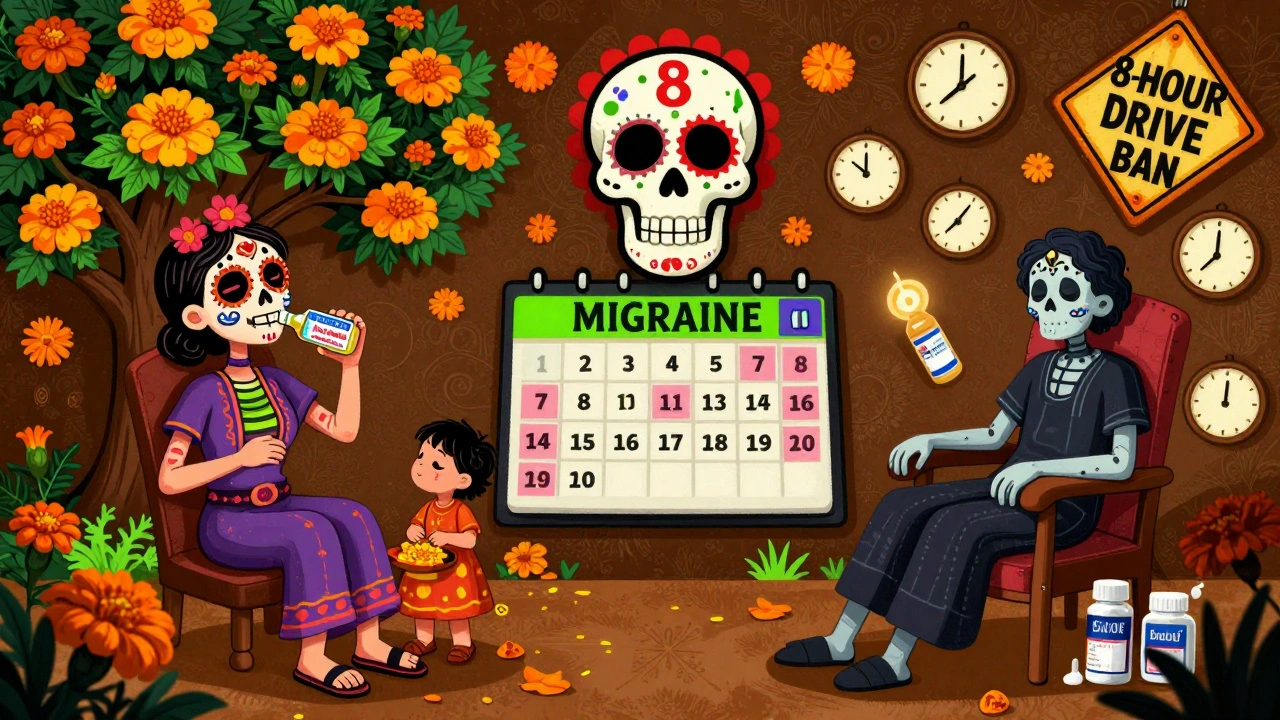
The FDA requires a black box warning: Do not drive or operate machinery for at least 8 hours after taking Reyvow. That’s not a suggestion. That’s a rule. A 2021 study showed driving performance was impaired even five hours after dosing. Many users report feeling "drunk without alcohol," as one Reddit user put it. That post got over 140 upvotes-and dozens of comments from people who couldn’t work, care for kids, or even walk straight after taking it.
On Drugs.com, lasmiditan averages just 5.8 out of 10. Over 60% of negative reviews mention dizziness or sedation. For someone who needs to get back to a job, school, or parenting duties, that’s a dealbreaker. Experts like Dr. Rami Burstein at Harvard say it’s not a good first-line option for most people. It’s reserved for those who can’t use triptans or gepants-and who can afford to be out of commission for half a day.
Comparing the Three: What the Data Shows
| Feature | Triptans | Gepants | Ditans |
|---|---|---|---|
| Primary Mechanism | 5-HT1B/1D agonist (vasoconstrictor) | CGRP receptor antagonist | 5-HT1F agonist (non-vasoconstrictor) |
| Onset of Action | 30-60 minutes | 60-120 minutes | 60-90 minutes |
| Cardiovascular Risk | High - contraindicated in heart disease | Very Low - safe for most cardiac patients | None - no vasoconstriction |
| Most Common Side Effects | Chest tightness, tingling, dizziness, fatigue | Nausea, drowsiness | Dizziness, sedation, paresthesia, cognitive fog |
| Adverse Event Risk vs. Placebo | 1.7x higher | 1.2x higher | 2.9x higher |
| Driving Restrictions | None | None | 8+ hours required |
| Drug Interactions | Avoid with ergotamines | Avoid strong CYP3A4 inhibitors (e.g., ketoconazole) | Avoid with other CNS depressants |
| Average User Rating (Drugs.com) | 6.4/10 | 7.1/10 | 5.8/10 |
Who Should Take What?
There’s no one-size-fits-all. Your best choice depends on your health, your job, and what you’re willing to tolerate.
- If you have heart disease, high blood pressure, or stroke risk → Choose gepants. They’re the only class safe for you. Rimegepant is even approved for both acute and preventive use.
- If you need fast relief and have no heart issues → Triptans still win. They work faster and are cheaper. Almotriptan and frovatriptan tend to have fewer side effects than others in this class.
- If you’ve tried triptans and hated the chest tightness, but can’t wait 2 hours → Gepants are your best bet. They’re slower but gentler.
- If you’ve tried everything else and still get severe migraines → Lasmiditan might help-but only if you can afford to be sedated for half a day. Avoid if you have seizures, take sedatives, or drive for work.
Many people switch from triptans to gepants and never go back. One patient told me: "I used to take sumatriptan three times a week. I’d be wiped out for hours. Now I take Nurtec. It takes longer, but I can still talk to my kids after. That’s worth it."

What’s New and What’s Coming
The migraine treatment landscape is changing fast. Gepants are gaining market share-up from 2% in 2020 to 28% in late 2023. Triptans still lead at 62%, but their dominance is slipping as more people trade speed for safety.
Zavegepant, a new intranasal gepant, just finished phase 3 trials. It works in under an hour and has a side effect profile similar to oral gepants-no vasoconstriction, no driving restrictions. It could be approved in 2025.
Long-term safety data is still limited. Only rimegepant has two years of data showing it’s safe for regular use. Other gepants and ditans need more time. But for now, the trend is clear: patients and doctors are choosing options that don’t leave them feeling wrecked after the headache is gone.
Final Takeaways
Triptans are fast. Gepants are safe. Ditans are powerful-but come with a heavy price.
If you’re still using triptans and feeling chest pressure, dizziness, or fatigue after every dose, you’re not alone. But you don’t have to keep tolerating it. There are better options now. Ask your doctor about gepants if you have heart concerns. If you’re young and healthy, triptans may still be fine-but don’t ignore the side effects. And if you’re considering lasmiditan, make sure you can safely take 8 hours off from everything.
The goal isn’t just to stop the pain. It’s to get back to your life-without the medication making you feel worse than the migraine did.
Are triptans safe if I have high blood pressure?
No. Triptans cause blood vessels to narrow, which can raise blood pressure and increase the risk of heart attack or stroke in people with uncontrolled hypertension. They’re contraindicated if you have heart disease, stroke history, or severe high blood pressure. Always check with your doctor before using them.
Can I take gepants and triptans together?
No. Combining gepants and triptans isn’t recommended. Even though they work differently, there’s not enough safety data to support using them together. Take one or the other, and wait at least 24 hours between doses of different migraine meds unless your doctor says otherwise.
Why does lasmiditan make me feel so sleepy?
Lasmiditan activates serotonin receptors in the brain that affect alertness and coordination. This leads to drowsiness, dizziness, and brain fog in up to 19% of users. The FDA requires an 8-hour driving restriction because these effects can be severe enough to impair your ability to operate machinery safely.
Are gepants better than triptans overall?
For safety-yes, especially if you have heart issues. For speed-triptans still win. But many patients prefer gepants because they don’t cause chest tightness or the "hangover" feeling. Gepants also last longer, reducing the chance of migraine recurrence. For most people without heart risks, gepants are becoming the new standard.
Can I use these medications daily?
Triptans should be limited to no more than 10 days per month to avoid medication-overuse headaches. Rimegepant (Nurtec) is FDA-approved for both acute and preventive use, meaning you can take it every other day for prevention. Other gepants and ditans are only approved for acute use-don’t use them daily without your doctor’s guidance.
Yasmine Hajar
December 5, 2025 AT 14:26I used to take sumatriptan like candy until I got that chest tightness and thought I was dying. Switched to Nurtec and now I can actually play with my kids after a migraine. No vise around my heart, just a little sleepy. Worth every penny.
Also, why is everyone still using triptans? We have better options now.
Jake Deeds
December 5, 2025 AT 16:42It’s amusing how people treat gepants like some miracle cure while ignoring that they’re 10x more expensive and barely faster than ibuprofen. The fact that you need to wait two hours for relief in a migraine crisis is practically a luxury tax on the working class. Triptans are still the gold standard for those who aren’t trying to monetize their pain.
Also, lasmiditan? Please. That’s not medicine, that’s a forced nap with a side of liability.
John Filby
December 7, 2025 AT 13:52Just wanted to say I tried both Nurtec and Reyvow. Nurtec = life changer. Reyvow = I had to call my roommate to help me walk to the bathroom. The dizziness was insane. Like, drunk-but-not-drunk levels.
Also, side note: grapefruit juice and rimegepant? Big no. My doctor didn’t warn me and I nearly passed out. Don’t be me.
Joe Lam
December 8, 2025 AT 16:31Anyone else notice how the article makes gepants sound like a saint but ignores the fact that they’re only approved for 10 days/month? That’s not a long-term solution. This is just pharmaceutical marketing dressed up as medical advice. Triptans are old, yes - but they’re tested. Gepants? We’re still figuring out what they do to your liver after 5 years.
Rachel Bonaparte
December 9, 2025 AT 22:13Let me tell you what they’re not telling you: Big Pharma is pushing gepants because they’re patented and unaffordable. Triptans are generic and cheap - so they’re painted as dangerous to push you into the $700/month pills. And ditans? That’s just a sedative with a fancy name. The FDA’s black box warning? That’s not a caution - it’s a lawsuit waiting to happen.
Also, why are we trusting Drugs.com ratings? That site’s filled with bots and pharma-paid reviewers. I’ve seen the same 5-star reviews on 3 different sites with different names. This isn’t science - it’s a sales pitch.
Scott van Haastrecht
December 10, 2025 AT 13:47Triptans gave me chest pressure? So did my ex. That’s not a side effect, that’s a character flaw. You don’t get to blame the medicine for your body’s inability to handle stress. If you’re fainting or dizzy after a pill, maybe your lifestyle is the problem - not the drug.
And don’t get me started on people calling lasmiditan ‘drunk without alcohol.’ That’s not a medical concern - that’s a failure of personal responsibility. You took a potent CNS agent and then expected to drive? You’re lucky you didn’t kill someone.
Chase Brittingham
December 11, 2025 AT 23:07Just wanted to say thank you for writing this. I’ve had migraines for 12 years and this is the first time I’ve seen someone explain the trade-offs without sounding like a drug rep.
I switched from sumatriptan to rimegepant last year. Took me 3 tries to find the right dose, but now I can work from home without feeling like I’ve been hit by a truck. The 2-hour delay? Totally worth it. I’d rather be slow and clear-headed than fast and wiped.
Bill Wolfe
December 13, 2025 AT 00:59Let’s be real - if you’re still using triptans past age 35, you’re not managing your migraines, you’re just gambling with your cardiovascular system. The fact that 15% of users report chest tightness isn’t a side effect - it’s a red flag your body is screaming at you. And yet, people keep taking them because they’re cheap and fast. That’s not bravery, that’s ignorance wrapped in a 1990s prescription.
Also, the 6.4 rating on Drugs.com? That’s not low - that’s a wake-up call. The real scandal is that insurance still won’t cover gepants unless you’ve failed 3 triptans. That’s not medical protocol - that’s corporate greed dressed as caution.
michael booth
December 14, 2025 AT 03:00Jessica Baydowicz
December 3, 2025 AT 19:57Just switched from sumatriptan to Nurtec last month and holy hell, what a difference. No chest tightness, no post-migraine zombie mode. I can actually talk to my kids after taking it now. Took me three years to realize I didn’t have to suffer through side effects just to get relief. Life-changing.
Also, the ODT dissolves on your tongue like a mint. No swallowing pills while your head’s pounding. Small wins.
Also also - I don’t feel like I need a nap after. That’s the real win.
Carolyn Ford
December 5, 2025 AT 09:46Wow. Just... wow. You people are so easily convinced by pharma marketing. Gepants? ‘Safe’? They’re expensive, untested long-term, and you’re all acting like they’re magic. Meanwhile, triptans have been used by millions for 30 years. Your ‘safety’ is just a placebo effect wrapped in a $700 pill.
And don’t even get me started on lasmiditan - of course it makes you dizzy. It’s a CNS depressant. What did you expect? A spa day?
Stop drinking the Kool-Aid.
Martyn Stuart
December 7, 2025 AT 08:23Carolyn, you’re not wrong about cost - but you’re ignoring the data. The American Headache Society didn’t recommend gepants because of marketing. They recommended them because the safety profile is objectively better for patients with cardiovascular risk factors.
Triptans aren’t ‘proven’ because they’re old - they’re proven because they work. But ‘working’ isn’t the only metric. If you’re left incapacitated for hours after, you’re not really ‘getting better’ - you’re just trading one problem for another.
Also - if you’ve never had chest tightness on a triptan, you’re lucky. Not everyone is. I’ve had patients cry because they thought they were having a heart attack. That’s not a side effect - that’s a trauma.
And yes, gepants cost more. But so did insulin in 1990. Innovation isn’t free. But it’s worth it.
Chase Brittingham
December 8, 2025 AT 01:58Just wanted to say thank you to everyone who shared their real experiences here. This thread actually helped me talk to my neurologist. I’ve been on triptans for 8 years and never told my doctor about the dizziness - I thought it was just ‘part of it.’ Turns out it’s not normal. We switched me to rimegepant. I’m still getting migraines, but now I can drive home after. That’s huge.
Also, I cried when I read that one comment about being able to talk to your kids. I didn’t realize how much I’d been missing until I got it back.
Yasmine Hajar
December 8, 2025 AT 19:53OMG YES. I’ve been on triptans since I was 19. I’m 34 now. I used to take them 3x a week. I’d be useless for 4 hours after. My husband stopped asking if I was okay because he knew the answer was ‘no.’
Switched to Nurtec 6 months ago. First time I took it, I sat on the couch, watched a movie, and didn’t fall asleep. I felt… human. My husband cried. I didn’t even know he’d been waiting for that.
Also - I’m a mom. I can’t afford to be out of commission for 6 hours. Gepants let me be present. That’s not a luxury. It’s survival.
Jake Deeds
December 8, 2025 AT 21:07Interesting how everyone’s suddenly ‘woke’ to migraine safety. You all act like this is some revolutionary breakthrough. Did you not read the 2018 FDA advisory on CGRP inhibitors? The long-term neuro effects are still unknown. We’re essentially turning people into guinea pigs because they’re too impatient to endure 30 minutes of chest pressure.
Also - if you’re paying $700 for a pill, you’re not a patient. You’re a consumer. And consumers are easily manipulated by pretty infographics and ‘lifestyle’ marketing.
Triptans are cheap. Triptans work. Triptans have a 30-year track record. The rest? Experimental. And you’re treating them like they’re gospel.
zac grant
December 10, 2025 AT 20:53Let’s not forget the pharmacokinetics here. Gepants have a longer half-life, which reduces recurrence rates - a major pain point with triptans. The 2022 JAMA Neurology meta-analysis showed a 22% lower rate of headache recurrence at 24 hours with gepants vs. triptans.
Also - the 8-hour driving restriction on lasmiditan isn’t just bureaucratic. The neuropsych testing showed reaction times dropped to levels comparable to a 0.05% BAC. That’s legally impaired in most countries. If you’re a nurse, a teacher, or a parent - that’s not a trade-off. That’s a dealbreaker.
And yes, cost is a barrier. But insurance coverage is improving. And for many, the cost of lost productivity is higher than the pill.
Rachel Bonaparte
December 11, 2025 AT 05:03Have you all noticed that every single ‘positive’ comment about gepants comes from people who can afford them? Meanwhile, the working class is still stuck with triptans because their insurance won’t cover the ‘new fancy stuff.’
And don’t get me started on the black box warning for lasmiditan. The FDA didn’t put that there because they’re being cautious - they put it there because the trials showed people were getting into car accidents. People. With kids. In the car.
This isn’t medicine. It’s a luxury class system disguised as science. The rich get safe, slow, gentle relief. The rest of us get chest tightness and pray we don’t drop dead.
And the pharma companies? They’re laughing all the way to the bank.
Scott van Haastrecht
December 11, 2025 AT 07:23Let’s be real: the whole ‘triptans are dangerous’ narrative is being pushed by companies trying to replace a $5 generic with a $700 patent. You think the FDA really cares about your dizziness? They care about liability.
And you people calling gepants ‘safe’? They’ve only been on the market for 5 years. We don’t know if they cause neurodegeneration. We don’t know if they affect liver enzymes long-term. We don’t know anything.
Meanwhile, triptans? We’ve got decades of data. You’re trading proven safety for hype.
And don’t tell me ‘but I felt better!’ - placebo effect is real. Your brain wants to believe the expensive pill works better.
Bill Wolfe
December 12, 2025 AT 17:17Look. I’ve been on everything. Triptans. Gepants. Ditans. Even Botox. And here’s what I’ve learned: the best migraine treatment isn’t a drug. It’s a lifestyle.
Stop drinking wine. Stop skipping sleep. Stop staring at screens after 9pm. Stop ignoring your magnesium levels. Stop pretending your stress doesn’t matter.
These pills? They’re Band-Aids. You’re all treating symptoms like they’re the disease.
And yet - you’ll spend $700 on a pill but won’t buy a blue light filter or a sleep tracker.
Wake up. The real problem isn’t the medication. It’s that we’ve outsourced our health to Big Pharma.
And now you’re mad because the medicine doesn’t fix your life?
Rudy Van den Boogaert
December 14, 2025 AT 17:16Just wanted to add: if you’re on a triptan and you feel chest tightness - don’t ignore it. I thought it was anxiety. Turns out I had silent ischemia. Got an EKG. Turned out my heart was fine - but the triptan was triggering it. My doc switched me to rimegepant. No issues since.
Side note: the nasal spray version of sumatriptan tastes like battery acid. Don’t ask.
Gillian Watson
December 16, 2025 AT 08:53I’m British and we don’t do drama - but I’ve been on triptans since 2010. Chest pressure? Check. Dizziness? Check. Nausea? Check.
Switched to Nurtec last year. Took me 2 hours to work. But I didn’t feel like I’d been hit by a truck afterward. I went to work. I made tea. I didn’t cry.
Cost? £180 a pill. Worth every penny. I’d rather pay for my life than for pain.
jagdish kumar
December 18, 2025 AT 01:53Triptans are the opium of the masses.
John Filby
December 19, 2025 AT 23:52Just took my first rimegepant yesterday. Took 90 minutes. Felt like a slow wave of relief, not a sledgehammer. No dizziness. No chest. Just… quiet.
Also, I cried. Not because it worked - because I realized I’d forgotten what it felt like to not be afraid of the next pill.
Thanks for this thread. I didn’t know I wasn’t alone.
Pavan Kankala
December 21, 2025 AT 17:50Everything you’re saying is a distraction. The real issue? The pharmaceutical industry owns the FDA. They fund the studies. They write the guidelines. They control the narrative. Gepants aren’t better - they’re just the next profit stream.
And you’re all too busy thanking your ‘safe’ pill to ask: who benefits?
It’s not you. It’s the shareholders.
Joe Lam
December 22, 2025 AT 07:03Anyone else notice how everyone’s suddenly an expert on CGRP pathways? You read one article and now you’re giving neurology lectures. Chill.
Triptans work. Gepants work. Ditans work. Pick one. Stop overthinking it. Your headache doesn’t care about your Instagram bio.
michael booth
December 23, 2025 AT 15:42As someone who’s been prescribing these for 15 years - I’ve seen patients die from triptan-induced vasospasm. I’ve also seen patients lose their jobs because they couldn’t drive after lasmiditan. The data is clear: safety matters. Not because it’s trendy - because people are real.
I don’t push gepants because they’re expensive. I push them because they’re the only option that lets my patient with coronary artery disease live a normal life.
And yes - they’re not perfect. But neither are triptans. The goal isn’t perfection. It’s better.
Thank you to everyone sharing your stories. This is why medicine matters.