How to Get 90-Day Fills to Lower Prescription Costs
 Dec, 25 2025
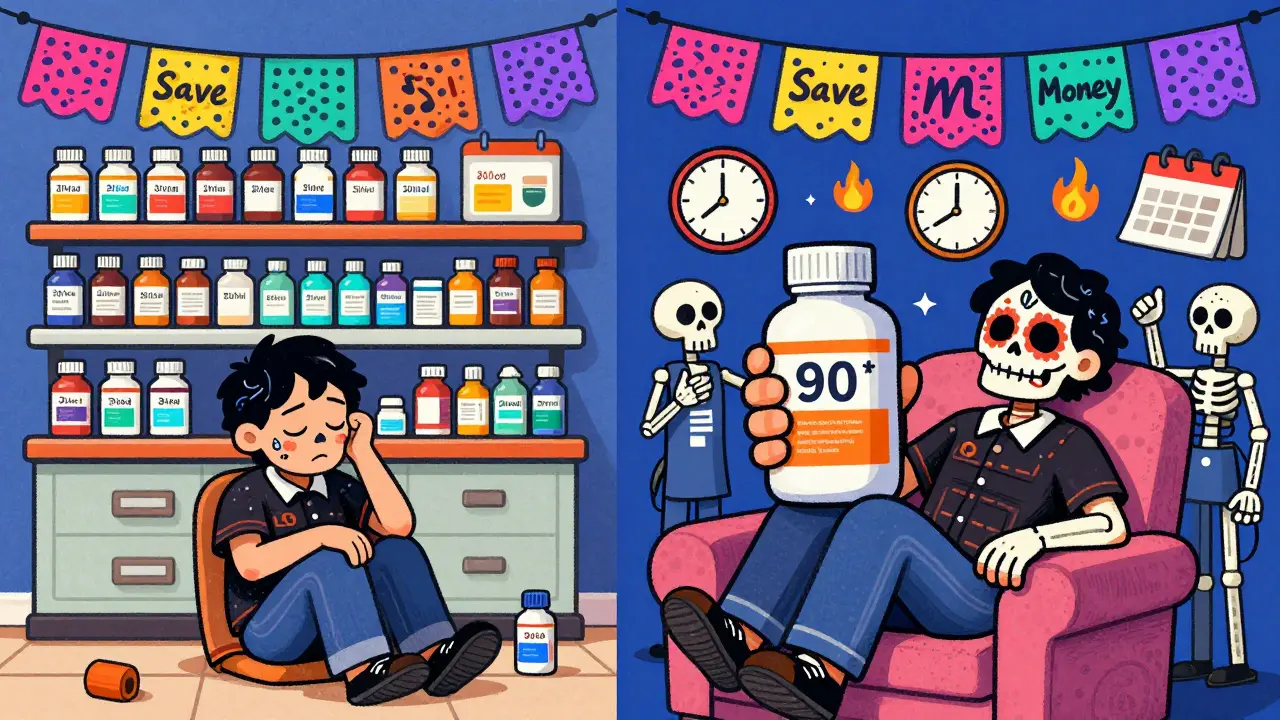
Getting a 90-day supply of your medication isn’t just about saving time-it’s one of the easiest ways to slash your out-of-pocket costs without changing your treatment. If you take the same pills every day for high blood pressure, diabetes, cholesterol, or another long-term condition, you’re likely paying more than you need to. Most people still pick up 30-day refills out of habit, but switching to a 90-day fill can cut your annual medication spending by hundreds of dollars-with no extra effort.
Why 90-Day Fills Save You Money
Most insurance plans charge the same copay whether you get 30 days or 90 days of medication. That means if your copay is $5 for a 30-day supply, you’re still paying $5 for 90 days. You get three times the pills for the same price. Over a year, that’s three fewer trips to the pharmacy and up to $39 in savings per medication. For someone taking five maintenance drugs, that’s nearly $200 saved annually-just by asking for a longer supply.Mail-order pharmacies take it even further. Many offer lower prices than retail pharmacies, especially for generic drugs. Some plans even cover home delivery for free. You don’t need to pay shipping, and your meds arrive right at your door. No waiting in line. No last-minute panic when you’re out.
It’s not magic. It’s how insurance works. Pharmacy benefit managers (PBMs) and insurers design these programs to encourage adherence. When you take your meds consistently, you’re less likely to end up in the hospital. That saves the system money-and they pass some of those savings to you.
Which Medications Qualify
Not every drug can be filled for 90 days. Only maintenance medications-those you take daily for chronic conditions-are eligible. Common examples include:- High blood pressure (lisinopril, amlodipine)
- Cholesterol (atorvastatin, simvastatin)
- Diabetes (metformin, glimepiride)
- Thyroid (levothyroxine)
- Depression or anxiety (sertraline, escitalopram)
- Asthma or COPD (fluticasone, tiotropium)
Controlled substances like opioids or strong painkillers usually don’t qualify. Same goes for antibiotics, short-term steroids, or drugs you only take occasionally. If you’re unsure, check your prescription label. If it says “refills: 3” or “refills: 6,” you’re likely eligible.
Insurance rules vary. Some plans require you to have used the medication for at least 30 days before approving a 90-day fill. Others may need prior authorization. Always confirm with your pharmacy or insurer before assuming.
How to Get a 90-Day Prescription
Getting a 90-day supply is simple. You have two options:- Ask your doctor to write a new prescription for 90 days. Many doctors now default to 90-day scripts for chronic conditions. Just say: “I’d like to switch to a 90-day supply to save money and reduce trips to the pharmacy.” Most will agree.
- Ask your pharmacy to extend your current 30-day script. If your prescription has refills left, the pharmacist can often dispense a 90-day supply even if the original script says 30 days. This works as long as your insurance allows it and you’ve been taking the drug without issues.
You don’t need to see your doctor again unless they’re out of refills. If your prescription has expired, you’ll need a new one. But if you still have refills, your pharmacy can usually handle the switch.
Where to Fill Your 90-Day Prescription
You can get your 90-day supply in two main ways:- Retail pharmacies like CVS, Walgreens, or Rite Aid now offer in-store 90-day fills. Just ask the pharmacist. This is convenient if you prefer picking up meds in person.
- Mail-order pharmacies like CVS Caremark, OptumRx, or HPSM’s Postal Prescription Services deliver your meds directly to your home. Many plans cover this for free. Mail-order often has the lowest prices, especially for generics.
Some plans push you toward mail-order by making it cheaper. Others give you the choice. Check your plan’s formulary or call customer service. Ask: “Do I get a lower copay with mail-order for my maintenance meds?”
Pro tip: If you’re using GoodRx or SingleCare, compare prices between your local pharmacy and mail-order options. Sometimes, even without insurance, a mail-order pharmacy can beat the retail price.
What to Watch Out For
There are a few traps to avoid:- Insurance restrictions: Some plans won’t cover 90-day fills for certain drugs. Always verify coverage before requesting it.
- Prior authorization: Your insurer might require paperwork before approving the longer supply. Your doctor’s office can help with this.
- Medication changes: If your dosage changes, you might need to go back to 30-day fills temporarily. Don’t panic-just call your pharmacy.
- Pharmacy resistance: A few retail staff might not know how to process 90-day fills. If they say no, ask to speak to the pharmacist or call your insurer directly.
Also, don’t stockpile meds you might stop taking. Only request 90-day fills for drugs you’re certain you’ll keep using. If you’re switching treatments, stick with 30-day refills until things stabilize.
Real Savings, Real Impact
In 2025, about 12% of maintenance prescriptions in the U.S. are filled as 90-day supplies-mostly through mail-order. That number is rising fast. If adoption hits 70%, consumers and employers could save over $1.9 billion in the first year alone.But the bigger win isn’t just the money. People who take their meds consistently are less likely to be hospitalized. Studies show 90-day fills improve adherence by 15-20%. That means fewer ER visits, fewer complications, and better long-term health.
And the convenience? Huge. Instead of visiting the pharmacy 12 times a year, you’ll go just four. That’s eight fewer trips. Less time off work. Less gas. Less stress.
Next Steps
Here’s exactly what to do today:- Make a list of all the medications you take daily for chronic conditions.
- Check your last prescription label. Do you still have refills?
- Call your pharmacy and ask: “Can I get a 90-day supply of [medication name]?”
- If they say no, ask: “What does my insurance cover for a 90-day fill?”
- If you need a new script, call your doctor’s office and request a 90-day prescription.
- Compare prices between your local pharmacy and your plan’s mail-order option.
You don’t need a special form. No complex application. Just ask. Most doctors and pharmacists are happy to help. They’ve seen the savings. They know how it works.
Start with one medication. If you save $40 on your blood pressure pill, you’ll probably want to do the same for your cholesterol and diabetes meds. Before you know it, you’re saving hundreds a year-without changing your routine.
Can I get a 90-day supply of any prescription?
No. Only maintenance medications for chronic conditions qualify-like those for high blood pressure, diabetes, cholesterol, or thyroid issues. You can’t get 90-day fills for antibiotics, painkillers, or drugs you only take occasionally. Check with your pharmacy or insurer to confirm eligibility.
Do I need a new prescription from my doctor?
Not always. If your current prescription still has refills, your pharmacy can often fill a 90-day supply without a new script. But if your prescription has expired or has no refills left, you’ll need a new one from your doctor. Just ask them to write it for 90 days instead of 30.
Is mail-order safer than picking up at the pharmacy?
Yes, and it’s often cheaper. Mail-order pharmacies are licensed, regulated, and inspected just like retail pharmacies. Many offer free delivery and lower prices, especially for generics. Your meds are shipped in tamper-proof packaging and tracked to your door. It’s a reliable option for long-term medications.
What if my insurance doesn’t cover 90-day fills?
Some plans don’t offer it for certain drugs. Call your insurer’s customer service line and ask: “Does my plan allow 90-day fills for [medication name]?” If not, ask if you can switch to a different plan during open enrollment. You can also use GoodRx or SingleCare coupons to compare prices at retail pharmacies.
Will I get my meds faster with mail-order?
Usually. Mail-order pharmacies process 90-day fills in advance. Once approved, your first shipment arrives in 7-10 days. After that, refills are automatically sent every 90 days. You don’t need to remember to refill. It’s hands-off. Retail pharmacies require you to show up each time.
Can I switch back to 30-day fills later?
Absolutely. If your medication changes, your dosage is adjusted, or you’re switching plans, you can go back to 30-day fills at any time. Just call your pharmacy or doctor. There’s no penalty or long-term commitment.
jesse chen
December 25, 2025 AT 20:13I switched my blood pressure med to 90-day mail-order last year, and honestly? Life changed. No more running out on weekends, no more pharmacy lines, and I saved like $180 just on that one pill. I didn’t even think it was possible to save that much without changing insurance.
Also, the delivery is so reliable-never lost, never late. I set a calendar reminder for when it’s due, and boom, it’s there. I wish I’d done this five years ago.
Joanne Smith
December 26, 2025 AT 13:37Oh wow, so you mean I’ve been paying $15 every month for my statin… just because I’m too lazy to ask for 90 days? And the pharmacy never told me? That’s like paying full price for a bulk pack of toilet paper and being proud you got the ‘convenient’ single roll.
Also, mail-order is basically the only reason I haven’t thrown my meds out the window during the 2023 pharmacy strikes. Thank you, invisible corporate gods of PBMs.
Prasanthi Kontemukkala
December 27, 2025 AT 17:34This is such a simple tip, but so many people don’t know it. I’m from India, and here, even 30-day supplies are hard to get without paperwork-but I’ve seen friends in the US struggle with the same thing. It’s not about complexity-it’s about awareness.
Just ask. That’s it. No forms, no drama. Your doctor wants you healthy. Your pharmacy wants you to come back. And your wallet? It just wants to breathe.
Start with one med. Then another. You’ll be amazed how fast the savings add up. And yes, mail-order is a game-changer if you’re busy or live far from a pharmacy.
Angela Spagnolo
December 28, 2025 AT 07:06i just realized i’ve been paying for 12 refills a year when i could’ve had 4… why did no one tell me this? i feel so dumb.
also my pharmacy said ‘we don’t do 90-day’ but then the pharmacist came out and was like ‘oh wait we do, i just thought you wanted 30’… why do people assume things??
anyway i switched my metformin and it’s already here. mail order is so chill. no waiting. no awkward small talk. just pills.
thank you for this post. i’m gonna do it for my bp med next.
Sarah Holmes
December 29, 2025 AT 12:15Let me be the one to say what no one else will: this is a corporate ploy disguised as consumer empowerment. PBMs don’t care about your savings-they care about reducing your hospital visits so they don’t have to pay for them. You’re being manipulated into compliance, not rewarded for wisdom.
And let’s not pretend mail-order is ‘convenient.’ What happens when your meds get lost? Who do you sue? The algorithm that routed your pills through three states? Your ‘savings’ are subsidized by your autonomy.
And yet… I still did it. Because I’m tired of paying $80 a month for a pill that costs $2 to make.
SHAKTI BHARDWAJ
December 30, 2025 AT 12:01OMG I JUST REALIZED I’VE BEEN PAYING FOR 12 MEDS A YEAR WHEN I COULD’VE GOTTEN THEM ALL IN 4 SHIPS??
AND NOW I’M SUPPOSED TO TRUST A MAIL ORDER COMPANY WITH MY ANTIDEPRESSANTS?? WHAT IF THEY SEND ME THE WRONG DOSE?? WHAT IF THEY SEND ME MY NEIGHBOR’S MEDS??
AND WHAT IF I MOVE?? THEN I’M STUCK WITH 90 DAYS OF DRUGS I CAN’T USE??
THIS IS A SCAM. I’M STICKING WITH 30-DAY. I LIKE THE TRIP TO THE PHARMACY. IT’S MY ‘ME TIME.’
ALSO I DIDN’T KNOW YOU COULD DO THIS. SO NOW I’M MAD AT EVERYONE.
PS: I’M SENDING THIS FROM MY PHONE IN THE PHARMACY LINE. I’M STILL DOING 30-DAY. I’M NOT AFRAID.
PPS: 🤬
Matthew Ingersoll
December 30, 2025 AT 12:46One of the most underrated financial moves in healthcare. People treat prescriptions like they’re lottery tickets-buy one at a time, hope it lasts. It’s not. It’s a subscription.
And if you’re paying retail for generics without using GoodRx, you’re literally giving money to middlemen who don’t even work there.
Just ask. Do it today. Your future self will high-five you.
josue robert figueroa salazar
December 31, 2025 AT 02:27Bryan Woods
January 1, 2026 AT 00:23This is an excellent, well-structured overview. I’ve been recommending this to my patients for years, but few act on it. The psychological barrier is real-people think changing the refill schedule means changing their treatment, when in fact it’s just logistics.
What’s often overlooked is that 90-day fills reduce medication waste. Patients who miss doses or discontinue treatment often discard unused pills. A 90-day supply encourages continuity. That’s not just cost-saving-it’s public health.
Ryan Cheng
January 2, 2026 AT 13:07Just did this for my thyroid med. Called my pharmacy, said ‘can you fill my next refill as 90-day?’ They said ‘sure, we’ll send it to mail-order unless you want to pick it up.’ No doctor visit needed.
Also, if you’re on Medicare Part D, 90-day is almost always cheaper. Even if your plan doesn’t push it, they’ll still honor it if you ask.
Pro tip: Use your plan’s mail-order portal. Sometimes the copay is $0 for generics. Zero. Like, free pills. That’s not a discount. That’s a miracle.
Shreyash Gupta
January 2, 2026 AT 17:39Why are we still talking about this like it’s new? In India, we’ve been getting 90-day supplies for years because pharmacies don’t have enough stock for daily runs.
Also, I tried mail-order once. My pills arrived in a box labeled ‘Medication for John Smith.’ I called them. They said ‘oh, that’s the wrong address.’ They sent me a new one. Two weeks later.
So yes, save money. But also… maybe keep a 30-day backup?
Also 🤘
Ellie Stretshberry
January 3, 2026 AT 21:01my bp med is next i think i might cry from savings
Zina Constantin
January 4, 2026 AT 15:31This is the kind of simple, powerful advice that changes lives. I used to be terrified of switching to mail-order-what if it got lost? What if I forgot to refill? Turns out, they auto-send. I got my first shipment, and I cried because I realized I hadn’t been stressed about meds in months.
Now I’m helping my mom do the same. She’s 72, doesn’t use tech, but she loves that the box shows up on her porch. No more Ubering to the pharmacy in the rain.
Ask. It’s that easy. And if you’re reading this and you’re on meds? Do it. Today.
Dan Alatepe
January 5, 2026 AT 20:25So I’ve been doing this for 3 years. I take 6 meds. Mail-order saves me $400/year. But here’s the thing: the first time I did it, the pharmacy sent me the wrong dosage. I didn’t notice until I took it. I called. They apologized. Sent a new box. But I had to go to the ER to get checked.
So yes, save money. But also, double-check your pills. Always. And maybe keep a 30-day backup. I’m not scared of savings. I’m scared of dying because someone mislabeled my anxiety meds.
Also 🙏