How Buyers Use Generic Drug Competition to Lower Prescription Prices
 Dec, 27 2025
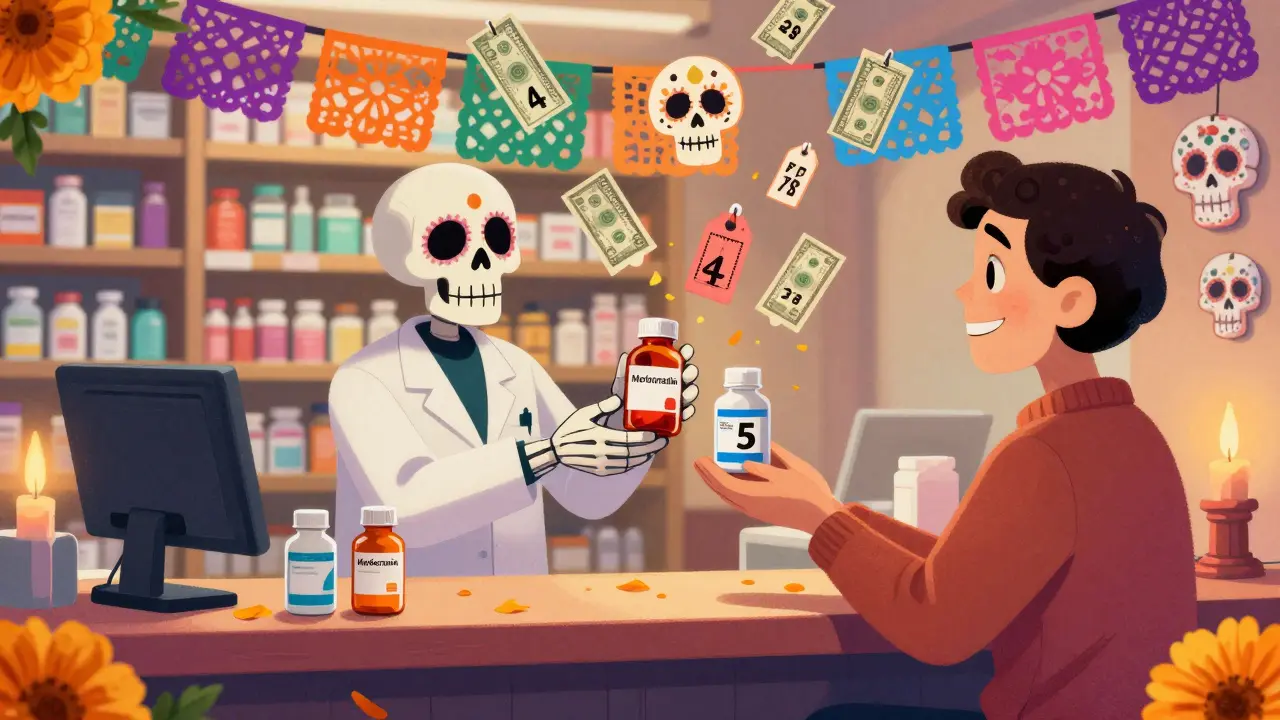
When you walk into a pharmacy and see a bottle of metformin for $4, or atorvastatin for $5, you’re seeing the result of something powerful: generic drug competition. It’s not magic. It’s economics. And it’s the single most effective tool buyers-like Medicare, insurers, and government agencies-use to bring down the cost of prescription drugs.
Here’s the reality: brand-name drugs often start at hundreds or even thousands of dollars per month. But once generics enter the market, prices don’t just drop a little-they collapse. Studies show that when six generic versions of a drug are available, the price falls by an average of 90.1%. With nine or more competitors, it drops nearly 97%. That’s not a rumor. That’s FDA data from 2021, based on real-world sales across the U.S.
How Generic Competition Forces Prices Down
Generic drugs aren’t just copies. They’re legally approved, bioequivalent versions of brand-name drugs that hit the market after patents expire. The moment one generic enters, the brand’s sales start slipping. When a second, third, or tenth generic shows up, the race to the bottom begins. Manufacturers slash prices to win shelf space, pharmacy contracts, and payer deals. There’s no advertising war here-just pure price pressure.
Take the diabetes drug glimepiride. Before generics, it cost $120 a month. After five generic makers entered the market, the average price fell to $7. That’s not a discount. That’s a revolution. And it’s happening across hundreds of drugs every year.
This isn’t accidental. It’s built into the system. The 1984 Hatch-Waxman Act created a fast-track approval path for generics, letting companies skip expensive clinical trials if they prove their product works the same way. That opened the floodgates. Today, 90% of all prescriptions in the U.S. are filled with generics-but they make up only 22% of total drug spending. That’s the power of competition at work.
How Buyers Actually Use This in Negotiations
Buyers don’t just sit back and wait for prices to drop. They actively use generic competition as leverage. The biggest player? Medicare.
Under the 2022 Inflation Reduction Act, Medicare can now directly negotiate prices for certain high-cost brand-name drugs. But here’s the twist: they’re not allowed to negotiate if a generic already exists. So how do they get lower prices? They use generics as a benchmark.
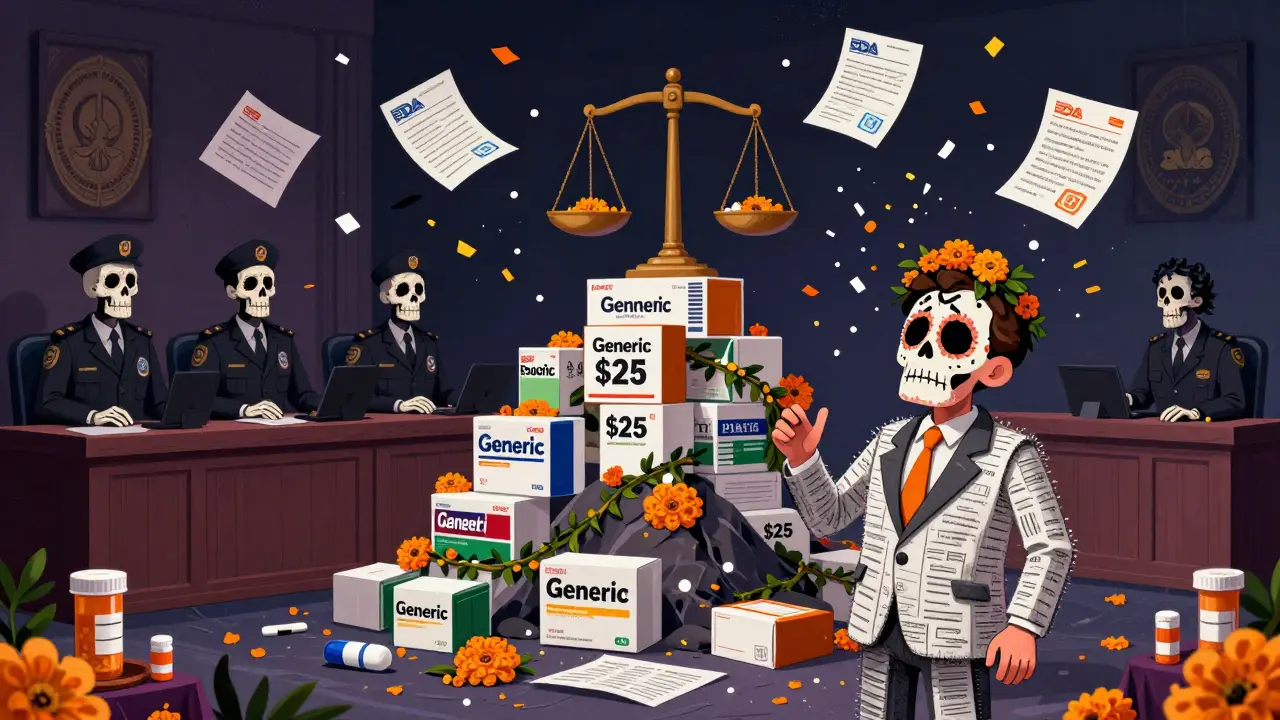
CMS (Centers for Medicare & Medicaid Services) looks at the average price of all approved generic versions of a drug. That becomes the starting point. If a brand-name drug like insulin lispro costs $200 a month, but the generic version sells for $25, CMS uses that $25 as the baseline. Then they ask the brand manufacturer: ‘Why should we pay you more than the generic?’
This isn’t theoretical. In June 2023, CMS released detailed guidance showing exactly how they calculate these benchmarks. They pull data from Prescription Drug Event (PDE) records and Average Manufacturer Prices (AMP) to confirm what generics are actually selling for-not what’s listed on a price list, but what’s paid in real transactions.
It’s the same tactic used by private insurers and pharmacy benefit managers (PBMs). They tell manufacturers: ‘We’ll cover your drug, but only if your price is lower than the cheapest generic alternative.’ That forces brand companies to lower their prices-or lose coverage entirely.
Global Models: What Other Countries Do
The U.S. isn’t alone. Canada has used a tiered pricing system since 2014. If a drug has only one generic, the government allows a higher maximum price. But as more generics enter-say, three or four-the maximum allowable price drops. It’s like a sliding scale based on competition.
Germany and the UK use reference pricing. They pick a group of similar drugs (including generics) and set one price that all of them must meet. If your drug costs more than the reference price, the patient pays the difference. That pushes manufacturers to match the lowest price in the group.
These systems work because they don’t just hope for competition-they design the market to force it. In the U.S., the system is more reactive. But with Medicare now actively using generic prices as leverage, it’s becoming more intentional.
The Dark Side: How Brand Companies Fight Back
Generic competition doesn’t scare brand companies-it terrifies them. So they’ve built a whole playbook to delay it.
One tactic? Product hopping. That’s when a brand company slightly changes a drug-say, switches from a pill to a capsule-and then pushes patients to the new version. The old version still has a patent, so generics can’t enter. Between 2015 and 2020, there were over 1,200 of these maneuvers, according to the FTC.
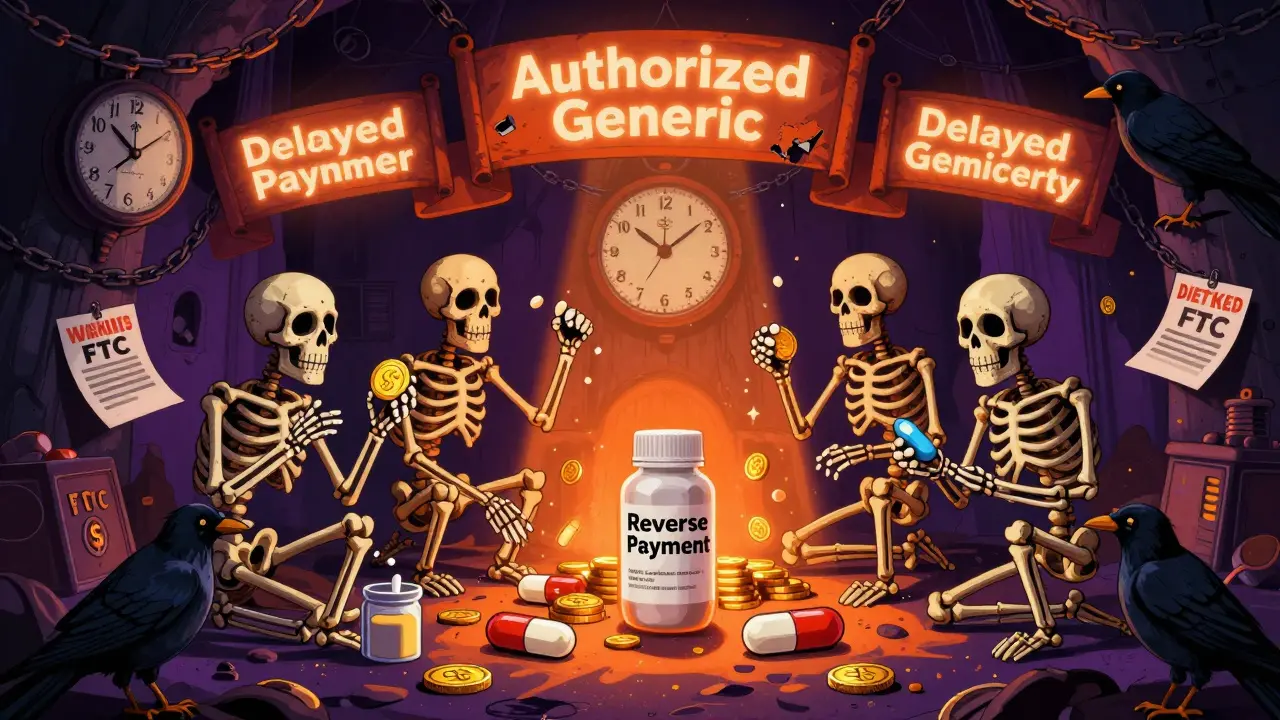
Another? Reverse payments. That’s when a brand company pays a generic maker to stay out of the market. Between 2010 and 2020, over 100 such deals were made to delay generic entry. The FTC calls them ‘pay-for-delay’ schemes. Courts have started cracking down, but they still happen.
And then there’s the rise of ‘authorized generics’-where the brand company itself launches a generic version under a different label. It looks like competition, but it’s the same company. These are often priced just below the brand, enough to scare off real generics but still keep profits high.
These tactics don’t just hurt patients. They hurt the system. When generics are delayed, prices stay high. And when they’re finally allowed in, the window for competition shrinks.
Who Wins? Who Loses?
The winners are clear: patients, taxpayers, and insurers. The Congressional Budget Office estimates that Medicare’s first 10 negotiated drugs will save $6.8 billion over ten years. The Association for Affordable Medicines says generic drugs have saved U.S. consumers over $3 trillion since 2000.
But the losers? Often, the small generic manufacturers. When CMS sets a low price for a brand drug, it creates a ceiling that generics can’t exceed. But if the brand price is set too low, generics can’t make money. Avalere Health found that in some cases, generics can’t even cover their manufacturing costs when competing against a government-set price.
That’s why the proposed EPIC Act wants to delay Medicare negotiations until after generics have had a chance to enter the market. The idea? Let the free market do its job first. Then, if prices are still too high, step in.
Big generic makers like Teva, Sandoz, and Viatris have the scale to absorb price pressure. But smaller companies? They’re squeezed. Many have stopped investing in new generic launches because the risk is too high.
What’s Next for Generic Competition?
The future of drug pricing hinges on two things: how fast generics can enter the market, and how smartly buyers use that timing.
Right now, the FDA is approving more generics than ever-over 2,400 between 2018 and 2020. But the legal battles are getting longer. Patent challenges take years. And complex drugs-like biosimilars for biologics-are harder and more expensive to copy. While traditional generics hit 90% market share, biosimilars only reach 45%.
Health systems are starting to use real-world data to predict competition. By 2025, 73% of health technology agencies plan to use actual patient outcomes to guide pricing decisions-not just clinical trial data.
And Medicare? It’s just getting started. The first negotiated drug prices take effect in January 2026. The real test will be whether those prices force more generic entry-or choke it off.
The bottom line? Generic competition isn’t just a market force. It’s the most reliable, proven, and scalable way to lower drug prices. But it only works if it’s allowed to work-without delays, without payoffs, and without government interference before the market has a chance to respond.
If you want lower drug costs, the answer isn’t just more regulation. It’s more competition. And that starts with letting generics in-fast, fair, and without strings attached.
Payton Daily
December 29, 2025 AT 01:55Bro, generics are the only reason I can afford my blood pressure meds. Used to pay $400 a month for the brand, now I pay $5. No cap. This system works. Stop overcomplicating it.
They don’t need more regulation. They need more generics. Period.
Kelsey Youmans
December 29, 2025 AT 10:59It is indeed remarkable how the introduction of generic pharmaceuticals has significantly mitigated the financial burden on public health systems. The data presented underscores the efficacy of market-driven pricing mechanisms in achieving equitable access to essential medications.
One must acknowledge the structural integrity of the Hatch-Waxman Act as a foundational policy achievement in this domain.
Hakim Bachiri
December 30, 2025 AT 13:18Ugh. Big Pharma is literally PAYING generics to NOT sell stuff?? Like, what even IS this? We’re not in a dystopian sci-fi novel… or are we?
And don’t get me started on ‘authorized generics’-that’s just corporate trickery dressed up as competition. It’s a scam. A FRAUD. The FDA should be SHUTTING THIS DOWN. And Medicare? They’re just now catching up?? After 20 years??
Meanwhile, I’m over here buying 90 pills of lisinopril for $3… and some CEO is sipping champagne on a yacht because he delayed a generic for 3 extra months. I’m not mad. I’m just disappointed.
Celia McTighe
December 30, 2025 AT 20:45Thank you for writing this. 💙 I’ve had family members who skipped doses because they couldn’t afford the brand name. Seeing those numbers-97% drop with 9 generics-made me cry. Not because it’s sad, but because it proves we CAN fix this.
And to the people saying ‘it’s too complicated’… it’s not. It’s just that the people who profit from high prices don’t want you to see how simple the solution is.
More generics. Faster. No exceptions. 🙏
Ryan Touhill
December 31, 2025 AT 14:22Let’s be honest-this entire system is a controlled demolition of pharmaceutical capitalism. The FDA, CMS, and even Congress are playing 4D chess while Big Pharma is stuck playing checkers.
But here’s the real conspiracy: they’re letting generics in… just enough to keep the masses calm. Meanwhile, they’re quietly patenting ‘new formulations’ of old drugs-like switching from tablet to liquid-to reset the clock. It’s not competition. It’s a performance.
And don’t forget: the same companies that lobby against price caps are the ones funding half the medical schools in America. We’re not just fighting greed. We’re fighting indoctrination.
Teresa Marzo Lostalé
December 31, 2025 AT 23:54It’s funny how we treat medicine like a luxury good instead of a human right. We don’t argue about the price of oxygen, but we’ll haggle over insulin like it’s a used car.
Generics are the quiet heroes here. No capes. No press releases. Just chemistry and competition. And yet, the people who need them the most still get treated like they’re asking for a favor.
Maybe next time we’re at the pharmacy, we should bow a little.
ANA MARIE VALENZUELA
January 1, 2026 AT 12:04Stop romanticizing generics. Yes, they’re cheaper-but they’re also less consistent. I’ve had patients switch from brand to generic and end up in the ER because their levels went haywire. Not every drug is metformin.
And let’s not pretend Medicare’s ‘benchmark’ pricing isn’t just price fixing disguised as market logic. You think a $25 insulin price is sustainable? It’s not. It’s a bubble. And when the generics can’t make money, they’ll stop making them.
Then what? You want to go back to $300/month? Or are you just happy to pretend the problem is solved?
Bradly Draper
January 2, 2026 AT 01:28I’m just glad I can fill my pills without choosing between food and medicine. That’s all I need to know.
Gran Badshah
January 3, 2026 AT 05:01in india we have generics for everything - insulin for $2, antibiotics for 50 cents. but here? even the generics are expensive because the system is rigged. why? because pharma owns the politicians. i work in a pharmacy in delhi - we give 100 pills for $1. here, they charge $20 for 30. same pill. same factory. just different country. it’s not about cost. it’s about power.