How to Safely Dispose of Chemotherapy Medication at Home
 Jan, 20 2026
Why Chemotherapy Medication Can't Be Tossed Like Regular Pills
Most people know you shouldn’t flush old pills down the toilet. But when it comes to chemotherapy drugs, the rules are completely different-and far more urgent. These aren’t just strong medications. They’re cytotoxic, meaning they’re designed to kill rapidly dividing cells. That’s why they fight cancer. But they don’t know the difference between a tumor and your child’s skin, your partner’s lungs, or the bacteria in your septic system.
Every time someone takes oral chemo at home, they’re handling something that can damage DNA. Even tiny amounts left on a pill bottle, spilled on a countertop, or washed down the drain can cause harm. The American Cancer Society warns that active chemo compounds can stay in urine, vomit, sweat, or feces for up to 72 hours after treatment. That means your toilet, your laundry, your kitchen sink-all of it-could become exposure points if you don’t follow strict rules.
What Happens If You Dispose of Chemo Wrong
Flushing chemotherapy drugs? Never. Throwing them in the trash with your coffee grounds? Still dangerous. Mixing them with cat litter? Not enough.
Improper disposal doesn’t just risk your family. It risks the environment. In 2021, the EPA found detectable levels of cyclophosphamide-a common chemo drug-in 67% of U.S. waterways. These chemicals don’t break down easily. They show up in rivers, lakes, and even drinking water supplies. And they don’t just affect fish. Scientists are still studying long-term effects on human reproductive health and fetal development.
There’s also the risk of accidental exposure at home. A child finds a pill bottle in the garbage. A caregiver touches a glove used during administration. A sanitation worker handles a bag that wasn’t sealed properly. Stericycle’s 2022 report found that 41% of patients improperly dispose of chemotherapy drugs-nearly double the rate for regular medications. That’s not just negligence. It’s a preventable public health hazard.
How to Handle Chemo Medication Safely at Home
If you’re taking oral chemotherapy at home, you need to treat every pill, bottle, and glove like a biohazard. Here’s how:
- Always wear disposable nitrile gloves (0.07-0.15mm thick) when handling pills, opening bottles, or cleaning up spills. Regular latex gloves won’t cut it-they can tear or let chemicals seep through.
- Never crush, chew, or split pills. The FDA explicitly warns against this. Crushing can release airborne particles that you or someone nearby could inhale.
- Use the double-bag method. Place all used items-pills, empty bottles, gloves, wipes, even tissues used to wipe your mouth-into a leak-proof plastic bag (at least 1.5 mil thick). Seal it tightly with a zip-tie or heat seal. Then put that bag inside a second identical bag. Seal it again. This isn’t overkill. Mayo Clinic testing showed this reduces exposure risk by 92% compared to single-bagging.
- For transdermal patches (like those applied to the skin), fold them so the sticky side sticks to itself before putting them in the bag. This prevents accidental skin contact.
- For liquid chemo, pour it into an absorbent material like cat litter or coffee grounds inside a sealed container before double-bagging. Don’t pour it down the sink.
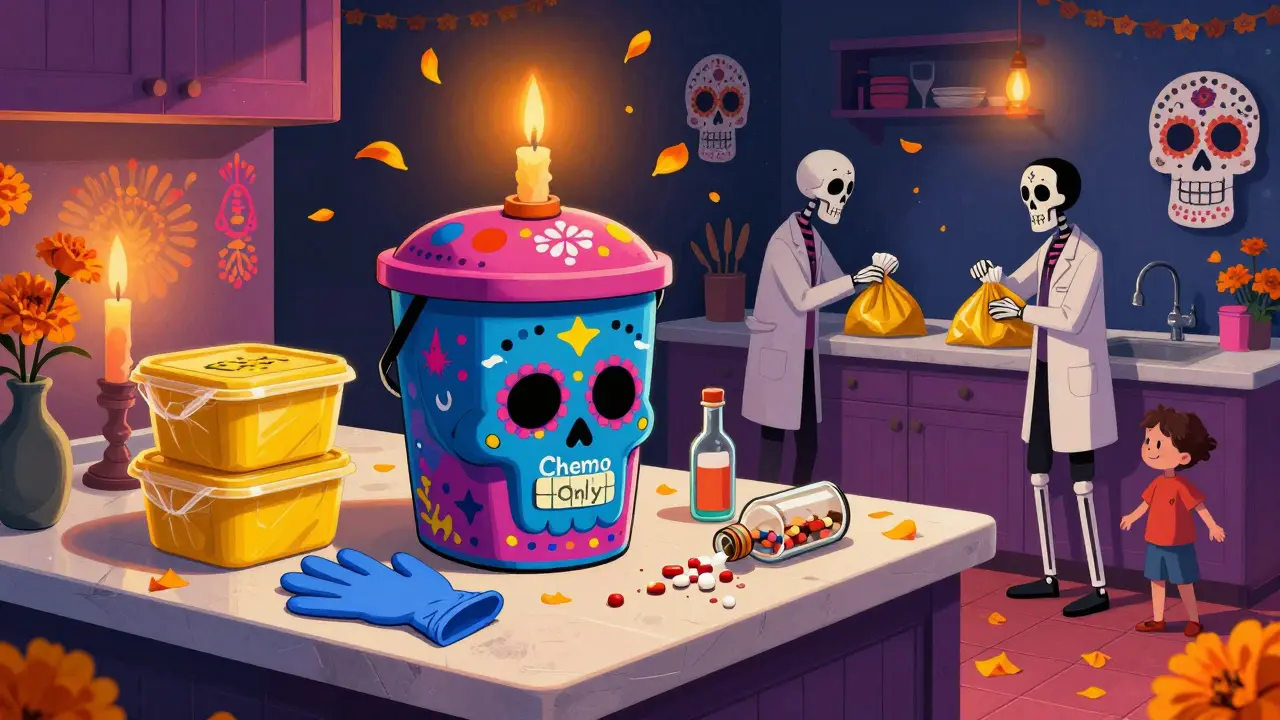
Keep all materials in a dedicated container-usually a yellow hazardous waste bin your oncology team provides. If you don’t have one, ask for it. Don’t reuse yogurt containers or old pill bottles. They’re not designed for this.
What to Do After Treatment (The 72-Hour Rule)
Disposal doesn’t end when you finish the bottle. The danger lingers.
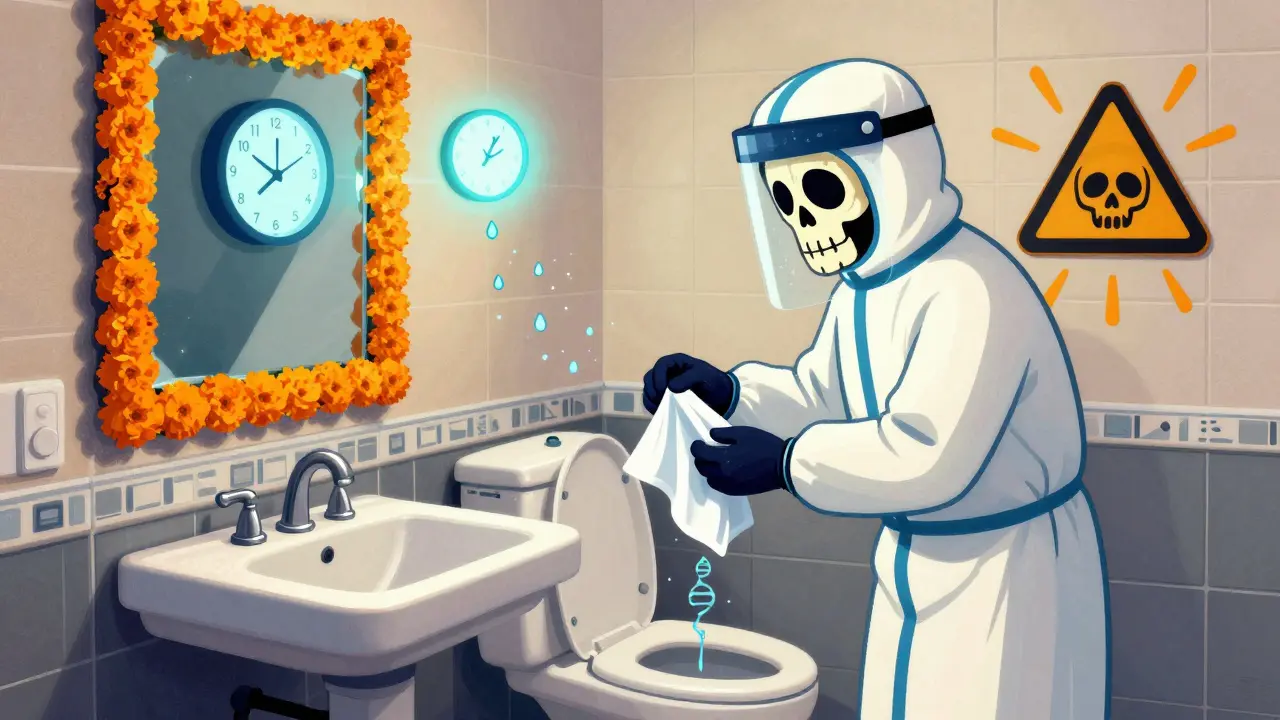
For 48 to 72 hours after taking chemo, your body is still excreting active drugs. That means:
- Use a separate toilet if possible. Flush twice after each use.
- Wash your hands thoroughly after using the bathroom-even if you wore gloves.
- Wear gloves when handling laundry that’s been soiled with sweat, vomit, or urine.
- Don’t let children or pets near the bathroom for at least three days after your last dose.
- Wipe down surfaces like the toilet seat, sink, and faucet with disposable cloths after use. Don’t reuse those cloths.
Dr. Michael Johnson, lead author of the 2022 Cancer Institute of New Jersey guidelines, says this 72-hour window is non-negotiable. Skipping it isn’t risky-it’s reckless.
What You Can’t Use (And Why)
There are plenty of products marketed as “safe drug disposal” tools. Most won’t work for chemo.
- Deterra® Drug Deactivation System-It works for painkillers and antidepressants. But the company’s own website says it’s “not approved for hazardous chemotherapy agents.”
- MedDrop kiosks-These are in pharmacies and hospitals. They accept some chemo drugs, but only about 63% of them. Check with your provider first.
- Mail-back programs-Only 28% of U.S. pharmacies offer these for chemotherapy. And even then, they’re often limited to specific drugs.
- Community take-back events-Most don’t accept chemo. DEA rules require law enforcement to be present, and few organizers have the training or equipment to handle cytotoxic waste.
Bottom line: If it’s not provided by your oncology team, don’t assume it’s safe. The rules for regular meds don’t apply here.
What Your Provider Should Give You
Receiving chemotherapy at home shouldn’t mean you’re left to figure this out alone. Your care team is legally and ethically responsible for giving you:
- A yellow hazardous waste container for storage
- Disposable nitrile gloves
- Leak-proof bags (ASTM D1735 standard)
- Clear, written instructions with diagrams
- A contact number for spill cleanup help
Memorial Sloan Kettering scored 9.2 out of 10 for clear disposal instructions in a 2022 patient survey. The industry average? 6.8. If your provider gives you a one-page handout with no visuals, ask for more. You’re entitled to it.
Replacement supplies cost about $15.75 per month on average. Many insurance plans cover this. Ask your oncology nurse.
What to Do If You Spill Chemo
Spills happen. A pill drops. A bottle leaks. A glove tears.
Don’t panic. Don’t use paper towels. Don’t reach for the bleach.
Follow this 15-step cleanup process from the Cancer Institute of New Jersey:
- Put on full PPE: gloves, gown, face shield, and mask.
- Block off the area. Keep people and pets away.
- Use disposable absorbent pads or cloths to soak up the spill.
- Place all contaminated materials into a sealed, double-bagged container.
- Wipe the area twice with water and detergent, then rinse.
- Dispose of cleaning materials in the same hazardous waste bin.
- Wash your hands thoroughly after removing gloves.
- Report the spill to your oncology team.
CancerCare’s 2022 survey found that 68% of patients needed multiple training sessions to feel confident doing this right. If you’re unsure, ask for a nurse to come to your home. It’s part of your care.
The Bigger Picture: Why This Matters
Home-based chemotherapy is growing fast. It was a $18.7 billion market in 2019. By 2023, it hit $24.3 billion. By 2027, the American Society of Clinical Oncology predicts a 35% increase in home treatments.
That means more people handling dangerous drugs in kitchens, bedrooms, and bathrooms. And right now, only 19 U.S. states have specific laws for chemo disposal. The rest rely on patchwork guidelines.
The Cancer Drug Disposal Act of 2021 is still in committee, but it could change everything. It would create federal standards, require clear labeling on all chemo bottles, and fund safer disposal technologies.
For now, the responsibility falls on you-and your care team. Getting it right isn’t just about following rules. It’s about protecting the people you love, the environment you live in, and the workers who handle your trash.
What’s Coming Next
Innovation is finally catching up. Two new disposal systems are in FDA review:
- ChemiSafe-A portable device that neutralizes chemo drugs in under 30 seconds using chemical activation.
- Oncology Waste Management Unit-A countertop device designed for home use, with built-in containment and deactivation.
These won’t be available everywhere yet. But they’re coming. And they’ll make a huge difference.
Until then, stick to the double-bag method. Use the gloves. Wait 72 hours. Don’t flush. Don’t guess. Ask. Repeat. Your safety-and the safety of others-depends on it.
Ben McKibbin
January 21, 2026 AT 12:04This is one of those posts that makes you realize how little we’re told about the real dangers of modern medicine. I had no idea chemo could linger in sweat for three days. My aunt went through oral chemo last year and they just handed her a pill bottle and said ‘take it daily.’ No gloves. No bags. No warnings. If this had been publicized like opioid disposal, we’d have PSAs on TV. The fact that 41% of patients mess this up isn’t negligence-it’s systemic failure.
Rod Wheatley
January 23, 2026 AT 02:24YES. YES. YES. This needs to be shouted from the rooftops!!
My sister’s oncology nurse came to her house for a 45-minute training session-showed her how to double-bag, how to wipe surfaces, even how to handle vomit safely. They gave her a yellow bin, gloves, and a laminated chart. It cost nothing. It saved her life-and our family’s peace of mind.
If your provider doesn’t give you this, ASK AGAIN. And again. And if they still don’t, call the hospital’s patient advocacy office. You’re not being difficult-you’re being smart. This isn’t optional. It’s survival.
Also-PLEASE don’t use bleach on spills. It creates chlorine gas with some chemo agents. I’ve seen it happen. It’s terrifying. Water and detergent. Always.
Jarrod Flesch
January 25, 2026 AT 01:24Man, I wish my dad had this when he was on oral chemo back in 2018 😔
He just threw the bottles in the trash with the rest of the junk. We didn’t know any better. Now I’m kinda freaked out thinking about all the times my little cousin played near the garbage can…
Thanks for laying this out so clearly. I’m printing this out and sending it to every family member who’s ever had cancer. And I’m tagging my local pharmacy-maybe they’ll start carrying those yellow bins.
Also, ChemiSafe sounds like sci-fi but I’m here for it 🤖💊
Barbara Mahone
January 25, 2026 AT 13:08Thank you for writing this. I’m a nurse in oncology, and I see families struggle with this every day. Most don’t realize the drugs are still active in bodily fluids. We spend so much time on side effects, but almost nothing on home safety. This should be mandatory reading for every patient starting oral chemo.
shubham rathee
January 26, 2026 AT 13:37They're hiding the truth again. Chemo isn't just toxic it's designed to be a slow poison that doesn't degrade. They want you to think it's safe if you follow the rules but the real agenda is to keep you dependent on the system. The EPA findings? Staged. The water contamination? A cover for Big Pharma's real goal: make you believe you need more chemo because the environment is poisoned by the last dose. Double bagging? Just a distraction. The real solution is to stop taking it entirely. Ask yourself: who profits when you flush your pills? Not your doctor. Not your family. The machine.
Kelly McRainey Moore
January 26, 2026 AT 21:31This made me cry. My mom went through this last year and we had no idea what to do. We used Ziplocs and hoped for the best. I wish I’d known about the 72-hour rule before I let my toddler play in the bathroom. I’m so sorry we didn’t do better. Thank you for this.
Stephen Rock
January 27, 2026 AT 21:08Wow. So much noise. All this over pills? You’re telling me we need gloves, double bags, and a whole protocol because someone might touch a pill that’s been sitting in a bag for two weeks? The real risk is anxiety. This is fear porn dressed as public health. People are dying of cancer. Don’t make them die of stress over a Ziploc.
Amber Lane
January 28, 2026 AT 06:04Double bagging works. I’ve seen it.
Ben McKibbin
January 29, 2026 AT 19:55That’s the thing. The people who say this is overkill? They’ve never held a vial of cyclophosphamide. Or watched a nurse in full PPE clean up a spill. Or had to explain to their kid why they can’t hug grandma for three days. This isn’t fear porn. It’s fact. And the fact is, we’re failing families because we treat this like a footnote. Amber’s right-double bagging works. So does training. So does asking. But only if we stop pretending it’s optional.