FDA Office of Generic Drugs: Role, Responsibilities, and Structure Explained
 Mar, 24 2026
The FDA Office of Generic Drugs (OGD) is the quiet engine behind most of the affordable medications you pick up at your local pharmacy. While brand-name drugs get headlines, it’s OGD that makes sure hundreds of cheaper, equally effective versions are available - and safe. If you’ve ever saved money on a prescription by choosing a generic, you’re seeing the direct result of OGD’s work.
What Is the Office of Generic Drugs?
The Office of Generic Drugs is a division inside the FDA’s Center for Drug Evaluation and Research (CDER). It doesn’t create drugs. It doesn’t manufacture them. But it decides whether they’re good enough to reach patients. Since its formal elevation to a "super office" in 2013, OGD has had direct reporting lines to the CDER director, giving it the authority and resources to move faster and more decisively than ever before.
Its mission is simple: ensure high-quality, affordable generic drugs are available to the American public. That means every generic pill, injection, or inhaler that claims to match a brand-name drug must pass strict scientific tests. OGD doesn’t just approve applications - it builds the standards those applications must meet.
How OGD Works: The Five Sub-Offices
OGD isn’t one big team. It’s five specialized offices working in sync, each with its own focus:
- Immediate Office (IO): The brain of OGD. It sets strategy, coordinates all other offices, and handles legal and global issues. This is where the Division of Legal and Regulatory Support advises on the Hatch-Waxman Act - the law that balances patent protections for brand drugs with faster access to generics.
- Office of Bioequivalence (OB): This is where science gets real. Bioequivalence means a generic drug must perform the same way in the body as the brand version. OB tests whether the generic absorbs into the bloodstream at the same rate and amount. If it doesn’t, it doesn’t get approved.
- Office of Generic Drug Policy: This team writes the rules. They interpret complex laws, update guidance documents, and answer questions from manufacturers, lawmakers, and foreign regulators. They’re the ones who determine whether a patent challenge is valid or if a drug qualifies for exclusivity.
- Office of Regulatory Operations (ORO): Think of this as the project management hub. ORO’s Regulatory Project Managers (RPMs) oversee every single Abbreviated New Drug Application (ANDA) review. They assign reviewers, track deadlines, and make sure OGD meets its GDUFA goals. Without them, the system would collapse under its own weight.
- Office of Research and Standards (ORS): They don’t just review - they innovate. ORS develops new testing methods, improves modeling tools, and studies how drugs behave in real-world conditions. Their work helps OGD stay ahead of emerging science, like new delivery systems or complex injectables.
There’s also the Office of Safety and Clinical Evaluation, which monitors adverse events linked to generics. If a generic drug causes unexpected side effects, this team digs in - often working with the FDA’s Center for Drug Safety.
The Laws That Shape OGD’s Work
OGD doesn’t operate in a vacuum. Two laws define its entire existence:
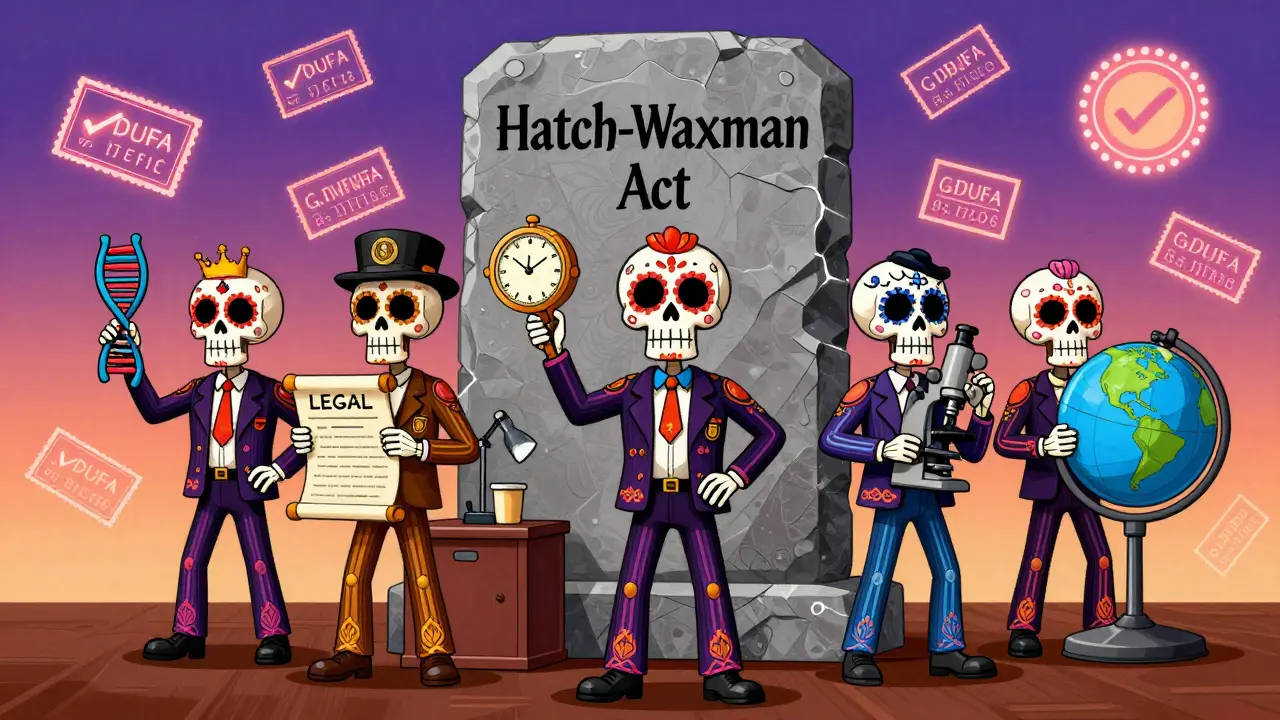
- The Hatch-Waxman Act (1984): This landmark law created the modern generic drug system. It allowed generic manufacturers to skip expensive clinical trials if they could prove their product was bioequivalent to the brand. In return, brand companies got extended patent terms to make up for time lost during FDA review. OGD’s Legal Division is the expert on every twist and turn of this law - from patent certifications to exclusivity periods.
- Generic Drug User Fee Amendments (GDUFA): Before GDUFA, the FDA relied on taxpayer money to review generics - and the backlog was huge. GDUFA, first enacted in 2012 and renewed since, lets generic manufacturers pay fees to fund the review process. Those fees pay for staff, technology, and training. In return, OGD commits to reviewing applications within strict timeframes. For first generics, the goal is 10 months. For others, it’s 15. Missing those deadlines costs money - and trust.
These aren’t just policies. They’re the backbone of America’s access to affordable medicine.
What OGD Reviews: The ANDA Process
Every generic drug must go through an Abbreviated New Drug Application (ANDA). Unlike brand drugs, which require full clinical trials, ANDAs rely on existing data. But that doesn’t mean they’re easy.
OGD checks:
- Is the active ingredient the same? (Yes - down to the exact molecule.)
- Is the strength, dosage form, and route of administration identical? (Must match the brand.)
- Is the manufacturing process consistent? (Quality control matters as much as chemistry.)
- Does the drug dissolve and absorb the same way in the body? (Bioequivalence data must be rock-solid.)
- Are the labels accurate and clear? (Patients need to know how to take it safely.)
OGD doesn’t just approve - it investigates. If a generic drug has a higher rate of adverse events than the brand, OGD can delay approval or demand additional studies. In 2023, OGD flagged over 400 applications for safety concerns before final approval.
Global Impact and Public Health Priorities
OGD doesn’t just serve the U.S. - it leads globally. Its Global Generic Drug Affairs Team works with regulators in Europe, Canada, India, and beyond to align standards. Why? Because generics are made all over the world. If a drug is made in India and sold in the U.S., OGD needs to trust the manufacturing site. That means inspections, data sharing, and joint training programs.
OGD also prioritizes drugs that address public health crises:
- First generics - the first to enter the market after a brand’s patent expires - get fast-tracked review.
- Drugs in shortage - like antibiotics or insulin - get special attention. OGD works with manufacturers to speed up approvals when supply is low.
- Complex generics - like inhalers, injectables, or topical creams - get extra scrutiny because they’re harder to copy accurately.
In 2024, OGD approved 842 generic drugs - 217 of them were first generics. That’s more than two per day, every day, year-round.
Why This Matters to You
Generic drugs make up over 90% of all prescriptions filled in the U.S. But they’re not cheap because they’re easy to make. They’re cheap because OGD made the system work.
Without OGD:
- Brand-name drugs would stay expensive longer - sometimes for years.
- Patients would wait months, sometimes over a year, for affordable alternatives.
- Manufacturers would face unclear rules, leading to delays and inconsistencies.
OGD keeps the system fair, fast, and safe. It’s not flashy. But every time you save $50 on a prescription, you’re feeling the impact of OGD’s work.
| Function | Key Responsibility | Related Entity |
|---|---|---|
| Review Applications | Approve Abbreviated New Drug Applications (ANDAs) | Regulatory Project Managers (RPMs) |
| Set Standards | Define bioequivalence and quality requirements | Office of Research and Standards (ORS) |
| Enforce Law | Interpret Hatch-Waxman Act, patent exclusivity | Division of Legal and Regulatory Support (DLRS) |
| Manage Review Timelines | Meet GDUFA goal dates (10-15 months) | Office of Regulatory Operations (ORO) |
| Monitor Safety | Track adverse events linked to generics | OGD Safety and Surveillance Team |
| Global Coordination | Work with international regulators | Global Generic Drug Affairs Team |
Frequently Asked Questions
How long does it take OGD to approve a generic drug?
Under GDUFA, OGD targets 10 months for first generics and 15 months for other applications. But timelines can stretch if the application is incomplete, if additional data is needed, or if there are patent disputes. About 70% of applications meet these goals. The rest are either delayed by the applicant or flagged for safety concerns.
Are generic drugs really as good as brand-name drugs?
Yes - and OGD makes sure of it. A generic must have the same active ingredient, strength, dosage form, and route of administration. It must also be bioequivalent, meaning it delivers the same amount of medicine into your bloodstream at the same rate. OGD tests thousands of samples every year. If a generic fails, it’s rejected. The FDA has found no meaningful difference in effectiveness or safety between approved generics and their brand-name counterparts.
What is bioequivalence, and why does it matter?
Bioequivalence means two drugs - one brand, one generic - perform the same way in the body. OGD tests this by measuring how quickly and completely the drug is absorbed. If the generic absorbs 80-125% as much as the brand, it’s considered bioequivalent. This range ensures safety and effectiveness. For example, if a drug has a narrow therapeutic window (like warfarin or lithium), OGD requires even tighter controls.
Why do some generics cost more than others?
Price isn’t set by OGD - it’s set by the market. But OGD does influence supply. When a first generic enters the market, prices usually drop 80-90%. But if only one manufacturer gets approval - or if manufacturing issues arise - prices stay higher. OGD prioritizes approvals to avoid shortages, but it can’t force companies to produce a drug. Competition drives prices down, and OGD helps create that competition.
Does OGD inspect manufacturing plants?
Yes. OGD works with the FDA’s Office of Regulatory Affairs to inspect facilities worldwide. In 2023, over 300 inspections were conducted at plants making generic drugs - half of them outside the U.S. If a plant fails inspection, OGD can refuse to approve any applications from that site until problems are fixed. This is why some generics are delayed: the factory needs to fix contamination, documentation, or equipment issues.
Can OGD reject a generic drug even after approval?
Yes. Approval isn’t permanent. If new safety data emerges - like a spike in adverse events, manufacturing flaws, or contamination - OGD can withdraw approval. In 2022, OGD pulled three generic versions of a blood pressure medication after reports of inconsistent potency. Patients were switched back to brand or other generics. Safety always comes before cost.
What Comes Next?
OGD is under pressure - more generics, more complex drugs, and more global supply chains. In 2025, OGD will start using AI tools to predict which applications are likely to have issues before they’re fully reviewed. It’s also expanding its global inspection program to include more real-time data sharing with countries like India and China.
If you’re a patient, the message is simple: trust your generic. OGD has spent decades building a system that works. If it’s on the shelf, it’s been tested - not just once, but repeatedly.
If you’re a manufacturer, the message is clearer: follow the rules. OGD doesn’t cut corners - and it won’t let you.