Employer Health Plans and Generic Preferences: How Formularies Control Your Prescription Costs
 Dec, 28 2025
When you pick up a prescription at the pharmacy, you might not realize that your out-of-pocket cost isn’t just about the drug itself-it’s shaped by a hidden system called a formulary. Most employer-sponsored health plans use formularies to decide which drugs are covered, and how much you pay for them. And more often than not, the system is designed to push you toward generics-not because they’re inferior, but because they’re dramatically cheaper.
Why Your Plan Pushes Generics
The FDA confirms that generic drugs are just as safe and effective as brand-name versions. The only real difference? Price. Generics cost 80-85% less because they don’t need to repeat expensive clinical trials or run nationwide ad campaigns. That’s why nearly every large employer health plan favors them.It’s not just about saving the company money-it’s about saving you money too. According to Schauer Group, generic medications save more than $3 billion every week in the U.S. That’s over $150 billion a year. But here’s the catch: those savings don’t always show up in your wallet.
How Tiered Formularies Work
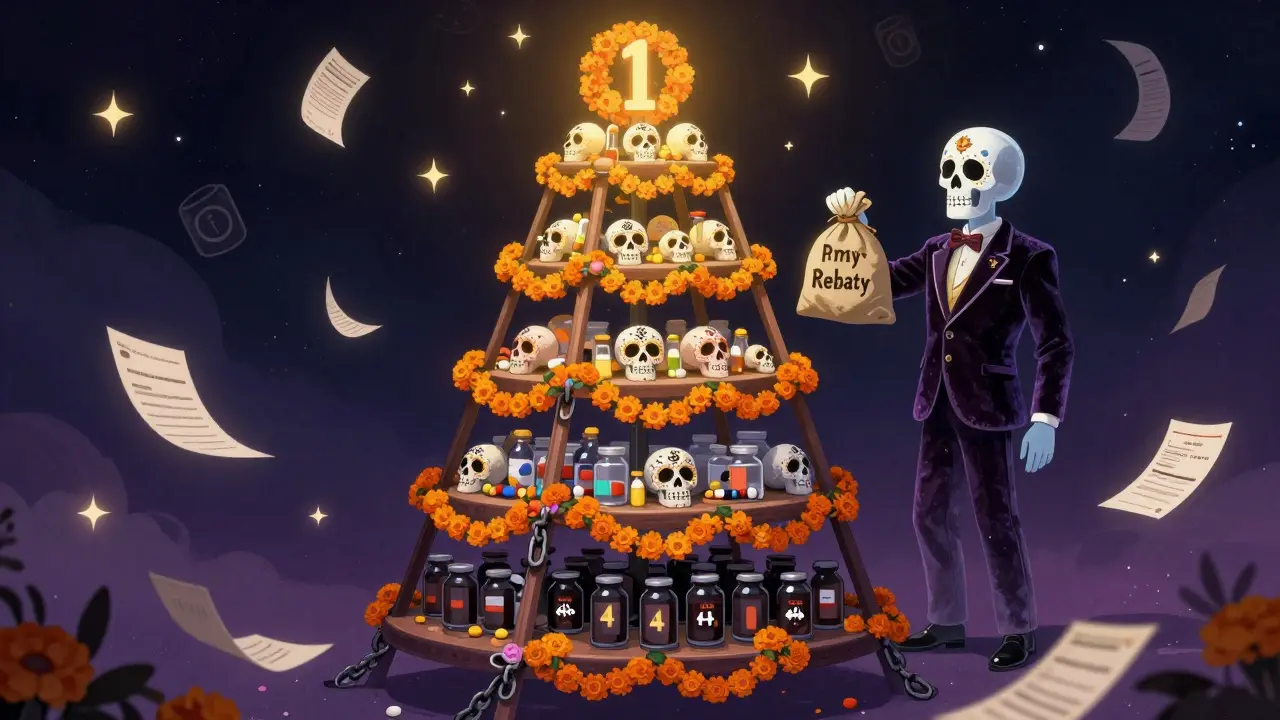
Employer plans organize drugs into tiers, each with a different cost to you. Think of it like a pricing ladder:- Tier 1: Generics - Usually $10 or less per prescription. This is where your plan wants you to be.
- Tier 2: Preferred Brand-Name Drugs - These are brand-name drugs your plan has negotiated lower prices for. Copay is typically around $40.
- Tier 3: Non-Preferred Brand-Name Drugs - If a generic exists but you choose the brand, you pay more-often $75 or higher.
- Tier 4: Specialty Drugs - For complex conditions like rheumatoid arthritis or hepatitis C. These can cost hundreds or even thousands per month.
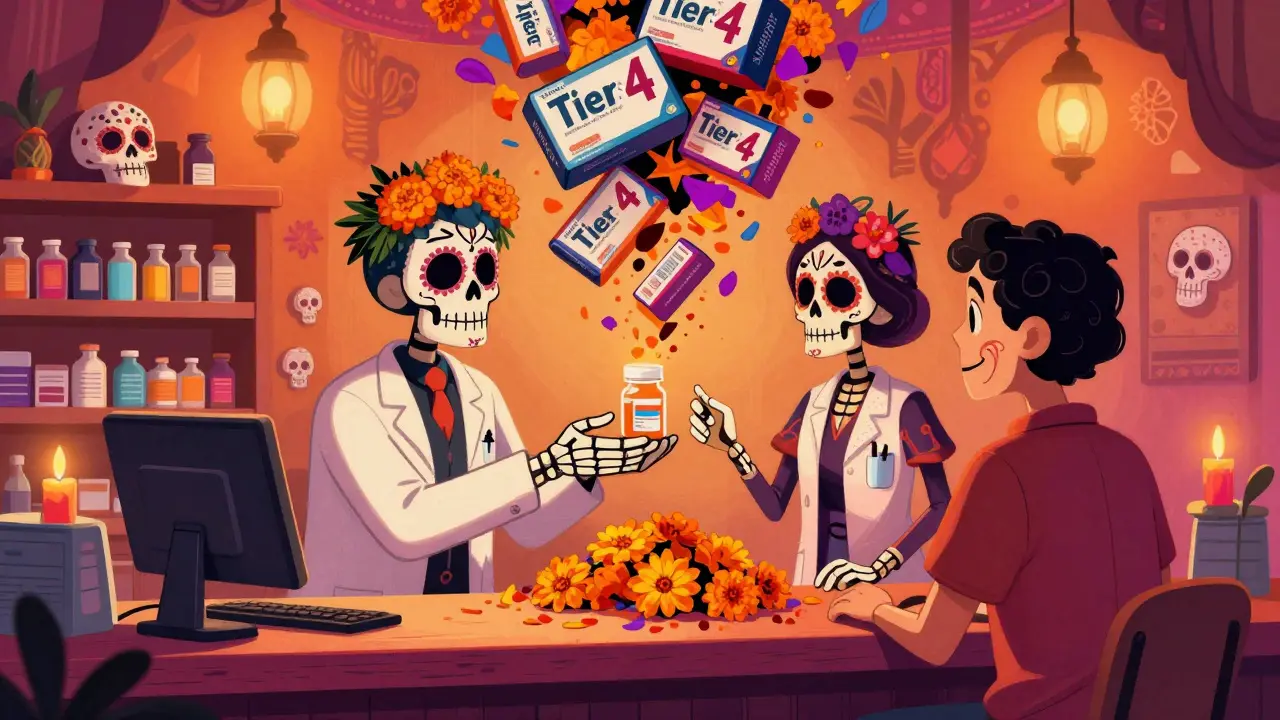
Here’s how it plays out in real life: If a brand-name drug like Lipitor becomes available as a generic (atorvastatin), your pharmacy benefit manager (PBM) automatically moves the brand to Tier 4 and the generic to Tier 1. Suddenly, your $10 copay becomes $75-if you still want the brand. You’re not being punished; the system is just steering you toward the cheaper option.
Who Controls Your Formulary?
You might think your health insurer decides what’s covered. But in most cases, it’s a Pharmacy Benefit Manager (PBM)-a middleman that negotiates drug prices between drugmakers and employers. The three biggest PBMs-OptumRx, CVS Caremark, and Express Scripts-control coverage for the majority of employer plans in the U.S.These companies don’t just set prices-they decide which drugs get excluded entirely. In January 2024, each of the three largest PBMs removed over 600 drugs from their formularies. That’s more than 1,800 drugs taken off coverage in one month. Why? To pressure drugmakers into offering bigger discounts. If a manufacturer won’t play ball, the drug disappears from your plan’s list.
That means you could be taking a medication one month, only to find out the next that your plan no longer covers it. And if your doctor prescribes it anyway, you’ll pay full price unless you file a medical exception request.
The Rebate Gap: Why Savings Don’t Always Reach You
PBMs make money through something called gross-to-net (GTN) pricing. Here’s how it works: A drug’s list price (what the manufacturer charges) is often much higher than what the PBM actually pays after rebates and discounts. KPMG estimates the average GTN spread is 55%. That means for every $100 a drug lists for, the PBM pays only $45 after rebates.Here’s the problem: those rebates rarely go to you. Instead, they go to the PBM or the employer. So while your plan saves money, your copay might stay the same-even if the drug’s true cost dropped. In fact, some PBMs will drop a drug from the formulary entirely if they can’t get a big enough rebate, even if it’s the only option for your condition.
That’s why you might see your insulin or asthma inhaler suddenly become unaffordable-not because it’s more expensive, but because the rebate deal fell through.
What You Can Do: Navigate Your Coverage
You can’t control your plan’s formulary, but you can control how you respond to it.- Check your formulary - Visit your insurer’s website and search for your medication. Look for the tier and copay. Don’t assume your doctor’s prescription is covered.
- Ask about generics - If your doctor prescribes a brand-name drug, ask: “Is there a generic version?” Most of the time, there is.
- Use in-network pharmacies - Some plans, like those from HealthOptions.org, have programs that automatically lower your cost on generics when you use in-network pharmacies.
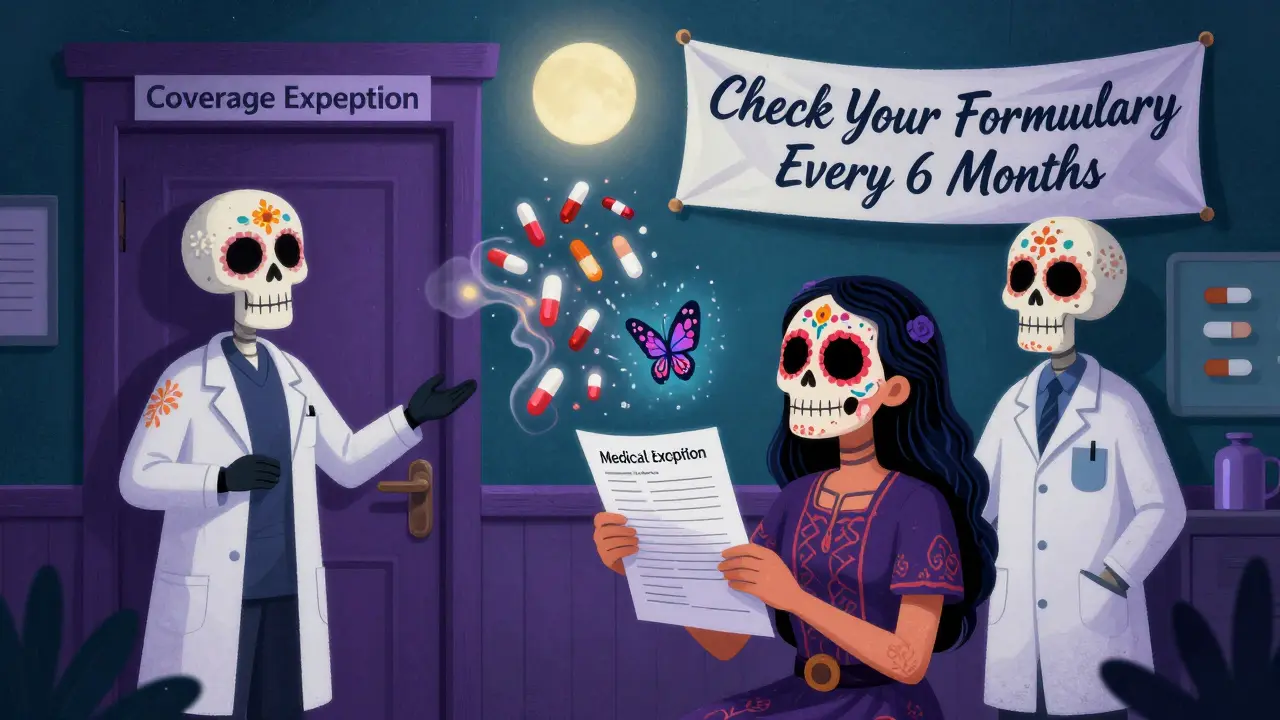
- Know your options if a drug is dropped - If your medication is removed from the formulary, contact your employer’s HR department or your insurer. You may qualify for a coverage exception if you can prove medical necessity.
- Review your Summary of Benefits and Coverage (SBC) - This document, given to you during open enrollment, explains your drug coverage in plain language. Read it.
Special Cases: Chronic Conditions and Support Programs
If you’re managing a long-term condition like diabetes, high blood pressure, or COPD, you’re more likely to be on expensive medications. But some employers offer support programs like HealthOptions.org’s Chronic Illness Support Program (CISP). These programs help you find lower-cost alternatives, connect you with care managers, and even help you apply for patient assistance programs from drugmakers.Don’t wait until your prescription runs out. Reach out early. A care manager can help you switch to a generic, find a cheaper brand, or navigate an exception request-all without you having to figure it out alone.
The Bigger Picture: Why This System Exists
Employers didn’t create this system to make life harder. They created it because prescription drug costs were rising faster than wages. In 2023, 99% of large employer plans included drug coverage-up from just 78% in 2000. But with drug prices climbing, they had to find ways to keep coverage affordable.Generics became the obvious solution. And for most people, they work. But the system has grown complex. PBMs hold too much power. Rebates are hidden. Formularies change without notice. And too often, the people who pay the most-those with chronic illnesses-are the least protected.
Employers are starting to push back. Some are demanding more transparency from PBMs. Others are switching to direct contracting models where they pay net prices instead of list prices. But until those changes become widespread, you’re still stuck navigating the current system.
What’s Next?
The trend won’t reverse. More drugs will become generic. More will be removed from formularies. More rebates will be negotiated behind closed doors. But awareness is your best tool.If you’re on a chronic medication, make it a habit to check your formulary every six months. Talk to your pharmacist-they know what’s changed. Ask your doctor to write prescriptions with generic names first. And if your plan drops a drug you rely on, don’t accept it quietly. File for an exception. Contact HR. Speak up.
You’re not just a policyholder. You’re the one who takes the pills. And you deserve to know why you’re paying what you’re paying.
Are generic drugs really as good as brand-name drugs?
Yes. The FDA requires generic drugs to have the same active ingredients, strength, dosage form, and route of administration as the brand-name version. They must also meet the same strict manufacturing standards. The only differences are inactive ingredients (like fillers or dyes) and price. Generics are not cheaper because they’re lower quality-they’re cheaper because they don’t need to repeat costly clinical trials.
Why does my copay change when a brand drug becomes generic?
When a brand-name drug gets a generic version, your pharmacy benefit manager (PBM) moves the brand to a higher tier (often Tier 4) and puts the generic in Tier 1. This makes the brand much more expensive for you, so the system encourages you to switch. It’s not a punishment-it’s a financial nudge. If you still need the brand, you’ll pay more, but you’ll still have access.
What if my medication is removed from the formulary?
If your drug is removed, you’ll pay full price unless you get a coverage exception. Contact your insurer or employer’s HR department. Your doctor can submit a medical necessity request, explaining why you can’t switch to another drug. Many exceptions are approved, especially for chronic conditions. Don’t assume you’re out of luck-ask.
Do PBMs pass savings on to employees?
Not always. PBMs earn money through rebates and gross-to-net pricing, but those savings often go to the employer or the PBM itself-not you. Even if a drug’s net cost drops, your copay might stay the same. That’s why some employers are demanding transparency and switching to models where they pay the actual net price, not the list price.
How often do formularies change?
Formularies can change at any time-sometimes without notice. New generics enter the market, rebates expire, and PBMs renegotiate contracts. The Ohio Department of Administrative Services warns that these changes happen frequently. That’s why checking your formulary every few months is critical, especially if you take long-term medications.
Can I switch to a different plan to get better drug coverage?
During open enrollment, you can choose a different employer plan if one is offered. But most employers only offer one or two options. If your current plan doesn’t cover your medication, your best move is to request a coverage exception or ask your employer to negotiate better terms with their PBM. You can also ask if your employer offers a supplemental drug savings program.
What’s the difference between a preferred and non-preferred brand drug?
A preferred brand drug is one your plan has negotiated a better price for-usually because the manufacturer agreed to a larger rebate. A non-preferred brand is one the plan doesn’t promote, often because it’s more expensive or has a generic alternative. You’ll pay more for non-preferred brands, even if they’re the same drug as the preferred version.
Do all employer plans have the same formulary?
No. Each employer chooses a different insurer and PBM, and each has its own formulary. Anthem, for example, offers six different drug lists for Ohio employers depending on the plan type. Even two employees at the same company might have completely different coverage if they’re on different plans. Always check your specific plan’s formulary.
Janette Martens
December 28, 2025 AT 18:14Marie-Pierre Gonzalez
December 29, 2025 AT 22:18Louis Paré
December 30, 2025 AT 09:24Samantha Hobbs
December 31, 2025 AT 16:19Nicole Beasley
December 31, 2025 AT 16:28sonam gupta
January 2, 2026 AT 16:05Julius Hader
January 4, 2026 AT 10:19Vu L
January 5, 2026 AT 02:51James Hilton
January 5, 2026 AT 05:11Hakim Bachiri
January 6, 2026 AT 06:24ANA MARIE VALENZUELA
January 6, 2026 AT 22:40Bradly Draper
January 8, 2026 AT 11:25